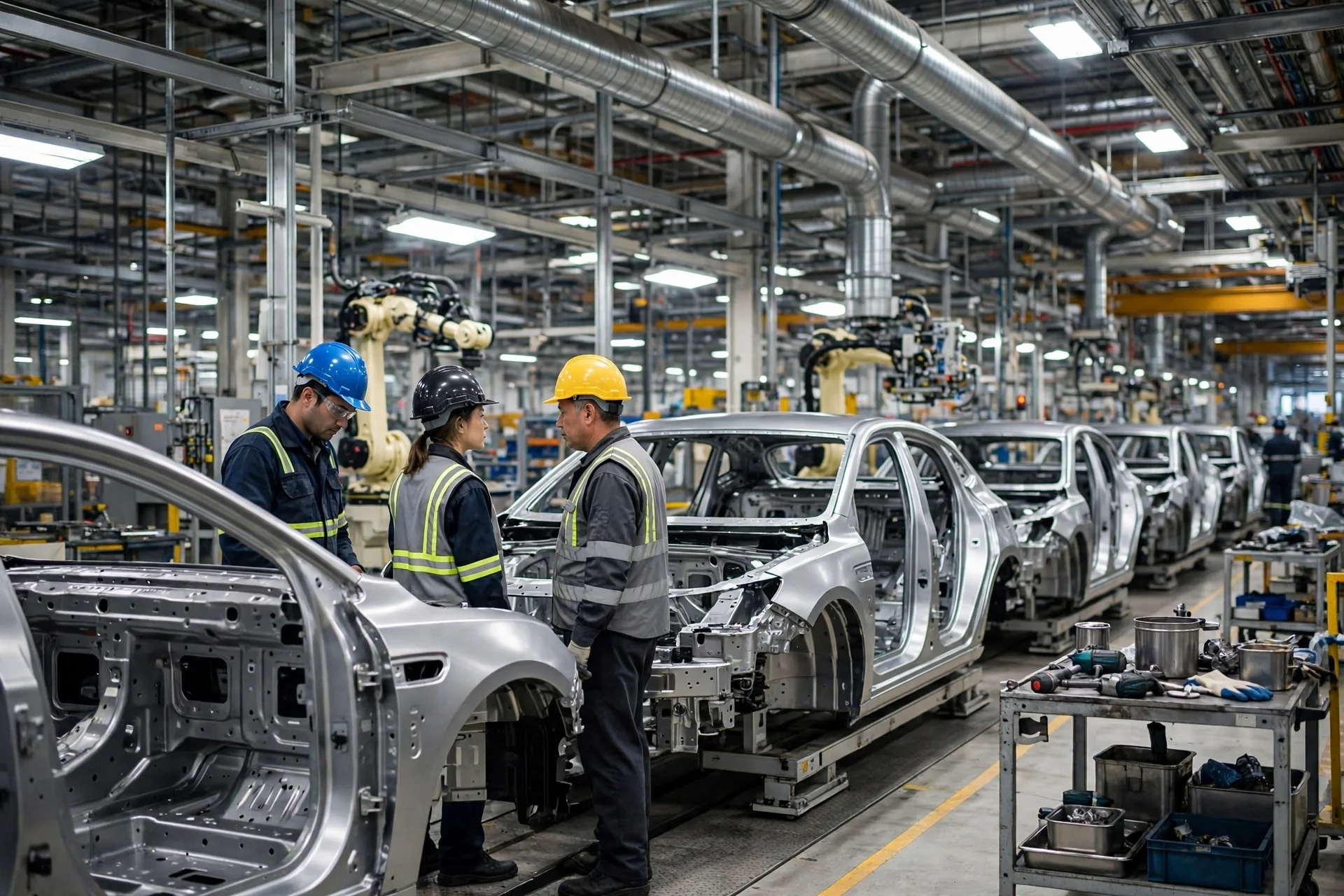
Línea de ensamblaje automotriz, en una imagen generada alusiva al proyecto industrial en Colombia. · Imagen generada para EPM
Colombia advances auto manufacturing with investment of up to US$150 million
The government of Abelardo De La Espriella and Renault-Sofasa are advancing an investment of up to US$150 million to manufacture a new vehicle in Colombia…
Government and Renault-Sofasa back Colombia as regional export platform
With an investment of up to US$150 million, the government of Abelardo De La Espriella and Renault-Sofasa seek to manufacture a new vehicle in Colombia and…
--- The context ---
Colombia is seeking to consolidate its position as a regional automotive production platform in Latin America. Against that backdrop, the government of President Abelardo De La Espriella and Renault-Sofasa are advancing a strategic investment project presented as one of the most significant industrial initiatives announced during the government's first 100 days.
--- The facts ---
The planned investment reaches up to US$150 million to manufacture a new vehicle in Colombia and boost exports to Argentina, Mexico, Ecuador, Venezuela, Uruguay and Paraguay. The initiative includes the adoption of new technologies, the strengthening of national production and the expansion of the Colombian automotive industry's export capacity.
According to the Ministry of Commerce, Industry and Tourism, the project would benefit 29 auto parts companies and have an impact across seven regions of the country. The ministry also said it would create new opportunities for national suppliers and promote technology transfer, the development of industrial capabilities and the creation of skilled employment.
--- The positions ---
Commerce Minister Mauricio Gómez Amín stressed, in attributed remarks, that the initiative seeks to turn business confidence into investment, production, innovation and exports, and sent a message of stability and competitiveness to attract new industrial projects to the country. The ministry said it will accompany the project's development together with Renault-Sofasa and the other actors involved in order to realize its productive and commercial potential.
--- What remains unknown ---
The model of the new vehicle, the city or plant where it will be manufactured, and the concrete timeline for the investment have not yet been disclosed. It also remains unclear how many skilled jobs would be created or how the impact would be distributed among the seven regions mentioned.
--- Unanswered questions ---
What vehicle model will be manufactured in Colombia and when will its production begin? How will the effective participation of the 29 auto parts companies and local suppliers in the value chain be guaranteed? What monitoring mechanisms will verify that the investment of up to US$150 million is fully carried out?
--- EPM analysis ---
The initiative's value will not be measured only by the amount announced, but by its capacity to root capabilities in the territory. If technology transfer reaches national suppliers and skilled employment is sustained over time, the project can strengthen the manufacturing base. If, instead, the benefit is concentrated without verifiable local linkages, its regional impact will fall short of what was promised.
📌 EPM Take:
In EPM's view, this project deserves support with verification, because it combines investment, skilled employment and opportunities for local suppliers across seven regions, but its real success will depend on every announced amount becoming verifiable production, effective technology transfer and decent, sustained work for the 29 auto parts companies and for the communities hoping to benefit from a stronger, more integrated Colombian automotive industry with a larger export presence in Latin America in the coming years.
--- The context ---
Colombia aims to position itself as an automotive production and export hub for Latin America. With that goal, the government of President Abelardo De La Espriella and Renault-Sofasa are advancing a strategic investment project of up to US$150 million, presented as one of the most significant industrial initiatives of the government's first 100 days.
--- The facts ---
The project involves manufacturing a new vehicle in the country and boosting exports to Argentina, Mexico, Ecuador, Venezuela, Uruguay and Paraguay. It also foresees the adoption of new technologies, the strengthening of national production and the expansion of the Colombian automotive industry's export capacity.
According to the Ministry of Commerce, Industry and Tourism, the initiative would benefit 29 auto parts companies and have an impact across seven regions of the country, with new opportunities for national suppliers, technology transfer, development of industrial capabilities and creation of skilled employment.
--- The positions ---
Commerce Minister Mauricio Gómez Amín stressed, in attributed remarks, that the initiative seeks to turn business confidence into investment, production, innovation and exports, and conveyed a message of stability and competitiveness to attract new industrial projects. The ministry said it will accompany the project's development together with Renault-Sofasa and the other actors involved.
--- What remains unknown ---
The vehicle's model, the exact production location and the investment disbursement schedule have not yet been disclosed. The regulatory and logistical conditions that will accompany the export expansion toward the six mentioned markets are also unknown.
--- Unanswered questions ---
Will Colombia maintain the stability and competitiveness needed for this investment to be completed and to attract similar ones? Will national production be able to meet the standards and volumes demanded by markets such as Argentina and Mexico? What guarantees will the private sector have to sustain the project over time?
--- EPM analysis ---
The central signal of the announcement is one of confidence. When a government offers stability and competitiveness and a company responds with capital, technology and an export vocation, the country gains a real productive platform. The challenge will be to sustain clear rules and efficient execution so Colombia can compete as a regional export platform without unnecessary obstacles.
📌 EPM Take:
In EPM's view, the investment confirms that business confidence, when it finds stability and competitiveness, translates into concrete production, innovation and exports, and that is why the project should advance without unnecessary bureaucratic obstacles, with stable rules that allow Colombia to consolidate itself as a regional export platform, take advantage of the markets of Argentina, Mexico, Ecuador, Venezuela, Uruguay and Paraguay, and show that private capital responds when the country offers certainty and industrial vision.
Colombia impulsa fabricación automotriz con inversión de hasta US$150 millones
El Gobierno de Abelardo De La Espriella y Renault-Sofasa adelantan una inversión de hasta US$150 millones para fabricar un nuevo vehículo en Colombia, impulsar…
Gobierno y Renault-Sofasa apuestan por Colombia como plataforma exportadora regional
Con una inversión de hasta US$150 millones, el Gobierno de Abelardo De La Espriella y Renault-Sofasa buscan fabricar un nuevo vehículo en Colombia y exportarlo…
--- El contexto ---
Colombia busca consolidar su posición como plataforma regional de producción automotriz en América Latina. En ese marco, el Gobierno del presidente Abelardo De La Espriella y Renault-Sofasa adelantan un proyecto de inversión estratégica que se presenta como una de las apuestas industriales más relevantes anunciadas en los primeros 100 días del Gobierno.
--- Los hechos ---
La inversión prevista alcanza hasta US$150 millones para fabricar un nuevo vehículo en Colombia e impulsar las exportaciones hacia Argentina, México, Ecuador, Venezuela, Uruguay y Paraguay. La iniciativa contempla la incorporación de nuevas tecnologías, el fortalecimiento de la producción nacional y la ampliación de la capacidad exportadora de la industria automotriz colombiana.
Según el Ministerio de Comercio, Industria y Turismo, el proyecto beneficiaría a 29 empresas autopartistas y tendría impacto en siete regiones del país. El Ministerio señaló además que se generarían nuevas oportunidades para proveedores nacionales y se promovería la transferencia tecnológica, el desarrollo de capacidades industriales y la creación de empleo cualificado.
--- Las posiciones ---
El ministro de Comercio, Mauricio Gómez Amín, destacó en términos atribuidos que la apuesta busca convertir la confianza empresarial en inversión, producción, innovación y exportaciones, y envió un mensaje de estabilidad y competitividad para atraer nuevos proyectos industriales al país. El Ministerio indicó que acompañará el desarrollo del proyecto junto con Renault-Sofasa y los demás actores involucrados para materializar su potencial productivo y comercial.
--- Lo que falta saber ---
Todavía no se conocen el modelo del nuevo vehículo, la ciudad o la planta donde se fabricará, ni los plazos concretos de ejecución de la inversión. Tampoco se ha precisado cuántos empleos cualificados se crearían ni cómo se distribuirá el impacto entre las siete regiones mencionadas.
--- Preguntas sin respuesta ---
¿Qué modelo de vehículo se fabricará en Colombia y en qué plazo comenzará su producción? ¿Cómo se garantizará que las 29 empresas autopartistas y los proveedores locales participen efectivamente en la cadena de valor? ¿Qué mecanismos de seguimiento permitirán verificar que la inversión de hasta US$150 millones se materialice por completo?
--- Análisis EPM ---
El valor de la iniciativa no se mide solo por el monto anunciado, sino por su capacidad de arraigar capacidades en el territorio. Si la transferencia tecnológica llega a los proveedores nacionales y el empleo cualificado se sostiene en el tiempo, el proyecto puede fortalecer la base manufacturera. Si, en cambio, el beneficio se concentra sin encadenamientos locales verificables, su impacto regional será menor al prometido.
📌 Conclusion EPM:
A juicio de EPM, este proyecto merece respaldo con verificación, porque combina inversión, empleo cualificado y oportunidades para proveedores locales en siete regiones, pero su éxito real dependerá de que cada peso anunciado se convierta en producción comprobable, transferencia tecnológica efectiva y trabajo digno y sostenido para las 29 empresas autopartistas y para las comunidades que esperan beneficiarse de una industria automotriz colombiana más fuerte, más integrada y con mayor presencia exportadora en América Latina durante los próximos años.
--- El contexto ---
Colombia aspira a posicionarse como centro de producción y exportación automotriz para Latinoamérica. Con ese objetivo, el Gobierno del presidente Abelardo De La Espriella y Renault-Sofasa adelantan un proyecto de inversión estratégica de hasta US$150 millones, presentado como una de las apuestas industriales más relevantes de los primeros 100 días del Gobierno.
--- Los hechos ---
El proyecto contempla fabricar un nuevo vehículo en el país e impulsar las exportaciones hacia Argentina, México, Ecuador, Venezuela, Uruguay y Paraguay. También prevé la incorporación de nuevas tecnologías, el fortalecimiento de la producción nacional y la ampliación de la capacidad exportadora de la industria automotriz colombiana.
De acuerdo con el Ministerio de Comercio, Industria y Turismo, la iniciativa beneficiaría a 29 empresas autopartistas y tendría impacto en siete regiones del país, con nuevas oportunidades para proveedores nacionales, transferencia tecnológica, desarrollo de capacidades industriales y creación de empleo cualificado.
--- Las posiciones ---
El ministro de Comercio, Mauricio Gómez Amín, destacó en términos atribuidos que la apuesta busca convertir la confianza empresarial en inversión, producción, innovación y exportaciones, y transmitió un mensaje de estabilidad y competitividad para atraer nuevos proyectos industriales. El Ministerio afirmó que acompañará el desarrollo del proyecto junto con Renault-Sofasa y los demás actores involucrados.
--- Lo que falta saber ---
Aún no se han divulgado el modelo del vehículo, la ubicación exacta de la producción ni el calendario de desembolso de la inversión. Tampoco se conocen las condiciones regulatorias y logísticas que acompañarán la expansión exportadora hacia los seis mercados mencionados.
--- Preguntas sin respuesta ---
¿Mantendrá Colombia la estabilidad y la competitividad necesarias para que esta inversión se complete y atraiga otras similares? ¿Podrá la producción nacional cumplir los estándares y los volúmenes que exigen mercados como Argentina y México? ¿Qué garantías tendrá el sector privado para sostener el proyecto en el tiempo?
--- Análisis EPM ---
La señal central del anuncio es de confianza. Cuando un gobierno ofrece estabilidad y competitividad y una empresa responde con capital, tecnología y vocación exportadora, el país gana una plataforma productiva real. El desafío será sostener reglas claras y una ejecución eficiente para que Colombia compita como plataforma exportadora regional sin trabas innecesarias.
📌 Conclusion EPM:
A juicio de EPM, la inversión confirma que la confianza empresarial, cuando encuentra estabilidad y competitividad, se traduce en producción, innovación y exportaciones concretas, y por eso el proyecto debe avanzar sin obstáculos burocráticos innecesarios, con reglas estables que permitan a Colombia consolidarse como plataforma exportadora regional, aprovechar los mercados de Argentina, México, Ecuador, Venezuela, Uruguay y Paraguay, y demostrar que el capital privado responde cuando el país ofrece certidumbre y visión industrial.