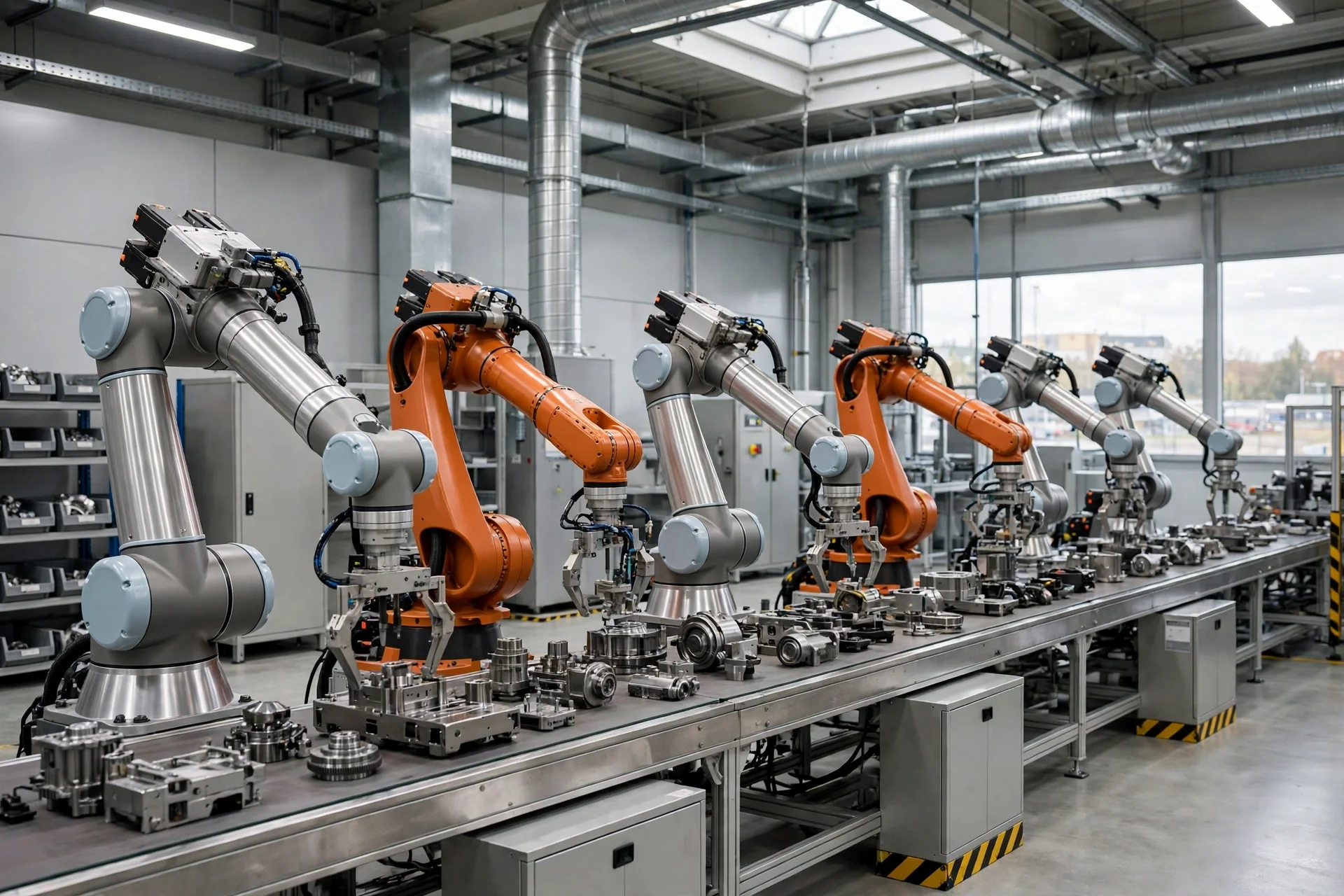
Brazos robóticos en una planta de manufactura moderna, imagen alusiva a la proclamación sobre importaciones de robótica y maquinaria industrial. · Imagen generada para EPM
Trump orders talks to adjust robotics and machinery imports
President Donald J. Trump signed a section 232 proclamation finding that imports of robotics and industrial machinery threaten national security and directing…
Imported robotics declared a threat to national security
The White House found that imports of robotics and industrial machinery threaten national security and ordered the Secretary of Commerce and the Trade…
--- The context ---
Modern American manufacturing runs largely on robotics and industrial machinery that the United States does not produce in sufficient quantity at home. Those machines are involved in making goods for defense, commercial and dual-use purposes, and they allow plants to operate longer and with minimal error on repetitive tasks. The proclamation signed by President Donald J. Trump starts from that reality: the defense industrial base's ability to surge production, including during wartime or armed conflict, relies on industrial robotics and machinery available to the country.
The economic dimension is equally broad. Robotics and industrial machinery support approximately $7.1 trillion in shipments of manufactured goods in 2024 and the production of approximately $86 billion worth of equipment in 2024, with expansive downstream effects on the industries that use those products. Industrial robots and machines are used across all 16 critical infrastructure sectors, from automotive, electrical and electronics production to metal and machinery, plastic and chemical products, and food and beverages. When one technology underpins defense, manufacturing and infrastructure at the same time, where it comes from stops being a trade detail and becomes a matter of public policy.
--- The facts ---
Within the past 90 days, the Secretary of Commerce transmitted to the President a report on his investigation, under section 232 of the Trade Expansion Act of 1962, into the effects of imports of robotics, industrial machinery and their parts and components on national security. Based on the facts considered, the Secretary found that those products are being imported in such quantities and under such circumstances as to threaten to impair the national security of the United States, and he recommended actions to adjust those imports.
The report finds that robotics support essential, state-of-the-art defense systems such as aircraft, tanks, ships, weapons and munitions. Advanced robots, including autonomous, humanoid and quadruped robots and autonomous ground vehicles, conduct intelligence, surveillance and reconnaissance missions and handle dangerous tasks such as casualty extraction and mine detection and clearing. The Secretary also found that the United States relies on foreign imports for most types of robotics and industrial machinery and their components, that the value of those imports has increased over the last decade and is projected to keep rising, and that equipment from certain foreign entities poses cybersecurity risks because these technologies routinely process and store sensitive data. Domestic industry, meanwhile, does not produce enough, lacks the capacity to meet demand from domestic sources and underutilizes the capacity it has.
--- The positions ---
The White House adopted the Secretary's conclusion as its own. The President stated that he concurs with the finding that these imports threaten to impair national security and determined that it is necessary and appropriate to enter into negotiations with trading partners to adjust them. The first step chosen is not an immediate tariff but a joint mandate: the Secretary of Commerce and the United States Trade Representative must pursue negotiations together and update the President on their progress within 180 days of the proclamation.
The proclamation also records the tools that remain available if negotiation fails. The text notes that section 232 allows a plan of action with adjustments over time, which may include tariffs, duties, quotas and fees, and that the President may take other actions if an agreement is not entered into within 180 days, is not being carried out or is ineffective. Among the future alternatives is a program to incentivize new investment in United States production of robotics, industrial machinery and their parts and components. The Secretary of Commerce will continue to monitor these imports and report any circumstances that might indicate the need for further presidential action.
--- What remains unknown ---
It is not yet known which trading partners will be approached first or what concrete terms the Secretary of Commerce and the Trade Representative will seek, since the proclamation leaves the choice of appropriate partners to them. Nor does it specify what conditions an agreement must meet to be judged effective, or what level of domestic production would be taken as the benchmark for reducing dependence. The monitoring duty is clear, but the metrics that will decide whether the strategy is working have not been published, and they will matter as much as the negotiations themselves.
--- Unanswered questions ---
Which trading partners will be asked to negotiate first, and what concrete commitments will be requested of them on robotics and industrial machinery? What criteria will the Secretary of Commerce and the Trade Representative use to declare an agreement effective or failed? How quickly could domestic industry expand real production capacity if the investment incentive program is activated? What cybersecurity requirements will be imposed on imported equipment that already processes and stores sensitive data in plants and defense systems?
--- EPM analysis ---
The decision sequences the problem clearly: a security diagnosis first, negotiation second, and harder adjustment measures only if they become necessary. That order matters because companies that rely on imported robots and machines need predictability to plan investment, and because well-conducted talks can close vulnerabilities without abruptly breaking the supply chains that currently sustain manufacturing. The plan's weak point is time: demand for domestically produced equipment will only increase, according to the report itself, while installed capacity remains underused, and closing that gap requires capital, skilled workers and sustained decisions that outlast a single round of talks.
📌 EPM Take: In EPM's view, the proclamation is right to treat dependence on imported robotics as a security problem rather than a simple trade imbalance, because a country that cannot build the machines behind its defense production is exposed in any crisis. Its success, however, will depend on pairing negotiation with real investment in domestic capacity, technical training and trustworthy supply chains. Bargaining without building would merely manage the dependence under another name. The progress report due within 180 days should show verifiable agreements, production goals and clear cybersecurity standards for equipment that handles sensitive data.
--- The context ---
American defense is quite literally built with robots and industrial machines. The proclamation signed by President Donald J. Trump recalls that robotics and industrial machinery enable defense readiness and the design, production and sustainment of essential defense systems, and that the defense industry uses them to automate the building of missiles, aircraft and ships, allowing production to last longer and repetitive tasks to be performed with minimal error. In wartime or armed conflict, the ability to surge production rests on that industrial base, which today is fed largely from abroad.
The economic weight is just as significant. Robotics and industrial machinery support approximately $7.1 trillion in shipments of manufactured goods in 2024 and the production of approximately $86 billion worth of equipment in 2024, and they are used across all 16 critical infrastructure sectors. Automotive, electrical, electronics, metal and machinery, plastic and chemical products, and food and beverage industries all depend on machines that mostly arrive from overseas. That is the paradox the proclamation sets out to correct: the world's leading military power relies on foreign suppliers for the very tools with which it builds its own arsenal.
--- The facts ---
Within the past 90 days, the Secretary of Commerce delivered to the President the report of his investigation, conducted under section 232 of the Trade Expansion Act of 1962, into the effects of imports of robotics, industrial machinery and their parts and components on national security. His conclusion was direct: those products are being imported in such quantities and under such circumstances as to threaten to impair the national security of the United States, and he recommended action to adjust those imports.
The report details that advanced robots already serve on the front line: autonomous, humanoid and quadruped robots and autonomous ground vehicles carry out intelligence, surveillance and reconnaissance missions and take on dangerous tasks such as casualty extraction and mine detection and clearing. It also warns that the United States relies on imports for most types of robotics and machinery, that the imported value has grown over the last decade and will keep growing, and that certain foreign suppliers create cybersecurity risks because this equipment processes and stores sensitive data. Domestic industry produces less than the country consumes, lacks the capacity to satisfy demand and underutilizes the manufacturing capacity it does have.
--- The positions ---
The President did not merely receive the report: he stated expressly that he concurs with the Secretary's finding and that, in his judgment, it is necessary and appropriate to enter into negotiations with trading partners to adjust the imports. The order falls jointly on the Secretary of Commerce and the United States Trade Representative, who must pursue or continue negotiations with the partners they deem appropriate and report back to the President on their status or outcome within 180 days.
But the proclamation is not diplomacy alone. The text recalls that section 232 authorizes plans of action with adjustments over time, including tariffs, duties, quotas and fees, and that the President may take other actions if an agreement is not entered into within 180 days, is not being carried out or is ineffective. Among the alternatives the President may consider are imposing or modifying those charges and establishing a program to incentivize new investment in United States production of robotics and industrial machinery and their components. The Secretary of Commerce will also keep these imports under continuous monitoring for national security purposes.
--- What remains unknown ---
What remains unknown is which partners will receive the first call and what concessions will be demanded of them, because the proclamation names no countries and sets no prior conditions. It also does not define what level of domestic production will be considered sufficient for the threat to be deemed closed, nor does it detail the design of the investment incentive program that could be activated if negotiation fails. What it does establish is the accountability calendar: a formal update within 180 days and continuous monitoring by the Secretary of Commerce, who must report any circumstances that might indicate the need for further action by the President.
--- Unanswered questions ---
Will trading partners accept agreements that reduce American dependence, or will they wait to see whether Washington applies tariffs and quotas? How much of today's underutilized industrial capacity can be activated immediately, and how much requires new investment? How will the cybersecurity of robots and machines already installed and processing sensitive data be audited? Will the 180 days be enough to close real agreements or only to open a longer negotiation?
--- EPM analysis ---
For years, dependence on foreign machinery was treated as a question of costs when it was in fact a question of security. The proclamation corrects that approach using the instrument the law has provided since 1962, in a sequence that combines firmness with prudence: negotiate first, with the full set of adjustment measures visible on the table. Its success will be measured in concrete facts, not declarations: factories expanding production, idle installed capacity put back to work and critical equipment manufactured under American control. The Secretary's warning admits no delay on one point: without intervention, the challenges facing United States manufacturers will likely continue while demand keeps rising.
📌 EPM Take: In EPM's view, the proclamation identifies the right wound: a nation that does not build the robots and machines behind its aircraft, tanks, ships and munitions has surrendered part of its industrial sovereignty. Negotiation is a reasonable first step, but dependence is not corrected with statements; it is corrected by producing at home, using the installed capacity now sitting idle and closing the vulnerabilities that certain foreign suppliers introduce into sensitive systems. If there are no effective agreements within 180 days, the adjustment measures written into this proclamation should not remain on paper.
Trump ordena negociar para ajustar importaciones de robótica
El presidente Donald J. Trump firmó una proclamación bajo la sección 232 que declara las importaciones de robótica y maquinaria industrial una amenaza a la…
Robótica importada, amenaza declarada a la seguridad nacional
La Casa Blanca declaró que las importaciones de robótica y maquinaria industrial amenazan la seguridad nacional y ordenó al secretario de Comercio y al…
--- El contexto ---
Estados Unidos sostiene buena parte de su manufactura moderna sobre robótica y maquinaria industrial que no produce en cantidad suficiente dentro de su propio territorio. Esas máquinas intervienen en la fabricación de bienes para la defensa, para el comercio y para usos duales, y permiten que las plantas trabajen durante más tiempo y con menos errores en tareas repetidas. La proclamación firmada por el presidente Donald J. Trump parte de esa realidad: la capacidad de aumentar la producción en tiempos de guerra o de conflicto armado depende, según el documento, de la robótica y la maquinaria industrial disponibles en el país.
Esa dependencia tiene además una dimensión económica amplia. La robótica y la maquinaria industrial respaldan actividades de gran escala, con billones de dólares en envíos de bienes manufacturados en 2024 y una producción de equipos también registrada ese año, y sus efectos se extienden a las industrias que consumen esos productos y a la creación de equipos. Cuando una tecnología sostiene al mismo tiempo la defensa, la manufactura y la infraestructura, su origen deja de ser un detalle comercial y se convierte en una cuestión de política pública que exige planificación, inversión y criterios de seguridad compartidos.
--- Los hechos ---
En los últimos 90 días, el secretario de Comercio transmitió al presidente el informe de su investigación sobre los efectos de las importaciones de robótica, maquinaria industrial y sus partes y componentes sobre la seguridad nacional, realizada al amparo de la sección 232 de la Trade Expansion Act de 1962. Tras examinar los hechos, el secretario concluyó que esos productos se importan en cantidades y circunstancias que amenazan con dañar la seguridad nacional, y así se lo comunicó al presidente junto con una serie de recomendaciones para ajustar dichas importaciones.
El informe sostiene que casi todos los sistemas modernos de defensa y los sectores de infraestructura crítica necesitan robótica o maquinaria industrial para funcionar o para fabricarse con eficacia. Los robots avanzados, incluidos los autónomos, los humanoides, los cuadrúpedos y los vehículos terrestres autónomos, apoyan al ejército en misiones de inteligencia, vigilancia y reconocimiento, y en tareas peligrosas como la extracción de heridos y la detección y limpieza de minas. Los robots y las máquinas industriales se utilizan además en los 16 sectores de infraestructura crítica y en industrias como la automotriz, la eléctrica, la electrónica, la metalúrgica, la de plásticos y productos químicos y la de alimentos y bebidas.
El secretario constató también que Estados Unidos depende de las importaciones extranjeras para la mayoría de los tipos de robótica y maquinaria industrial y para sus componentes, y que el valor de esas importaciones aumentó durante la última década y, según las proyecciones recogidas, seguirá aumentando. A ello se suma un riesgo específico: la robótica y la maquinaria procedentes de ciertas entidades extranjeras procesan y almacenan datos sensibles dentro de sistemas de manufactura y de defensa, lo que puede abrir vulnerabilidades de ciberseguridad con consecuencias graves. La industria nacional, mientras tanto, no produce lo suficiente, no alcanza a cubrir la demanda con fuentes propias y no utiliza toda su capacidad instalada.
--- Las posiciones ---
La Casa Blanca hizo suyo el hallazgo del secretario de Comercio. El presidente declaró que coincide con la conclusión de que estas importaciones amenazan la seguridad nacional y determinó que es necesario y apropiado negociar con los socios comerciales para ajustarlas. La medida elegida en esta primera etapa no es un arancel inmediato, sino una negociación encargada de forma conjunta al secretario de Comercio y al Representante Comercial de Estados Unidos, que deberán informar sobre su avance dentro de 180 días.
La proclamación deja constancia, al mismo tiempo, de las herramientas que quedan sobre la mesa si la negociación no prospera. El propio texto recuerda que la sección 232 permite adoptar un plan de acción con ajustes a lo largo del tiempo, que puede incluir aranceles, derechos, cuotas y tasas, y que el presidente puede actuar también si un acuerdo no se alcanza dentro de 180 días, no se cumple o resulta ineficaz. Entre las alternativas futuras figura además un programa para incentivar nuevas inversiones en la producción estadounidense de robótica, maquinaria industrial y sus componentes.
--- Lo que falta saber ---
Todavía no se conocen los socios comerciales con los que se negociará primero ni el contenido concreto de los acuerdos que buscarán el secretario de Comercio y el Representante Comercial, a quienes la proclamación deja la elección de las contrapartes que consideren apropiadas. Tampoco se detalla qué condiciones deberán cumplir esos acuerdos para considerarse eficaces, ni qué umbrales de producción nacional se tomarán como referencia para juzgar si la dependencia se reduce. El secretario de Comercio seguirá monitoreando las importaciones y deberá informar al presidente de cualquier circunstancia que, a su juicio, indique la necesidad de medidas adicionales.
--- Preguntas sin respuesta ---
¿Qué socios comerciales serán convocados primero a negociar y qué compromisos concretos se les pedirán sobre robótica y maquinaria industrial? ¿Qué criterios usarán el secretario de Comercio y el Representante Comercial para declarar que un acuerdo es eficaz o ha fracasado? ¿Cuánto tardaría la industria nacional en ampliar su capacidad real de producción si se activa el programa de incentivos a la inversión? ¿Qué controles de ciberseguridad se exigirán a los equipos importados que hoy procesan y almacenan datos sensibles en plantas y sistemas de defensa?
--- Análisis EPM ---
La decisión ordena el problema en una secuencia clara: primero el diagnóstico de seguridad, después la negociación y solo al final, si hace falta, las medidas de ajuste más duras. Ese orden importa porque las empresas que dependen de robots y máquinas importadas necesitan previsibilidad para planear inversiones, y porque una negociación bien llevada puede corregir vulnerabilidades sin romper de golpe las cadenas de suministro que hoy sostienen a la manufactura. El punto débil del plan es el tiempo: la demanda de producción nacional seguirá creciendo, según el propio informe, mientras la capacidad instalada permanece subutilizada, y cerrar esa brecha exige capital, trabajadores calificados y decisiones sostenidas más allá de un solo ciclo de negociación.
📌 Conclusion EPM: A juicio de EPM, la proclamación acierta al tratar la dependencia de robótica importada como un problema de seguridad y no solo de comercio, porque una base industrial que no produce lo que su defensa consume queda expuesta ante cualquier crisis. El acierto, sin embargo, dependerá de que la negociación venga acompañada de inversión real en capacidad, formación técnica y cadenas de suministro confiables. Negociar sin construir sería administrar la dependencia con otro nombre. El informe de progreso dentro de 180 días debe mostrar acuerdos verificables, metas de producción nacional y criterios claros de ciberseguridad para equipos que procesan datos sensibles en plantas y sistemas de defensa.
--- El contexto ---
La defensa de Estados Unidos se construye, literalmente, con robots y máquinas industriales. La proclamación firmada por el presidente Donald J. Trump recuerda que la robótica y la maquinaria industrial hacen posibles la preparación, el diseño, la producción y el sostenimiento de sistemas de defensa esenciales, y que la industria de defensa automatiza con ellas la fabricación de misiles, aviones y buques, con jornadas más largas y un margen de error mínimo en las tareas repetidas. En caso de guerra o conflicto armado, la capacidad de disparar la producción depende de esa base industrial, hoy alimentada en gran parte desde el extranjero.
El peso económico no es menor. La robótica y la maquinaria industrial respaldan billones de dólares en envíos de bienes manufacturados en 2024 y la producción de equipos registrada ese mismo año, y se emplean en los 16 sectores de infraestructura crítica del país. Industrias como la automotriz, la eléctrica, la electrónica, la metalúrgica, la de plásticos y productos químicos y la de alimentos y bebidas dependen de máquinas que, en su mayoría, llegan de fuera. Esa es la paradoja que la proclamación busca corregir: la primera potencia militar del mundo depende de proveedores extranjeros para las herramientas con las que fabrica su propio arsenal.
--- Los hechos ---
En los últimos 90 días, el secretario de Comercio entregó al presidente el informe de su investigación, realizada bajo la sección 232 de la Trade Expansion Act de 1962, sobre los efectos de las importaciones de robótica, maquinaria industrial y sus partes y componentes en la seguridad nacional. Su conclusión fue directa: esos productos se importan en cantidades y circunstancias que amenazan con dañar la seguridad nacional de Estados Unidos, y recomendó actuar para ajustar esas importaciones antes de que el daño se consume.
El informe detalla que los robots avanzados ya sirven en el frente: unidades autónomas, humanoides, cuadrúpedas y vehículos terrestres autónomos realizan misiones de inteligencia, vigilancia y reconocimiento y asumen tareas peligrosas como la extracción de heridos y la detección y limpieza de minas. También advierte de que Estados Unidos depende de importaciones para la mayoría de los tipos de robótica y maquinaria, que el valor importado creció durante la última década y seguirá creciendo, y de que ciertos proveedores extranjeros introducen riesgos de ciberseguridad porque estos equipos procesan y almacenan datos sensibles. La industria nacional produce menos de lo que el país consume, carece de capacidad para cubrir la demanda y subutiliza la que tiene.
--- Las posiciones ---
El presidente no se limitó a recibir el informe: declaró expresamente que coincide con el hallazgo del secretario de Comercio y que, a su juicio, es necesario y apropiado entrar en negociaciones con los socios comerciales para ajustar las importaciones. La orden recae de forma conjunta sobre el secretario de Comercio y el Representante Comercial de Estados Unidos, que deberán buscar acuerdos con los socios que estimen apropiados y rendir cuentas al presidente sobre el avance dentro de 180 días.
Pero la proclamación no es solo diplomacia. El texto recuerda que la sección 232 autoriza planes de acción con ajustes progresivos que incluyen aranceles, derechos, cuotas y tasas, y que el presidente podrá aplicar otras medidas si un acuerdo no se firma dentro de 180 días, no se ejecuta o resulta ineficaz. Entre las alternativas que el propio presidente podrá considerar figuran imponer o modificar esas cargas y crear un programa de incentivos para nueva inversión en producción estadounidense de robótica, maquinaria industrial y sus componentes. El secretario de Comercio, además, mantendrá la vigilancia permanente sobre estas importaciones.
--- Lo que falta saber ---
Falta por saber qué socios recibirán la primera llamada y qué concesiones se les exigirán, porque la proclamación no nombra países ni fija condiciones previas. Tampoco define qué nivel de producción nacional se considerará suficiente para dar por cerrada la amenaza, ni detalla el diseño del programa de incentivos a la inversión que podría activarse si la negociación fracasa. Lo que sí establece es el calendario de rendición de cuentas: una actualización formal dentro de 180 días y monitoreo continuo del secretario de Comercio, que deberá alertar de cualquier circunstancia que aconseje nuevas medidas presidenciales.
--- Preguntas sin respuesta ---
¿Aceptarán los socios comerciales acuerdos que reduzcan la dependencia estadounidense o preferirán esperar a ver si Washington aplica aranceles y cuotas? ¿Qué parte de la capacidad industrial hoy subutilizada puede activarse de inmediato y qué parte exige inversión nueva? ¿Cómo se auditará la ciberseguridad de los robots y máquinas ya instalados que procesan datos sensibles? ¿Servirá el plazo de 180 días para cerrar acuerdos reales o solo para abrir una negociación más larga?
--- Análisis EPM ---
Durante años, la dependencia de maquinaria extranjera se trató como un asunto de costos, cuando en realidad era un asunto de seguridad. La proclamación corrige ese enfoque con el instrumento que la ley prevé desde 1962 y con una secuencia que combina firmeza y prudencia: negociar primero, con el arsenal de medidas de ajuste visible sobre la mesa. Su éxito se medirá en hechos concretos, no en declaraciones: fábricas que amplíen producción, capacidad instalada que deje de estar ociosa y equipos críticos fabricados bajo control estadounidense. La advertencia del secretario de Comercio es clara en un punto que no admite demora: sin intervención, las dificultades de los fabricantes nacionales seguirán creciendo mientras la demanda no deja de aumentar.
📌 Conclusion EPM: A juicio de EPM, la proclamación pone el dedo en la llaga correcta: un país que no fabrica los robots ni las máquinas con las que se construyen sus aviones, tanques, buques y municiones ha cedido una parte de su soberanía industrial. La negociación es un primer paso razonable, pero la dependencia no se corrige con comunicados: se corrige produciendo en casa, usando la capacidad instalada que hoy se desperdicia y cerrando las vulnerabilidades que ciertos proveedores extranjeros introducen en sistemas sensibles. Si dentro de 180 días no hay acuerdos eficaces, las medidas de ajuste previstas no deberían quedarse en el papel.