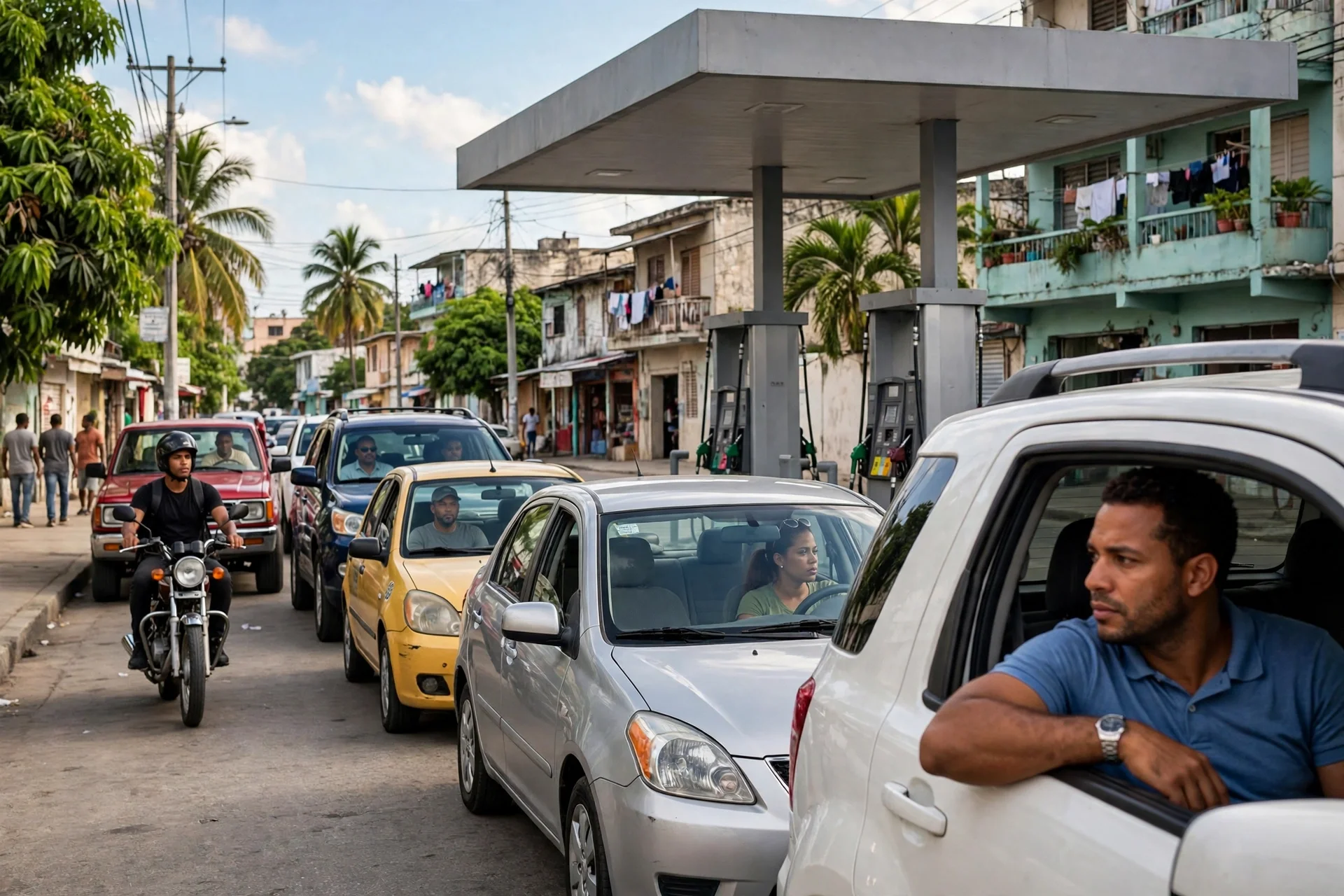
People's Force questions vehicle tax hike amid fuel price surge
The People's Force questioned the vehicle tax increase ordered by the Dominican tax authority and denounced asymmetric fiscal indexation: the marbete rises…
Dominican party denounces asymmetric indexation in vehicle tax
The People's Force denounced that the marbete increase immediately applies 84% of accumulated inflation, while the income tax exempt minimum is updated by 73%…
--- The context ---
The Economic Affairs Secretariat of the People's Force questioned the increase in the Vehicle Circulation Tax, known as the marbete, ordered by the Internal Taxes Directorate. In its view, the measure reveals an asymmetric fiscal policy: the Government uses inflation to recover the real value of its revenue without applying the same criterion to protect taxpayers' income.
--- The facts ---
Economist Haivanjoe Ng Cortiñas, head of the secretariat, pointed out that the adjustment, established through Administrative Resolution No. DDG-AR1-2026-00009, was justified by accumulated inflation of 58.1% between September 2016 and September 2026. The measure raises the tax from RD$1,500 to RD$2,000 for vehicles manufactured up to and including 2021, and from RD$3,000 to RD$4,000 for those from 2022 onward: an increase of 33.3%.
The authority estimates revenue will rise from RD$3,525 million to RD$4,700 million in the 2026-2027 season, with additional income of RD$1,175 million. Ng Cortiñas acknowledged that a tariff frozen for ten years may require revision, without a full pass-through of inflation: a complete update would have set RD$2,372 and RD$4,743.
--- The positions ---
The economist warned, in reported terms, that if the Government recognizes that inflation reduced the real value of the marbete and uses that argument to charge more, it must also recognize that the same inflation eroded Dominicans' purchasing power, and that inflation cannot be a unilateral indexation mechanism for the State. He recalled that Article 327 of the Tax Code establishes the annual inflation update of income tax brackets, not applied for almost a decade.
By that contrast, Law 30-26 raised the exempt minimum from RD$416,220 to RD$480,000 a year starting in 2027, a partial adjustment, because with the same 58.1% inflation it should be around RD$658,000 a year. The marbete is updated immediately at 84% of accumulated inflation; the exempt minimum, by barely 73% and only from next year, leaving the salaried worker around RD$14,800 a month short in exempt income.
--- What remains unknown ---
The organization asked the Government to make transparent the distribution of vehicles by category, the effective impact on households and the criteria used to set the new tariffs. It also noted that mandatory salary adjustments concentrated on private-sector minimum wages, without a general mechanism protecting workers' real income.
--- Unanswered questions ---
Will the Government apply the same inflation criterion to income tax brackets that it used for the marbete? Will it publish the distribution by category and the impact on households? Will a discussion open on general mechanisms to protect workers' real income?
--- EPM analysis ---
The increase arrives amid a sustained fuel escalation: according to official weekly prices, between January 2026 and the week of October 24 to 30, premium gasoline rose 23.4%, regular gasoline 16.5%, optimal diesel 31.4% and regular diesel 20.5%. The secretariat warned that fixed amounts are regressive: a used vehicle worth RD$400,000 will pay 0.5% of its value, while a RD$5 million vehicle manufactured in 2021 will pay barely 0.04%, hitting independent workers, drivers, merchants and small business owners hardest.
📌 EPM Take: In EPM's view, the debate opened by the People's Force raises a demand for fiscal coherence that is hard to dismiss: if accumulated inflation of 58.1% justifies immediately updating what the State charges, the same reasoning should protect what workers earn. The proposal to fully apply Article 327 and compensate the unrecognized inflation in income tax brackets moves the discussion onto the ground of equity, transparency and predictable rules, where the Government will have to respond with public figures, clear criteria and a calendar that treats collection and protection by the same measure.
--- The context ---
The Economic Affairs Secretariat of the People's Force questioned the increase in the Vehicle Circulation Tax, known as the marbete, ordered by the Internal Taxes Directorate. For the organization, the measure reveals an asymmetric fiscal policy: the Government uses inflation to recover the real value of its revenue, but does not apply the same criterion to protect taxpayers' income.
--- The facts ---
Economist Haivanjoe Ng Cortiñas, head of the secretariat, pointed out that the adjustment was established through Administrative Resolution No. DDG-AR1-2026-00009 and justified by accumulated inflation of 58.1% between September 2016 and September 2026. The measure raises the tax from RD$1,500 to RD$2,000 for vehicles manufactured up to and including 2021, and from RD$3,000 to RD$4,000 for those from 2022 onward: an increase of 33.3%.
The authority estimates that revenue will rise from RD$3,525 million to RD$4,700 million in the 2026-2027 season, with additional income of RD$1,175 million. The economist himself acknowledged that a tariff frozen for ten years may require revision and that the full accumulated inflation was not passed on, since a complete update would have set the tariffs at RD$2,372 and RD$4,743.
--- The positions ---
Ng Cortiñas warned, in reported terms, that the Government does not treat inflation the same way when workers' income is at stake, and he stated that inflation cannot be a unilateral indexation mechanism for the State. He recalled that Article 327 of the Tax Code mandates the annual inflation update of personal income tax brackets, a provision that was not applied for almost a decade.
The contrast is measurable: Law 30-26 raised the exempt minimum from RD$416,220 to RD$480,000 a year starting in 2027, but with the same 58.1% inflation it should be around RD$658,000 a year. The marbete recognizes 84% of accumulated inflation and applies immediately; the exempt minimum, barely 73% and only from next year, and the salaried worker keeps missing out on around RD$14,800 a month of exempt income.
--- What remains unknown ---
The People's Force asked for transparency on the distribution of vehicles by category, the effective impact on households and the criteria used to set the new tariffs. It also observed that mandatory salary adjustments concentrated on private-sector minimum wages, with no general mechanism protecting workers' real income.
--- Unanswered questions ---
What technical criteria support the new marbete tariffs against accumulated inflation of 58.1%? Will the Government correct the incomplete update of the income tax brackets provided for in Article 327? When will the effective impact of the increase on Dominican households be known?
--- EPM analysis ---
The questioning is reinforced by the fuel context: according to official weekly prices, from January 2026 to the week of October 24 to 30, premium gasoline rose 23.4%, regular gasoline 16.5%, optimal diesel 31.4% and regular diesel 20.5%. A driver who consumes 10 gallons of regular gasoline a week now pays RD$450 more each week than in January, almost the equivalent of the RD$500 annual marbete increase: a double burden on the same pocket.
📌 EPM Take: In EPM's view, an orderly fiscal policy requires symmetric and predictable rules, applied consistently in both directions: indexing when collecting and also when protecting strengthens the credibility of the tax system and taxpayers' trust. The demand for transparency on categories, impact and criteria points in that institutional direction, and the discussion on mechanisms to protect real income deserves to proceed with complete data, without the adjustment of a tariff frozen for ten years becoming a disproportionate burden on those who use their vehicle as a work tool every day.
Fuerza del Pueblo cuestiona el alza del marbete y la indexación fiscal
La Fuerza del Pueblo cuestionó el aumento del marbete dispuesto por la administración tributaria y denunció una indexación fiscal asimétrica: el impuesto…
FP denuncia asimetría fiscal en el aumento del marbete dominicano
La Fuerza del Pueblo denunció que el aumento del marbete aplica de inmediato el 84% de la inflación acumulada, mientras el mínimo exento del impuesto sobre la…
--- El contexto ---
La Secretaría de Asuntos Económicos de la Fuerza del Pueblo cuestionó el alza del Impuesto de Circulación Vehicular (marbete) dispuesta por la Dirección General de Impuestos Internos. A su juicio, la medida evidencia una política fiscal asimétrica: el Gobierno usa la inflación para recuperar sus ingresos sin aplicar ese criterio al ingreso de los contribuyentes.
--- Los hechos ---
El economista Haivanjoe Ng Cortiñas, titular de esa secretaría, señaló que el ajuste, establecido por la Resolución Administrativa núm. DDG-AR1-2026-00009, se justificó en la inflación acumulada de 58.1% entre septiembre de 2016 y septiembre de 2026. La disposición eleva de RD$1,500 a RD$2,000 el impuesto para vehículos hasta 2021 inclusive, y de RD$3,000 a RD$4,000 para los desde 2022: un aumento de 33.3%.
La administración estima que la recaudación pasará de RD$3,525 millones a RD$4,700 millones en la temporada 2026-2027, con ingresos adicionales por RD$1,175 millones. Ng Cortiñas reconoció que una tarifa congelada durante diez años puede requerir revisión, sin traslado total de la inflación: la actualización íntegra habría fijado RD$2,372 y RD$4,743.
--- Las posiciones ---
El economista advirtió, en indirecto, que si el Gobierno reconoce que la inflación redujo el valor real del marbete y lo usa para cobrar más, debe reconocer que esa inflación deterioró el poder adquisitivo de los dominicanos, y que la inflación no puede ser un mecanismo de indexación unilateral del Estado. Recordó que el artículo 327 del Código Tributario establece la actualización anual por inflación de los tramos del Impuesto sobre la Renta, disposición no aplicada durante casi una década.
En ese contraste, la Ley 30-26 elevó el mínimo exento de RD$416,220 a RD$480,000 anuales a partir de 2027, un ajuste parcial, porque con la misma inflación de 58.1% debería rondar los RD$658,000. El marbete se actualiza de inmediato y en un 84% de la inflación acumulada; el mínimo exento, en apenas un 73% y solo desde el próximo año, y el asalariado sigue dejando de recibir alrededor de RD$14,800 al mes de ingreso exento.
--- Lo que falta saber ---
La organización solicitó transparentar la distribución por categoría, el impacto del incremento sobre los hogares y los criterios de las nuevas tarifas. También planteó que los ajustes salariales se concentraron en los mínimos del sector privado, sin un mecanismo general de protección del ingreso real.
--- Preguntas sin respuesta ---
¿Aplicará el Gobierno a los tramos del Impuesto sobre la Renta el criterio que usó para el marbete? ¿Publicará la distribución por categoría y el impacto sobre los hogares? ¿Se abrirá una discusión sobre mecanismos generales de protección del ingreso real?
--- Análisis EPM ---
El aumento llega en plena escalada de los combustibles: según los precios oficiales semanales, entre enero y la semana del 24 al 30 de octubre de 2026, la gasolina premium subió 23.4%, la regular 16.5%, el gasoil óptimo 31.4% y el gasoil regular 20.5%. La secretaría advirtió que el cobro por montos fijos es regresivo: un vehículo usado de RD$400,000 pagará el 0.5% de su valor, mientras uno de RD$5 millones de 2021 pagará apenas el 0.04%, y afecta sobre todo a conductores.
📌 Conclusion EPM: A juicio de EPM, el debate abierto por la Fuerza del Pueblo pone sobre la mesa una exigencia de coherencia fiscal difícil de eludir: si la inflación acumulada de 58.1% justifica actualizar de inmediato lo que el Estado cobra, el mismo razonamiento debería valer para proteger lo que el trabajador gana. La propuesta de aplicar íntegramente el artículo 327 y compensar la inflación no reconocida en los tramos del impuesto sobre la renta traslada la discusión al terreno de la equidad, donde el Gobierno tendrá que responder con cifras y criterios públicos.
--- El contexto ---
La Secretaría de Asuntos Económicos de la Fuerza del Pueblo cuestionó el incremento del Impuesto de Circulación Vehicular, conocido como marbete, dispuesto por la Dirección General de Impuestos Internos. Para la organización, la medida evidencia una política fiscal asimétrica: el Gobierno usa la inflación para recuperar el valor real de sus ingresos sin aplicar ese criterio para proteger el ingreso de los contribuyentes.
--- Los hechos ---
El economista Haivanjoe Ng Cortiñas, titular de la secretaría, señaló que el ajuste se estableció mediante la Resolución Administrativa núm. DDG-AR1-2026-00009 y se justificó en una inflación acumulada de 58.1% entre septiembre de 2016 y septiembre de 2026. La disposición eleva de RD$1,500 a RD$2,000 el impuesto para vehículos fabricados hasta 2021 inclusive, y de RD$3,000 a RD$4,000 para los fabricados desde 2022: un aumento de 33.3%.
La administración estima que la recaudación pasará de RD$3,525 millones a RD$4,700 millones en la temporada 2026-2027, con ingresos adicionales por RD$1,175 millones. El propio economista reconoció que una tarifa congelada durante diez años puede requerir revisión y que no se trasladó toda la inflación acumulada, ya que la actualización íntegra habría fijado RD$2,372 y RD$4,743.
--- Las posiciones ---
Ng Cortiñas advirtió, en indirecto, que el Gobierno no trata la inflación igual cuando se trata del ingreso de los trabajadores, y que la inflación no puede ser un mecanismo de indexación unilateral del Estado. Recordó que el artículo 327 del Código Tributario ordena la actualización anual por inflación de los tramos del Impuesto sobre la Renta, disposición no aplicada durante casi una década.
El contraste es medible: la Ley 30-26 elevó el mínimo exento de RD$416,220 a RD$480,000 anuales a partir de 2027, pero con la misma inflación de 58.1% debería rondar los RD$658,000. El marbete reconoce el 84% de la inflación y se aplica de inmediato; el mínimo exento, apenas el 73% y desde el próximo año, y el trabajador asalariado sigue dejando de recibir alrededor de RD$14,800 al mes de ingreso exento.
--- Lo que falta saber ---
La Fuerza del Pueblo solicitó transparentar la distribución de los vehículos por categoría, el impacto efectivo del incremento sobre los hogares y los criterios para fijar las nuevas tarifas. También observó que los ajustes salariales se concentraron en los mínimos del sector privado, sin un mecanismo general de protección del ingreso real.
--- Preguntas sin respuesta ---
¿Qué criterios sustentan las nuevas tarifas frente a la inflación de 58.1%? ¿Corregirá el Gobierno la actualización incompleta de los tramos del impuesto sobre la renta prevista en el artículo 327? ¿Cuándo se conocerá el impacto efectivo del incremento sobre los hogares dominicanos?
--- Análisis EPM ---
El cuestionamiento se refuerza con los combustibles: según los precios oficiales semanales, desde enero de 2026 hasta la semana del 24 al 30 de octubre, la gasolina premium subió 23.4%, la regular 16.5%, el gasoil óptimo 31.4% y el gasoil regular 20.5%. Un conductor que consume 10 galones de gasolina regular a la semana paga hoy RD$450 más cada semana que en enero, casi el equivalente al aumento anual de RD$500 del marbete: una doble carga sobre el mismo bolsillo.
📌 Conclusion EPM: A juicio de EPM, una política fiscal ordenada exige reglas simétricas y previsibles: indexar cuando se cobra y también cuando se protege fortalece la credibilidad del sistema tributario y la confianza de los contribuyentes. El reclamo de transparencia sobre categorías, impacto y criterios apunta en esa dirección institucional, y la discusión sobre mecanismos de protección del ingreso real merece tramitarse con datos completos, sin que el ajuste de una tarifa congelada durante diez años se convierta en carga desproporcionada para quienes usan su vehículo como herramienta de trabajo.