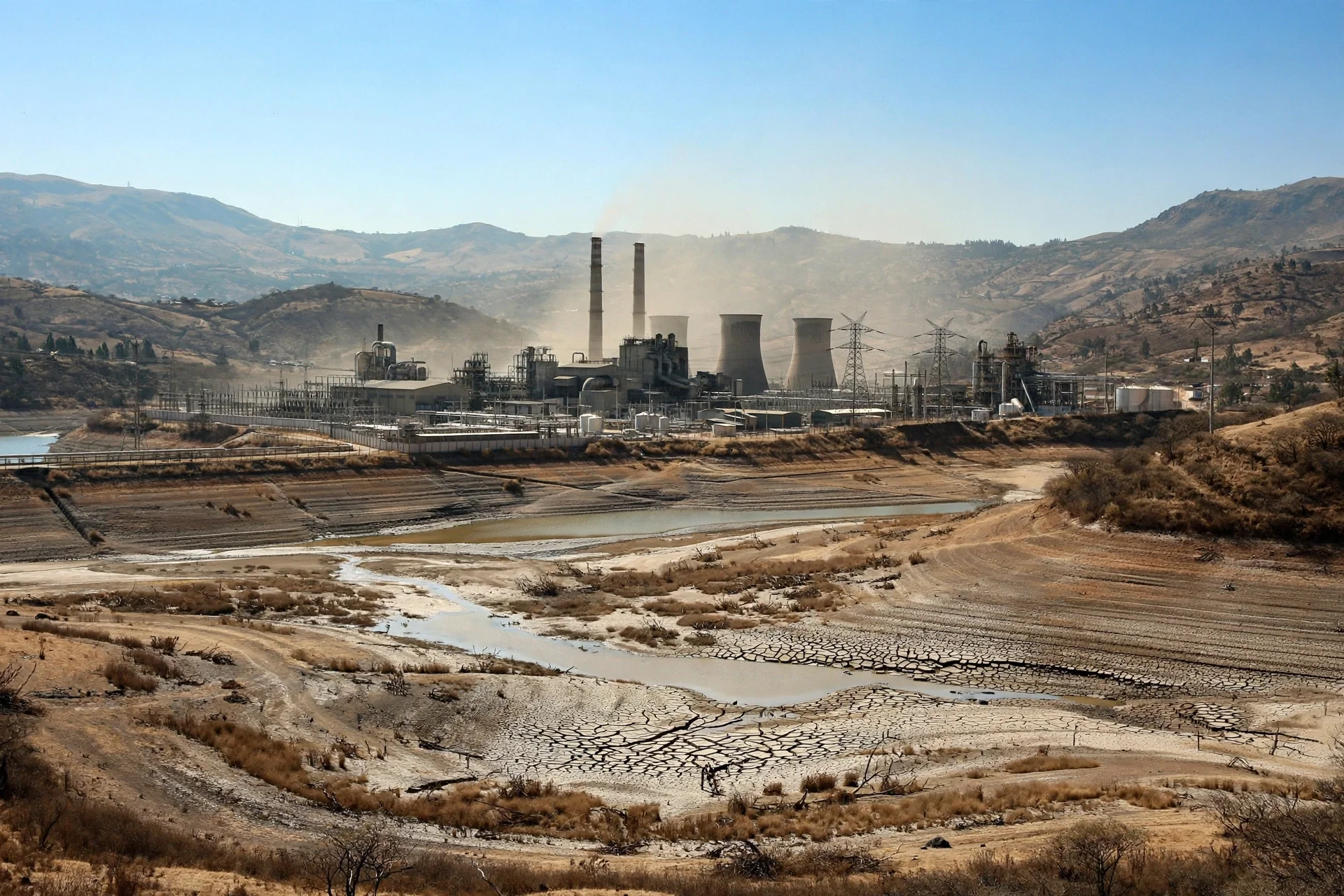
Imagen alusiva a una planta térmica frente a un embalse en niveles bajos durante la sequía. · Imagen generada por EPM
Thermal plants face drought, tight cash and systemic risk during El Niño
Thermal plants warn of negative cash flow and systemic risk during El Niño, while compliance with the firm energy users pay for is verified and reservoirs aim…
El Niño tests firm energy promises and the finances of thermal plants
The demand for greater thermal generation to protect reservoirs clashes with warnings of negative cash flow, unrecognized costs and fuel risk, while compliance…
--- The context ---
Colombia is facing an El Niño event that President Abelardo De La Espriella described on Sunday, October 25, as very strong in intensity. In his address he explained that the country has had six months with rainfall below normal, that October has been the driest month of this semester and that reservoirs have received almost 40 percent less water than they normally receive this month. He also recalled that no government can make it rain, but it does have the obligation to responsibly manage the available water. Behind that statement there is a growing tension between caring for the reservoirs, demanding the firm energy that users already pay for and financially sustaining the thermal plants called upon to back up the system.
--- The facts ---
The president focused on the reliability charge, the mechanism that users pay in their bills to remunerate firm energy availability obligations and back up the system in complicated circumstances. According to his account, against obligations of 118 gigawatt-hours per day, 95 have been requested, but generation barely reaches 83. In 42 days, the goal was met only once, and although some companies have responded, others have delivered less than 30 percent of what was committed. For that reason he asked the Superintendencia de Servicios Públicos to carry out the corresponding investigations, verify compliance with those obligations and examine the measures that may apply within its competences.
In early September, the energy and gas regulator, the Creg, issued a resolution to secure electricity supply during El Niño, leading thermal plants to greater generation in order to care for the water in the reservoirs. The stated objective is to reach the month of December with reservoirs at 80 percent. To that end, the regulator set generation goals of between 95 and 100 gigawatts per day, out of the nearly 240 that the country demands, in order to preserve water and take advantage of the available thermal capacity. The debate centers on the eventual failure of thermal plants to meet those goals.
On prices, the exchange price corresponds to the highest offer price of the centrally dispatched units scheduled to generate in the ideal dispatch and without inflexibility, and it represents a single price for the interconnected system in each hourly period. The scarcity price is a ceiling price that corresponds to the maximum value that demand in the country can pay for energy, according to XM. Today the scarcity price for October stands at 1.463 pesos per kilowatt, while the exchange price, on average over the last month, is 637 pesos. A scarcity condition arises when the exchange price exceeds the scarcity price, and then firm energy obligations become enforceable and the covered energy is remunerated at the scarcity price.
--- The positions ---
The government maintains that its intervention has sought to avoid a systemic risk. The minister of mines and energy, María Nohemí Arboleda, argued in a session of the Senate Fifth Commission in Barranquilla that, unlike in other El Niño events, in this case there are companies that can go bankrupt and that, if they go bankrupt, the sector is affected systemically. In that intervention she said that what has been done from the government together with the Creg is to avoid that risk, that the price could rise above one thousand and that many companies are exposed on the exchange. That position also reflects the difficult financial situation of Air-e and Afinia, and defends not recognizing exceptional rents in the middle of a crisis.
Thermal generators and sector voices present the other side. They argue that the intervention has meant that almost all of the time the exchange price has not been able to exceed the scarcity price, so that the condition for firm energy obligations to become enforceable is not met. They add that the decision to recognize only costs results in a negative cash position, because withholding tax must be paid on income even if no margin is achieved, and that this situation cannot be maintained for much longer. They also warn that credit lines with fuel suppliers can be canceled if it is perceived that there is no margin, which can cause a lack of fuel during El Niño and the impossibility of generating. Added to this, Air-e alone owes these companies 2,5 billones de pesos.
--- What remains unknown ---
The result of the investigations requested from the Superintendencia de Servicios Públicos is still unknown, as is the detail, company by company, of compliance with each firm energy obligation. Nor is it clear which costs will finally be recognized to generators or how long a remuneration based only on costs can be sustained without deteriorating cash flow and access to fuel. Another open element is maintenance: between September and October, between 10 and 15 percent of plants have gone through that process, which will continue in November, because generators are preparing for the conditions expected in February, March and April. That technical reality coexists with the immediate demand for generation.
--- Unanswered questions ---
How will it be verified, plant by plant, whether lower delivery of firm energy is due to noncompliance, to scheduled maintenance or to the effects of the price intervention itself? What mechanism will protect users from exceptional rents without leaving thermal plants with negative cash flow during the most demanding months of El Niño? Will reservoir levels reach 80 percent in December if thermal generation remains below the goals of between 95 and 100 gigawatts per day? What will happen to fuel supply if suppliers credit lines are canceled before February, March and April?
--- EPM analysis ---
The controversy is a dispute over who bears the cost of the drought. If the exchange price does not exceed the scarcity price, obligations do not become enforceable under the terms described, but the system still needs the energy to preserve water. If the price is allowed to rise without limits, inframarginal rents appear: a plant that entered at 500 pesos can receive 800 per kilowatt and obtain a gain of 300 pesos. The balance point demands transparency in both directions: verifiable compliance with what users paid for and verifiable recognition of real generation costs.
📌 EPM Take:
In EPM's view, the immediate priority is to protect water, users and continuity of service without passing on to households the exceptional rents that a crisis can generate. That protection will only be sustainable, however, if the rules transparently recognize the real costs of generating and if every obligation paid through the reliability charge is verified and fulfilled. Drought, cash flow and trust are not separate problems: they are the same problem seen from the reservoir, the plant and the bill. Facing them together, with public data and effective controls, is the minimum condition for getting through El Niño without an electrical blackout or a financial one and without breaking the chain.
--- The context ---
The El Niño event has once again placed thermal plants at the center of the Colombian electricity system. On Sunday, October 25, President Abelardo De La Espriella warned in his address that the event will have a very strong intensity, that the country has had six months with rainfall below normal and that October has been the driest month of this semester, with almost 40 percent less water reaching reservoirs compared with what is usual this month. The president maintained that no government can make it rain, but it does have the obligation to responsibly manage the available water. On that basis he asked for verification of firm energy compliance, while generators warn that current rules leave them with negative cash flow.
--- The facts ---
The president recalled that for years users have paid in their bills the reliability charge, a mechanism that remunerates firm energy availability obligations to back up the system when complicated circumstances arise. According to his account, against obligations of 118 gigawatt-hours per day, 95 have been requested, but generation barely reaches 83. In 42 days, the goal was met only once. Although some companies have responded, others have delivered less than 30 percent of what was committed. For that reason, he asked the Superintendencia de Servicios Públicos to carry out the corresponding investigations, verify compliance with those obligations and examine the measures that may apply within its competences.
In early September, the Creg issued a resolution to secure electricity supply during El Niño, leading thermal plants to greater generation to care for the water in the reservoirs and address the tensions of the climate event. The goal is to reach the month of December with reservoirs at 80 percent. The regulator set generation goals of between 95 and 100 gigawatts per day, out of the nearly 240 that the country demands, to preserve water and take advantage of the available thermal capacity. On prices, the scarcity price for October stands at 1.463 pesos per kilowatt, while the exchange price, on average over the last month, is 637 pesos.
Firm energy is the maximum energy that a plant can deliver reliably and with certainty, and firm energy obligations are the commitments that plants acquired when they won that charge to deliver energy under scarcity conditions. That condition arises when the exchange price exceeds the scarcity price; in that scenario, the covered energy is remunerated at the scarcity price. When the exchange price exceeds the scarcity price, companies know they will receive enough income to cover their costs, and that is where inframarginal rents operate.
--- The positions ---
Thermal generators maintain that the government carried out an intervention that has meant that almost all of the time the exchange price has not been able to exceed the scarcity price, so that the condition for firm energy obligations to become enforceable is not met. While the government says they are not delivering firm energy, thermal generators argue, in that reading, that the intervention does not allow reaching the scarcity price. A sector businessman explained that recognizing only costs results in a negative cash position, because withholding tax must be paid on income even if no margin is achieved, and warned that this cannot be maintained for much longer. It was also pointed out that it is wrong to assume generators obtain margins in periods other than El Niño and that credit lines with fuel suppliers can be canceled if it is noticed that there is no margin, with a risk of fuel shortages and inability to generate.
From the government, the minister of mines and energy, María Nohemí Arboleda, stated in a session of the Senate Fifth Commission in Barranquilla that what has been done from the government together with the Creg is to avoid a systemic risk, because there are companies that can go bankrupt and, if they go bankrupt, the sector is affected as a whole. In that intervention she proposed that generators were invited to think of something that would guarantee their income in some way, but that would not mean exceptional rents that in this crisis will not be seen, because that would lead companies to bankruptcy. She added that the price could rise above one thousand and that many companies are exposed on the exchange. That position reflects the difficult financial situation of Air-e and Afinia, while, on the other side, Air-e alone owes thermal generators 2,5 billones de pesos, a sum that worsens their cash position.
--- What remains unknown ---
The result of the investigations by the Superintendencia de Servicios Públicos is not yet known, nor is there a public verification that distinguishes, plant by plant, between noncompliance, maintenance and the effects of the price intervention. Nor has it been specified which costs remain outside the current recognition or how fuel will be financed if credit lines are canceled. An analyst cited in the debate maintained that the Creg decision creates a mechanism not contemplated in regulation and does not establish sanctions for noncompliance, and that it disregards the technical conditions of the sector, because between September and October, between 10 and 15 percent of plants have undergone maintenance, a process that will continue in November while generators prepare for February, March and April.
--- Unanswered questions ---
Can full compliance with firm energy obligations be demanded if the intervention itself prevents the scarcity condition that makes them enforceable from arising? Which concrete costs will be recognized to thermal plants and what will happen with withholding tax when remuneration leaves no margin and cash flow is already negative? How will fuel be guaranteed during El Niño if suppliers cancel credit lines upon noticing that there is no margin? Will reservoirs reach 80 percent in December without compromising the availability of plants now under maintenance for February, March and April?
--- EPM analysis ---
The heart of the clash is predictability: goals of between 95 and 100 gigawatts per day, on the one hand, and remuneration that, according to generators, does not cover all costs, on the other. If a plant entered at 500 pesos and the price closed at 800 per kilowatt, its inframarginal gain is 300 pesos; eliminating all margin can avoid exceptional rents, but it can also dry up credit and fuel. The way out demands auditing what was committed and paying what it costs to generate.
📌 EPM Take:
In EPM's view, energy security requires stable rules, contracts that are honored and companies able to finance fuel, maintenance and operation throughout the entire emergency. Demanding firm energy without recognizing full costs or the technical condition of the plants transfers the problem to the future and turns it into a supply risk. At the same time, every obligation charged to users through the reliability charge must be rigorously audited and sanctioned when noncompliance is proven. Order, predictability and fiscal responsibility are not obstacles to overcoming El Niño: they are the only basis for having energy available in December and also in February, March and April.
Térmicas entre la sequía, la caja negativa y el riesgo de un apagón financiero
Las plantas térmicas advierten caja negativa y riesgo sistémico en pleno fenómeno de El Niño, mientras se verifica el cumplimiento de la energía firme que los…
El Niño pone a prueba la energía firme y las finanzas de las térmicas colombianas
La exigencia de mayor generación térmica para cuidar los embalses choca con la advertencia de caja negativa, costos no reconocidos y riesgo de combustible…
--- El contexto ---
Colombia enfrenta un fenómeno de El Niño que el presidente Abelardo De La Espriella describió el domingo 25 de octubre como de una intensidad muy fuerte. En su alocución explicó que el país lleva seis meses con lluvias por debajo de lo normal, que octubre ha sido el mes más seco de este semestre y que a los embalses ha llegado casi un 40 por ciento menos de agua de la que normalmente reciben este mes. También recordó que ningún Gobierno puede hacer llover, pero sí tiene la obligación de administrar responsablemente el agua disponible.
--- Los hechos ---
El mandatario se detuvo en el cargo por confiabilidad, el mecanismo que los usuarios pagan en sus facturas para remunerar obligaciones de disponibilidad de energía firme y respaldar el sistema en circunstancias complicadas. Según su balance, frente a obligaciones de 118 gigavatios hora diarios, se han solicitado 95, pero la generación apenas llega a 83. En 42 días, la meta solo se cumplió una vez, y aunque algunas empresas han respondido, otras han entregado menos del 30 por ciento de lo comprometido. Por ello solicitó a la Superintendencia de Servicios Públicos que adelante las investigaciones correspondientes, verifique el cumplimiento de esas obligaciones y examine las medidas que procedan dentro de sus competencias.
A principios de septiembre, la Comisión de Regulación de Energía y Gas, la Creg, expidió una resolución para asegurar el abastecimiento durante El Niño, llevando a las térmicas a una mayor generación para cuidar el agua de los embalses. El objetivo planteado es llegar al mes de diciembre con el 80 por ciento en el nivel de los embalses. Para ello, el regulador fijó metas de generación de entre 95 y 100 gigavatios diarios, de los cerca de 240 que demanda el país, con el fin de preservar el agua y aprovechar la capacidad térmica disponible. El debate se centra en el eventual incumplimiento de esas metas por parte de las térmicas.
En materia de precios, el precio de bolsa corresponde al mayor precio de oferta de las unidades con despacho centralizado programadas para generar en el despacho ideal y sin inflexibilidad, y representa un precio único para el sistema interconectado en cada periodo horario. El precio de escasez es un precio techo que corresponde al valor máximo que puede pagar la demanda del país por la energía, según XM. Hoy el precio de escasez para octubre está en 1.463 pesos por kilovatio, mientras que el de bolsa, en promedio, en el último mes es de 637 pesos. La condición de escasez se configura cuando el precio de bolsa supera el precio de escasez, y entonces las obligaciones de energía firme se vuelven exigibles y la energía cubierta se remunera al precio de escasez.
--- Las posiciones ---
Desde el Gobierno se sostiene que la intervención ha buscado evitar un riesgo sistémico. La ministra de Minas y Energía, María Nohemí Arboleda, planteó en una sesión de la Comisión Quinta del Senado en Barranquilla que, a diferencia de otros fenómenos de El Niño, en este caso hay empresas que se pueden quebrar y que, si se quiebran, el sector se afecta sistémicamente. En esa intervención señaló que lo hecho desde el Gobierno en compañía de la Creg es evitar ese riesgo, que el precio podría subir por encima de mil y que hay muchas empresas que están descubiertas en bolsa. Esa posición refleja también la difícil situación financiera de Air-e y Afinia, y defiende que no se reconozcan rentas excepcionales en plena crisis.
Desde las térmicas y desde voces del sector se plantea la otra cara. Se afirma que la intervención ha hecho que casi todo el tiempo el precio de bolsa no haya podido superar el precio de escasez, de modo que no se cumple la condición de exigibilidad de las obligaciones de energía firme. Se agrega que la decisión de reconocer solo los costos da como resultado una posición de caja negativa, porque hay que pagar retefuente sobre los ingresos incluso si no se logra margen, y que esa situación no puede mantenerse mucho más tiempo. También se advierte que existen líneas de crédito con los proveedores de combustible que pueden cancelarse si se percibe que no hay margen, lo que puede provocar falta de combustible durante El Niño y la imposibilidad de generar. A ello se suma que solo Air-e les adeuda 2,5 billones de pesos a estas empresas.
--- Lo que falta saber ---
Todavía no se conoce el resultado de las investigaciones solicitadas a la Superintendencia de Servicios Públicos ni el detalle del cumplimiento de cada obligación de energía firme. Tampoco está claro qué costos serán reconocidos ni cuánto puede sostenerse una remuneración basada solo en costos sin deteriorar la caja y el acceso al combustible. Otro elemento abierto es el mantenimiento: entre septiembre y octubre, entre el 10 y el 15 por ciento de las plantas han pasado por ese proceso, que continuará en noviembre, porque las generadoras se preparan para febrero, marzo y abril.
--- Preguntas sin respuesta ---
¿Cómo se verificará, planta por planta, si la menor entrega de energía firme obedece a incumplimiento, a mantenimiento programado o a los efectos de la propia intervención de precios? ¿Qué mecanismo permitirá proteger a los usuarios de rentas excepcionales sin dejar a las térmicas en caja negativa durante los meses más exigentes de El Niño? ¿Alcanzará el nivel de los embalses el 80 por ciento en diciembre si la generación térmica se mantiene por debajo de las metas de entre 95 y 100 gigavatios diarios? ¿Qué ocurrirá con el suministro de combustible si las líneas de crédito de los proveedores se cancelan antes de febrero, marzo y abril?
--- Análisis EPM ---
La controversia es una disputa sobre quién asume el costo de la sequía. Si el precio de bolsa no supera el de escasez, las obligaciones no se vuelven exigibles en los términos descritos, pero el sistema igual necesita la energía para preservar el agua. Si se deja subir el precio sin límites, aparecen las rentas inframarginales: una planta que entró con 500 pesos puede recibir 800 por kilovatio y obtener una ganancia de 300 pesos. El equilibrio exige transparencia en ambas direcciones: cumplimiento verificable de lo pagado por los usuarios y reconocimiento verificable de los costos reales de quien genera.
📌 Conclusion EPM:
A juicio de EPM, la prioridad inmediata es proteger el agua, a los usuarios y la continuidad del servicio sin trasladar a los hogares rentas excepcionales propias de una crisis. Esa protección, sin embargo, solo será sostenible si las reglas reconocen con transparencia los costos reales de generar y si cada obligación pagada mediante el cargo por confiabilidad se verifica y se cumple. Sequía, caja y confianza no son problemas separados: son el mismo problema visto desde el embalse, la planta y la factura. Afrontarlos juntos, con datos públicos y controles efectivos, es la condición mínima para atravesar El Niño sin apagón eléctrico ni apagón financiero y sin romper la cadena.
--- El contexto ---
El fenómeno de El Niño volvió a colocar a las plantas térmicas en el centro del sistema eléctrico colombiano. El domingo 25 de octubre, el presidente Abelardo De La Espriella advirtió que el evento tendrá una intensidad muy fuerte, que el país lleva seis meses con lluvias por debajo de lo normal y que octubre ha sido el mes más seco de este semestre, con casi un 40 por ciento menos de agua llegando a los embalses. El mandatario sostuvo que ningún Gobierno puede hacer llover, pero sí tiene la obligación de administrar responsablemente el agua disponible.
--- Los hechos ---
El presidente recordó que durante años los usuarios han pagado en sus facturas el cargo por confiabilidad, un mecanismo que remunera obligaciones de disponibilidad de energía firme para respaldar el sistema cuando se presentan circunstancias complicadas. Según su balance, frente a obligaciones de 118 gigavatios hora diarios, se han solicitado 95, pero la generación apenas llega a 83. En 42 días, la meta solo se cumplió una vez. Aunque algunas empresas han respondido, otras han entregado menos del 30 por ciento de lo comprometido. Por ello, solicitó a la Superintendencia de Servicios Públicos que adelante las investigaciones correspondientes, verifique el cumplimiento de esas obligaciones y examine las medidas que procedan dentro de sus competencias.
A principios de septiembre, la Creg expidió una resolución para asegurar el abastecimiento de energía eléctrica durante El Niño, llevando a las térmicas a una mayor generación para cuidar el agua de los embalses y atender las tensiones del evento climático. La meta es llegar al mes de diciembre con el 80 por ciento en el nivel de los embalses. El regulador fijó metas de generación de entre 95 y 100 gigavatios diarios, de los cerca de 240 que demanda el país, para preservar el agua y aprovechar la capacidad térmica disponible. En precios, el precio de escasez para octubre está en 1.463 pesos por kilovatio, mientras que el de bolsa, en promedio, en el último mes es de 637 pesos.
La energía en firme es la energía máxima que puede entregar la planta de manera confiable y con certeza, y las obligaciones de energía firme son los compromisos que las plantas adquirieron cuando se ganaron ese cargo para entregar energía bajo condiciones de escasez. Esa condición se configura cuando el precio de bolsa supera el precio de escasez; en ese escenario, la energía cubierta se remunera al precio de escasez. Cuando el precio de bolsa supera al de escasez, las empresas saben que recibirán ingresos suficientes para cubrir sus costos, y allí operan las rentas inframarginales.
--- Las posiciones ---
Desde las térmicas se sostiene que el Gobierno hizo una intervención que ha hecho que casi todo el tiempo el precio de bolsa no haya podido superar el precio de escasez, de modo que no se cumple la condición de exigibilidad de las obligaciones de energía firme. Mientras el Gobierno dice que no están entregando la energía firme, los térmicos afirman, en esa lectura, que la intervención no deja llegar al precio de escasez. Un empresario del sector explicó que reconocer solo los costos da como resultado una posición de caja negativa, ya que hay que pagar retefuente sobre los ingresos incluso si no se logra margen, y advirtió que esto no puede mantenerse mucho más tiempo. También se señaló que es erróneo suponer que los generadores obtienen márgenes en periodos distintos a los de El Niño y que las líneas de crédito con proveedores de combustible pueden cancelarse si se advierte que no hay margen, con riesgo de falta de combustible e imposibilidad de generar.
Desde el Gobierno, la ministra de Minas y Energía, María Nohemí Arboleda, expuso en una sesión de la Comisión Quinta del Senado en Barranquilla que lo hecho desde el Gobierno en compañía de la Creg es evitar un riesgo sistémico, porque hay empresas que se pueden quebrar y, si se quiebran, el sector se afecta en su conjunto. En esa intervención planteó que se invitó a los generadores a pensar en algo que les garantizara de alguna manera sus ingresos, pero que no significara rentas excepcionales que en esta crisis no se van a ver, porque eso llevaría a empresas a la quiebra. Añadió que el precio podría subir por encima de mil y que hay muchas empresas que están descubiertas en bolsa. Esa posición refleja la difícil situación financiera de Air-e y Afinia, mientras que, del otro lado, solo Air-e les adeuda 2,5 billones de pesos a los generadores térmicos, una suma que agrava su posición de caja.
--- Lo que falta saber ---
No se conoce aún el resultado de las investigaciones de la Superintendencia de Servicios Públicos ni una verificación que distinga entre incumplimiento, mantenimiento y efectos de la intervención de precios. Tampoco se ha precisado qué costos quedan por fuera del reconocimiento ni cómo se financiará el combustible si se cancelan las líneas de crédito. Un analista sostuvo que la decisión de la Creg crea un mecanismo no contemplado en la regulación ni establece sanciones, y que desconoce las condiciones técnicas del sector, porque entre septiembre y octubre, entre el 10 y el 15 por ciento de las plantas han pasado por mantenimiento, proceso que continuará en noviembre.
--- Preguntas sin respuesta ---
¿Puede exigirse el cumplimiento pleno de las obligaciones de energía firme si la propia intervención impide que se configure la condición de escasez que las vuelve exigibles? ¿Qué costos concretos quedarán reconocidos a las térmicas y qué ocurrirá con la retefuente cuando la remuneración no deja margen y la caja ya es negativa? ¿Cómo se garantizará el combustible durante El Niño si los proveedores cancelan las líneas de crédito al advertir que no hay margen? ¿Llegarán los embalses al 80 por ciento en diciembre sin comprometer la disponibilidad de las plantas que hoy están en mantenimiento para febrero, marzo y abril?
--- Análisis EPM ---
El fondo del choque es la previsibilidad: metas de entre 95 y 100 gigavatios diarios, por un lado, y una remuneración que, según los generadores, no cubre todos los costos, por el otro. Si una planta entró con 500 pesos y el precio cerró en 800 por kilovatio, su ganancia inframarginal es de 300 pesos; eliminar todo margen puede evitar rentas excepcionales, pero también puede secar el crédito y el combustible. La salida exige auditar lo comprometido y pagar lo que cuesta generar.
📌 Conclusion EPM:
A juicio de EPM, la seguridad energética exige reglas estables, contratos que se cumplan y empresas capaces de financiar combustible, mantenimiento y operación durante toda la emergencia. Exigir energía firme sin reconocer los costos completos ni la condición técnica de las plantas traslada el problema al futuro y lo convierte en riesgo de suministro. Al mismo tiempo, toda obligación cobrada a los usuarios mediante el cargo por confiabilidad debe auditarse con rigor y sancionarse cuando el incumplimiento quede probado. Orden, previsibilidad y responsabilidad fiscal no son obstáculos para superar El Niño: son la única base para que haya energía disponible en diciembre y también en febrero, marzo y abril.