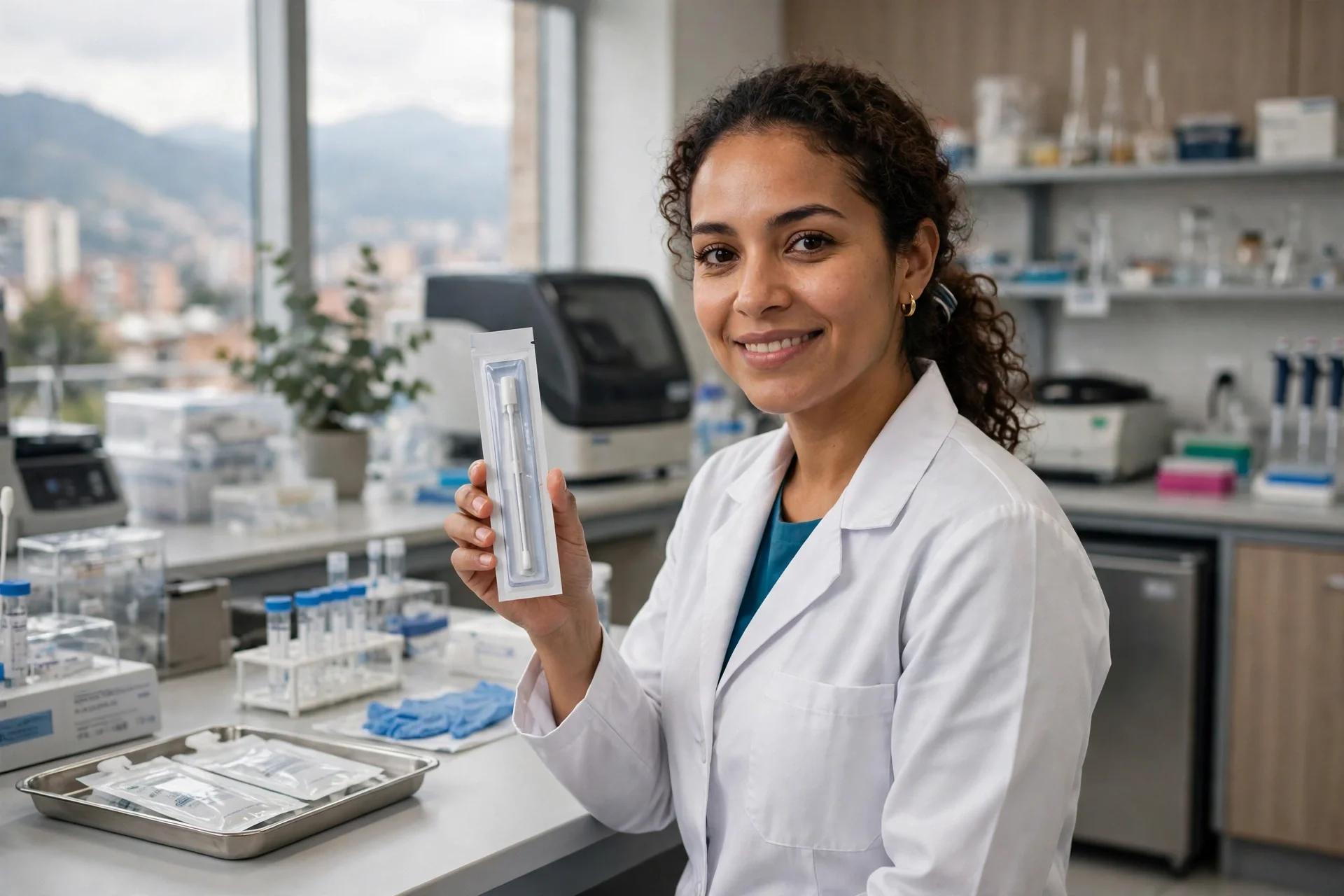
Imagen alusiva a un laboratorio y un kit de autotoma para la detección temprana del VPH. · Imagen generada por EPM
Colombian home test aims to flag cervical cancer risk earlier
A self-sampling device promoted by Colombian scientists lets women collect at home a sample to detect human papillomavirus and, with a molecular biomarker…
At-home HPV sampling awaits Colombian approval before wider use
The MIA by CytoTest self-sampling device showed 95.5 percent agreement with clinician sampling in studies in three countries, but in Colombia it still awaits…
--- The context ---
Each year, nearly 14 out of every 100,000 Colombian women are diagnosed with cervical cancer and mortality exceeds 50 percent. In Latin America, about 180 receive that diagnosis daily and more than 90 die. Behind those figures lies a challenge that goes beyond technology, ensuring that women gain timely access to detection tests and receive prompt care when the result requires it, instead of arriving after the disease has advanced.
The conventional examination requires inserting a speculum to access the cervix, an experience some consider uncomfortable, painful or embarrassing. According to Frank Meléndez Montoya, barely 45 percent of women in the country take part in screening campaigns when that method is used. That low participation, together with the distance from services in many regions, helps explain why so many diagnoses still arrive late despite the availability of molecular testing.
--- The facts ---
MIA by CytoTest is a self-sampling device that allows a vaginal sample to be collected at home and later analyzed in a laboratory. It has a slim design, similar in use to a sanitary tampon, and collects cells through adhesion. The woman inserts it partially into the vaginal canal, rotates it three times, removes it and places the sample in a dry container to send to the laboratory, without necessarily having to reach the cervix.
The sample is used exclusively for molecular testing. First, DNA is analyzed to determine whether human papillomavirus is present and, when the result is positive, a biomarker based on messenger RNA E6 and E7 is applied, linked to the activity of viral proteins involved in the cancer process. These are three complementary components, self-sampling, virus detection and molecular stratification, while clinical interpretation remains in the hands of the health professional.
The virus includes nearly 200 identified genotypes, most of them low risk, while 14 are considered high risk because of their relationship with cancer. Seven of them, 16, 18, 31, 33, 45, 52 and 58, account for 92 percent of cervical cancers globally, according to the researchers, and they are the same genotypes covered by the vaccine. Having the virus does not amount to having cancer, because the immune system spontaneously clears between 80 and 90 percent of infections.
The sensitivity comparison completes the technical picture. Conventional cytology has sensitivity close to 50 percent, while molecular DNA tests raised that capacity to 96.5 percent, according to the figures provided by the team. Even so, detecting the virus does not always make it possible to establish which patients require priority care, so the biomarker is proposed as a complement that adds information about risk in women who obtain a positive result.
--- The positions ---
Liliana Montes Correa, an engineer from Cali and global chief operating executive at Mel Mont Medical, and Frank Meléndez Montoya, from Medellín and global executive for clinical and commercial affairs at the company, take part in a development that began in Oslo, Norway, in 2003. Although they have lived outside the country for decades, they promoted manufacturing the device in Colombia. Montes said the starting point was differentiating who is at risk, who should receive priority management and who can wait, while Meléndez argued that the central challenge was getting women to participate.
The evidence presented covers two distinct lines. Since 2003, studies of the biomarker have included 127,000 women from Europe, Africa and Mexico, with findings published in 28 scientific articles. Separately, validation of self-sampling in Mexico, Spain and the United States, with participants aged 25 to 64, compared a sample taken by a professional with a speculum against one collected by the women themselves guided by a leaflet, and showed 95.5 percent agreement, according to Montes. Those studies included 1,050 and 450 women in Mexico, 275 in Spain and 360 in the United States, figures reported by the researchers for the device.
--- What remains unknown ---
In Colombia, MIA still depends on health authorization. Montes said the process before the National Institute for Food and Drug Surveillance is advanced and estimated that approval could arrive in three or four months. In the United States, according to Meléndez, the DNA test and the biomarker already have approval, while the device for collection at home remains under evaluation, with a notification expected in 60 days and implementation projected from January 2027.
--- Unanswered questions ---
When will the process before the Colombian health authority conclude and under what conditions could self-sampling be offered in the country? How will it be guaranteed that a woman in a remote area with a positive result receives later care without delays that cancel out the advantage of detecting it earlier? Who will assume processing of the samples, communication of the results and the costs of the complete process in each territory?
--- EPM analysis ---
The proposal gains a social dimension in remote regions. Meléndez mentioned Vaupés, the Amazon, the Orinoquía and the Pacific coast, where health infrastructure is limited and transporting samples can delay results. The purpose described is to support rural brigades with devices and trained personnel, process samples in reference laboratories and make it easier for teams to return to communities. The idea, he said, is that a woman can take the sample in complete privacy and obtain molecular results within seven days instead of months.
From an equity perspective, the potential value lies in bringing the first step closer to those who participate least today. If sampling can be done at home and in privacy, a barrier that the conventional method did not overcome could be reduced. But self-sampling does not remove the need for a system that processes samples, communicates results and guarantees later care, and that complete chain is what still must prove it can work in a sustained way in daily practice.
📌 EPM Take: In EPM's view, the relevance of this proposal lies in joining three pieces that separately were not enough, a sampling method women will actually accept, more sensitive molecular detection and a way to distinguish real risk among so many positive results. Its greatest promise is territorial, reaching places where the speculum, distance and embarrassment left many outside screening. But that promise only becomes public health if authorization arrives, if laboratories respond on time and if every positive result finds effective care and guaranteed follow-up for each woman tested.
--- The context ---
Each year, nearly 14 out of every 100,000 Colombian women are diagnosed with cervical cancer and mortality exceeds 50 percent. In Latin America, about 180 receive that diagnosis daily and more than 90 die. Those figures require the problem to be viewed without shortcuts, because behind each number there are diagnoses that arrived late and treatments that began when the disease had already advanced too far.
The conventional procedure requires inserting a speculum to access the cervix, an experience some consider uncomfortable, painful or embarrassing. According to Frank Meléndez Montoya, barely 45 percent of women in the country take part in screening campaigns when that method is used. That low participation explains part of the backlog, although distance from services and the later response capacity of the health system also weigh heavily.
--- The facts ---
MIA by CytoTest is a self-sampling device that allows a vaginal sample to be collected at home for analysis in a laboratory. It has a slim design, similar in use to a sanitary tampon, and collects cells through adhesion. The woman inserts it partially into the vaginal canal, rotates it three times, removes it and places the sample in a dry container to send to the laboratory, without necessarily reaching the cervix.
The sample is used exclusively for molecular testing and follows a defined order. First, DNA is analyzed to determine whether human papillomavirus is present and, when the result is positive, the biomarker based on messenger RNA E6 and E7 is applied, linked to the activity of viral proteins involved in the cancer process. Interpretation of results and clinical decisions remain in the hands of the health professional, a limit the promoters themselves expressly recognize.
The virus includes nearly 200 identified genotypes, most of them low risk, while 14 are considered high risk because of their relationship with cancer. Seven of them, 16, 18, 31, 33, 45, 52 and 58, are responsible for 92 percent of cervical cancers globally, according to Meléndez, and they are the same genotypes covered by the vaccine. Having the virus does not amount to having cancer, because the immune system spontaneously clears between 80 and 90 percent of infections, without consequences for health.
In sensitivity, the comparison should be read with prudence. Conventional cytology has sensitivity close to 50 percent, while molecular DNA tests raised that capacity to 96.5 percent, according to the figures provided by the team. Even so, detecting the virus does not always make it possible to establish which patients require priority care, so the biomarker is presented as an informational complement and not as a substitute for clinical judgment or later medical assessment.
--- The positions ---
Liliana Montes Correa, an engineer from Cali and global chief operating executive at Mel Mont Medical, and Frank Meléndez Montoya, from Medellín and global executive for clinical and commercial affairs at the company, take part in a development that began in Oslo, Norway, in 2003. Although they have lived outside the country for decades, they promoted manufacturing the device in Colombia. Montes recounted that the initial approach was to differentiate who is at risk, who should receive priority management and who can wait, and Meléndez argued that the central challenge was getting women to participate.
The evidence is organized in two lines that should be kept separate. Since 2003, studies of the biomarker have included 127,000 women from Europe, Africa and Mexico, with findings published in 28 scientific articles. In parallel, validation of self-sampling in Mexico, Spain and the United States, with participants aged 25 to 64, compared professional sampling with a speculum against collection by the women themselves guided by a leaflet, and demonstrated 95.5 percent agreement, according to Montes. Those studies included 1,050 and 450 women in Mexico, 275 in Spain and 360 in the United States, figures reported by the researchers for the device.
--- What remains unknown ---
In Colombia, MIA still depends on health authorization and that fact outweighs any enthusiasm. Montes said the process before the National Institute for Food and Drug Surveillance is advanced and estimated that approval could arrive in three or four months, an estimate from the promoter rather than authorization already granted. In the United States, the DNA test and the biomarker already have approval, according to Meléndez, while the device for collection at home remains under evaluation, with a notification expected in 60 days and implementation projected from January 2027.
--- Unanswered questions ---
On what exact date and with what scope will the Colombian authority grant the authorization that remains pending today for the device? What concrete mechanisms will ensure that medical interpretation and later care accompany every positive result obtained through self-sampling at home? How will brigades, sample transport and reference laboratories be financed so that the proposal is not limited to the cities that are best served?
--- EPM analysis ---
The territorial dimension is real and should not be dismissed. Meléndez mentioned Vaupés, the Amazon, the Orinoquía and the Pacific coast, where health infrastructure is limited and transporting samples can delay results. The purpose described is to support rural brigades with devices and trained personnel, process samples in reference laboratories and make it easier for medical teams to return to communities, with molecular results in seven days instead of months, according to the researcher.
That same reach imposes a requirement of order. Self-sampling can reduce an entry barrier, but it does not remove the need for a system that processes samples, communicates results and guarantees later care. Without that complete and verifiable chain, broader detection could generate more positive results without a clear clinical route, so a serious assessment must look at the same time at technical agreement, regulatory approval and institutional capacity to respond after the laboratory.
📌 EPM Take: In EPM's view, the merit of this proposal lies in its discipline, it distinguishes infection from risk, keeps clinical decisions in medical hands and rests on separate validations for the biomarker and for self-sampling. Its limit is also clear, it still lacks authorization in Colombia and its rural reach depends on brigades, laboratories and follow-up that must work without failures. Prudence requires welcoming the evidence presented and demanding, with equal firmness, complete regulatory compliance before any broad deployment across the country in the coming period.
Prueba casera colombiana busca anticipar el riesgo de cáncer cervical
Un dispositivo de autotoma impulsado por científicos colombianos permite recoger en casa una muestra para detectar el virus del papiloma humano y, con un…
Autotoma en casa para detectar VPH aguarda aval sanitario en Colombia
La autotoma MIA by CytoTest mostró una concordancia del 95,5 por ciento frente a la toma médica en estudios en tres países, pero en Colombia todavía espera la…
--- El contexto ---
Cada año, cerca de 14 de cada 100.000 mujeres colombianas son diagnosticadas con cáncer de cuello uterino y la mortalidad supera el 50 por ciento. En América Latina, unas 180 reciben ese diagnóstico diariamente y más de 90 fallecen. Detrás de esas cifras hay un desafío que va más allá de la tecnología, conseguir que las mujeres accedan a tiempo a las pruebas de detección y reciban atención oportuna cuando el resultado lo exige.
El examen convencional requiere introducir un espéculo para acceder al cuello uterino, una experiencia que algunas consideran incómoda, dolorosa o vergonzosa. Según afirmó Frank Meléndez Montoya, apenas el 45 por ciento de las mujeres en el país participa en campañas de tamizaje cuando se utiliza ese método. Esa baja participación, sumada a la distancia de los servicios en muchas regiones, ayuda a explicar por qué tantos diagnósticos llegan tarde.
--- Los hechos ---
MIA by CytoTest es un dispositivo de autotoma que permite recoger en casa una muestra vaginal para analizarla en un laboratorio. Tiene un diseño delgado, similar en su uso a un tampón sanitario, y recoge células mediante adhesión. La mujer lo introduce parcialmente en el canal vaginal, lo gira tres veces, lo retira y deposita la muestra en un recipiente seco para enviarla al laboratorio, sin que sea obligatorio alcanzar el cuello uterino.
La muestra se usa exclusivamente para pruebas moleculares. Primero se analiza el ADN para determinar si hay presencia del virus del papiloma humano y, cuando el resultado es positivo, se aplica un biomarcador basado en ARN mensajero E6 y E7, relacionado con la actividad de proteínas virales implicadas en el proceso oncogénico. Son tres componentes complementarios, autotoma, detección del virus y estratificación molecular, y la interpretación clínica sigue en manos del profesional de la salud.
El virus comprende cerca de 200 genotipos identificados, la mayoría de bajo riesgo, y 14 se consideran de alto riesgo por su relación con el cáncer. Siete de ellos, el 16, el 18, el 31, el 33, el 45, el 52 y el 58, concentran el 92 por ciento de los cánceres cervicouterinos a nivel global, según precisaron los investigadores, y son los mismos cubiertos por la vacuna. Tener el virus no equivale a padecer cáncer, porque el sistema inmunológico elimina espontáneamente entre el 80 y el 90 por ciento de las infecciones.
La comparación de sensibilidad completa el cuadro técnico. La citología convencional tiene una sensibilidad cercana al 50 por ciento, mientras que las pruebas moleculares de ADN elevaron esa capacidad al 96,5 por ciento, según las cifras aportadas por el equipo. Aun así, detectar el virus no siempre permite establecer qué pacientes requieren atención prioritaria, y por eso el biomarcador se propone como complemento que aporta información sobre el riesgo en las mujeres con resultado positivo.
--- Las posiciones ---
Liliana Montes Correa, ingeniera caleña y directora ejecutiva global de Operaciones de Mel Mont Medical, y Frank Meléndez Montoya, de Medellín y director ejecutivo global de Asuntos Clínicos y Comerciales de la compañía, participan en un desarrollo que comenzó en Oslo, Noruega, en 2003. Aunque llevan décadas fuera del país, impulsaron la fabricación del dispositivo en Colombia. Montes planteó que el punto de partida fue diferenciar quién está en riesgo, quién debe recibir manejo prioritario y quién puede esperar, mientras Meléndez sostuvo que el reto central era lograr que las mujeres participaran.
La evidencia presentada comprende dos líneas distintas. Desde 2003, los estudios del biomarcador han incluido a 127.000 mujeres de Europa, África y México, con hallazgos publicados en 28 artículos científicos. Por separado, la validación de la autotoma en México, España y Estados Unidos, con participantes de 25 a 64 años, comparó la muestra tomada por un profesional con espéculo frente a la recogida por las propias mujeres guiadas por un folleto, y mostró una concordancia del 95,5 por ciento, según afirmó Montes. Esos estudios incluyeron 1.050 y 450 mujeres en México, 275 en España y 360 en Estados Unidos, cifras reportadas por los investigadores para el dispositivo.
--- Lo que falta saber ---
En Colombia, MIA todavía depende de la autorización sanitaria. Montes aseguró que el proceso ante el Instituto Nacional de Vigilancia de Medicamentos y Alimentos está avanzado y estimó que la aprobación podría llegar en tres o cuatro meses. En Estados Unidos, según Meléndez, la prueba de ADN y el biomarcador ya cuentan con aprobación, mientras el dispositivo para la recolección en casa sigue en evaluación, con una notificación esperada en 60 días y una implementación proyectada desde enero de 2027.
--- Preguntas sin respuesta ---
¿Cuándo concluirá el trámite ante la autoridad sanitaria colombiana y bajo qué condiciones podrá ofrecerse la autotoma en el país? ¿Cómo se garantizará que una mujer de una zona apartada con un resultado positivo reciba atención posterior sin demoras que anulen la ventaja de detectarlo antes? ¿Quién asumirá el procesamiento de las muestras, la comunicación de los resultados y los costos del proceso completo en cada territorio?
--- Análisis EPM ---
La apuesta adquiere una dimensión social en las regiones apartadas. Meléndez mencionó Vaupés, la Amazonía, la Orinoquía y el litoral Pacífico, donde la infraestructura sanitaria es limitada y el traslado de las muestras puede retrasar los resultados. El propósito descrito es apoyar brigadas rurales con dispositivos y personal capacitado, procesar las muestras en laboratorios de referencia y facilitar que los equipos regresen a las comunidades. La idea, según afirmó, es que la mujer se tome la muestra en total intimidad y obtenga resultados moleculares en siete días en lugar de meses.
Desde una mirada de equidad, el valor potencial está en acercar el primer paso a quien hoy participa menos. Si la toma puede hacerse en casa y con privacidad, una barrera que el método convencional no logró superar podría reducirse. Pero la autotoma no elimina la necesidad de un sistema que procese las muestras, comunique los resultados y garantice la atención posterior, y esa cadena completa es la que todavía debe demostrar su funcionamiento sostenido en la práctica diaria.
📌 Conclusion EPM: A juicio de EPM, la relevancia de esta propuesta está en juntar tres piezas que por separado no alcanzaban, una toma que las mujeres sí acepten, una detección molecular más sensible y una forma de distinguir el riesgo real entre tantos positivos. Su promesa mayor es territorial, llegar donde el espéculo, la distancia y la vergüenza dejaron a muchas fuera del tamizaje. Pero esa promesa solo se vuelve salud pública si la autorización llega, si el laboratorio responde a tiempo y si cada resultado positivo encuentra atención efectiva y seguimiento garantizado para cada mujer evaluada.
--- El contexto ---
Cada año, cerca de 14 de cada 100.000 mujeres colombianas son diagnosticadas con cáncer de cuello uterino y la mortalidad supera el 50 por ciento. En América Latina, unas 180 reciben ese diagnóstico diariamente y más de 90 fallecen. Esas cifras obligan a mirar el problema sin atajos, porque detrás de cada número hay diagnósticos que llegaron tarde y tratamientos que comenzaron cuando la enfermedad ya había avanzado demasiado.
El procedimiento convencional requiere introducir un espéculo para acceder al cuello uterino, una experiencia que algunas consideran incómoda, dolorosa o vergonzosa. Según afirmó Frank Meléndez Montoya, apenas el 45 por ciento de las mujeres en el país participa en campañas de tamizaje cuando se utiliza ese método. Esa baja participación explica parte del rezago, aunque también pesan la distancia a los servicios y la capacidad de respuesta posterior del sistema sanitario.
--- Los hechos ---
MIA by CytoTest es un dispositivo de autotoma que permite recoger en casa una muestra vaginal para analizarla en un laboratorio. Tiene un diseño delgado, similar en su uso a un tampón sanitario, y recoge células mediante adhesión. La mujer lo introduce parcialmente en el canal vaginal, lo gira tres veces, lo retira y deposita la muestra en un recipiente seco para enviarla al laboratorio, sin necesidad de alcanzar obligatoriamente el cuello uterino.
La muestra se utiliza exclusivamente para pruebas moleculares y sigue un orden definido. Primero se analiza el ADN para determinar si hay presencia del virus del papiloma humano y, cuando el resultado es positivo, se aplica el biomarcador basado en ARN mensajero E6 y E7, relacionado con la actividad de proteínas virales implicadas en el proceso oncogénico. La interpretación de los resultados y las decisiones clínicas siguen en manos del profesional de la salud, un límite que los propios promotores reconocen.
El virus comprende cerca de 200 genotipos identificados, la mayoría de bajo riesgo, y 14 se consideran de alto riesgo por su relación con el cáncer. Siete de ellos, el 16, el 18, el 31, el 33, el 45, el 52 y el 58, son responsables del 92 por ciento de los cánceres cervicouterinos a nivel global, según precisó Meléndez, y son los mismos cubiertos por la vacuna. Tener el virus no equivale a padecer cáncer, porque el sistema inmunológico elimina espontáneamente entre el 80 y el 90 por ciento de las infecciones, sin consecuencias para la salud.
En sensibilidad, la comparación debe leerse con prudencia. La citología convencional tiene una sensibilidad cercana al 50 por ciento, mientras que las pruebas moleculares de ADN elevaron esa capacidad al 96,5 por ciento, según las cifras aportadas por el equipo. Aun así, detectar el virus no siempre permite establecer qué pacientes requieren atención prioritaria, de modo que el biomarcador se plantea como complemento informativo y no como sustituto del criterio clínico ni de la valoración médica posterior.
--- Las posiciones ---
Liliana Montes Correa, ingeniera caleña y directora ejecutiva global de Operaciones de Mel Mont Medical, y Frank Meléndez Montoya, de Medellín y director ejecutivo global de Asuntos Clínicos y Comerciales de la compañía, participan en un desarrollo que comenzó en Oslo, Noruega, en 2003. Aunque llevan décadas fuera del país, impulsaron la fabricación del dispositivo en Colombia. Montes relató que el planteamiento inicial fue diferenciar quién está en riesgo, quién debe recibir manejo prioritario y quién puede esperar, y Meléndez sostuvo que el reto central era lograr que las mujeres participaran.
La evidencia se ordena en dos líneas que conviene mantener separadas. Desde 2003, los estudios del biomarcador han incluido a 127.000 mujeres de Europa, África y México, con hallazgos publicados en 28 artículos científicos. En paralelo, la validación de la autotoma en México, España y Estados Unidos, con participantes de 25 a 64 años, comparó la toma profesional con espéculo frente a la recogida por las propias mujeres guiadas por un folleto, y demostró una concordancia del 95,5 por ciento, según afirmó Montes. Esos estudios incluyeron 1.050 y 450 mujeres en México, 275 en España y 360 en Estados Unidos, cifras reportadas por los investigadores para el dispositivo.
--- Lo que falta saber ---
En Colombia, MIA todavía depende de la autorización sanitaria y ese hecho manda sobre cualquier entusiasmo. Montes aseguró que el proceso ante el Instituto Nacional de Vigilancia de Medicamentos y Alimentos está avanzado y estimó que la aprobación podría llegar en tres o cuatro meses, una estimación de la promotora y no una autorización concedida. En Estados Unidos, la prueba de ADN y el biomarcador ya cuentan con aprobación, según Meléndez, mientras el dispositivo para la recolección en casa sigue en evaluación, con notificación esperada en 60 días e implementación proyectada desde enero de 2027.
--- Preguntas sin respuesta ---
¿En qué fecha exacta y con qué alcance concederá la autoridad colombiana la autorización que hoy sigue pendiente para el dispositivo? ¿Qué mecanismos concretos asegurarán que la interpretación médica y la atención posterior acompañen cada resultado positivo obtenido mediante autotoma en casa? ¿Cómo se financiarán las brigadas, el transporte de muestras y los laboratorios de referencia para que la propuesta no quede limitada a las ciudades mejor servidas?
--- Análisis EPM ---
La dimensión territorial es real y no debe despreciarse. Meléndez mencionó Vaupés, la Amazonía, la Orinoquía y el litoral Pacífico, donde la infraestructura sanitaria es limitada y el traslado de las muestras puede retrasar los resultados. El propósito descrito es apoyar brigadas rurales con dispositivos y personal capacitado, procesar las muestras en laboratorios de referencia y facilitar que los equipos regresen a las comunidades, con resultados moleculares en siete días en lugar de meses, según afirmó el investigador.
Ese mismo alcance impone una exigencia de orden. La autotoma puede reducir una barrera de entrada, pero no elimina la necesidad de un sistema que procese las muestras, comunique los resultados y garantice la atención posterior. Sin esa cadena completa y verificable, una detección más amplia podría generar más positivos sin ruta clínica clara, por lo que la evaluación seria debe mirar al mismo tiempo la concordancia técnica, el aval regulatorio y la capacidad institucional de responder después del laboratorio.
📌 Conclusion EPM: A juicio de EPM, el mérito de esta propuesta está en su disciplina, distingue infección de riesgo, mantiene la decisión clínica en manos médicas y se apoya en validaciones separadas para el biomarcador y para la autotoma. Su límite también es claro, todavía no tiene autorización en Colombia y su alcance rural depende de brigadas, laboratorios y seguimiento que deben funcionar sin fallos. La prudencia manda celebrar la evidencia presentada y exigir, con la misma firmeza, el cumplimiento regulatorio completo antes de cualquier despliegue amplio en el país.