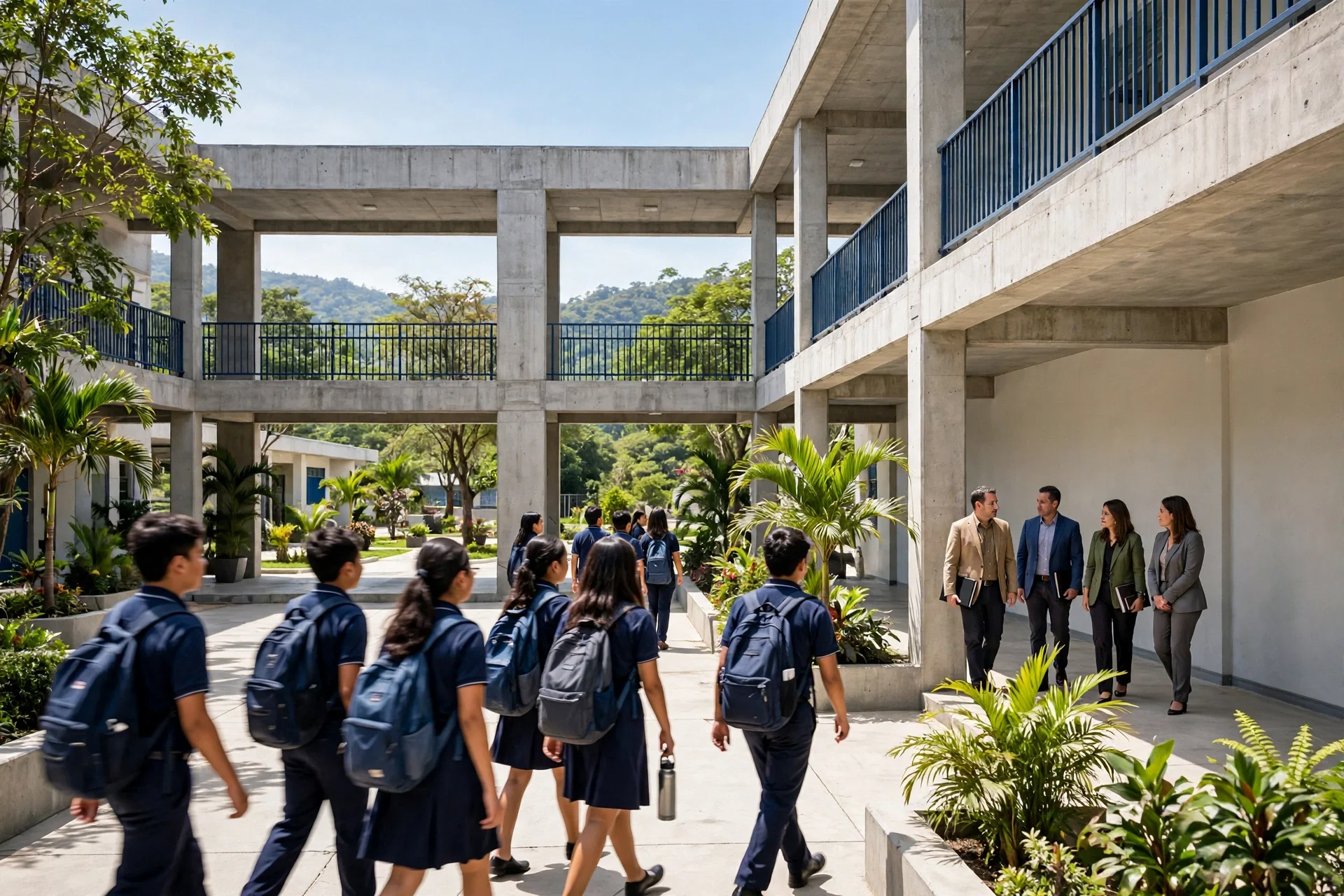
Imagen alusiva a un colegio público salvadoreño durante una visita oficial. · Imagen generada por EPM
Fujimori visits Salvadoran school and studies technology model
Keiko Fujimori toured a renovated public school in Santa Tecla, El Salvador, observed its technology model for more than one hundred children, and proposed…
Peru studies Salvadoran classrooms built with order and technology
The Peruvian president visited in El Salvador a school built by trust phase inmates, praised its combination of technology, order and discipline, and announced…
--- The context ---
The visit by Peru's President Keiko Fujimori to a public school in El Salvador placed a subject that rarely leads diplomatic headlines at the center of a bilateral agenda: how students learn inside a state classroom when resources are limited and technology has not yet reached every territory. The tour took place at the Marcelino García Flamenco School Center in Santa Tecla, one of the schools renovated under the initiative identified as 2EscuelasXDía, which now operates as a hub of innovation within the Salvadoran public system.
The context matters because Fujimori herself linked the visit to a concrete need in her own country. As she explained during the trip, many Peruvian state schools, particularly those located in areas far from urban centers, still face shortcomings in both infrastructure and teaching tools, and students there lack computers and screens to access digital content. Against that diagnosis, seeing first hand an experience that combines renovated buildings, interactive learning and individual follow-up appeared as a practical reference, not merely as a protocol gesture between governments seeking closer ties.
--- The facts ---
Fujimori toured the Marcelino García School accompanied by El Salvador's Minister of Education, Science and Technology, Karla Trigueros, and observed the technology-based teaching model that the center applies to more than one hundred children. During the tour she greeted a student who was working in front of a laptop with headphones, and the child showed her the digital learning method used at the school. On an additional screen, geography content was displayed, including references to kilometers, territorial extension and landmarks of the country, which students explore interactively to identify the most important places in El Salvador.
The building that was visited also has a feature that distinguishes it from a conventional school project. According to the information shared during the visit, it was built entirely by low-risk inmates, people with short sentences who entered the so-called trust phase program, through which they can reduce their time in prison in exchange for work on projects of public interest. The result brings together in a single physical space two policies that are usually managed separately: prison reintegration and school modernization, in a school that is home to approximately more than one hundred children.
--- The positions ---
The Peruvian president publicly praised the Salvadoran education plan and argued, in statements attributed during the meeting, that the plan is already producing results and that PISA test examinations show the major progress being made. She also thanked President Nayib Bukele and Minister Trigueros for the presentation of the plan, and said that she had liked what she saw very much, while acknowledging that implementing it in Peru would take a little time. In her framing, artificial intelligence can have a very strong and still unknown dimension, but El Salvador is using it in a very positive way by establishing the corresponding safeguards.
On the Salvadoran side, Trigueros's presence expressed an institutional philosophy defined the previous night by Bukele himself in his meeting with Fujimori: schools must combine technological innovation with order and discipline. The appointment of an army captain to lead education translates that idea into institutional terms. That same appointment, however, generated questions in the teaching sector. Francisco Zelada, general secretary of the Union of Teachers of Public Education, pointed out that no prior experience in educational management could be identified in the minister's profile, an objection recorded as part of the debate over her appointment.
--- What remains unknown ---
The operational detail of how Peru would adapt what was observed to its own school network is not yet known, nor are the timelines, costs or selection criteria for the first centers that would receive a similar scheme. The source describes the delegation's intention and interest, but it does not provide a signed agreement, an execution schedule or an independent evaluation of the impact of the Salvadoran model beyond the reference to the PISA test mentioned by Fujimori. It also does not specify how satellite connectivity would be financed in remote areas or how teachers would be trained to sustain the proposed daily follow-up.
--- Unanswered questions ---
In what concrete timelines could Peru build and interconnect the announced schools, and with what financing would that expansion be sustained over time? How will it be ensured that support through artificial intelligence respects clear safeguards for students and does not replace the work of teachers in the classroom? What public evaluation will make it possible to verify whether the model of fast modular construction and interactive learning effectively improves learning in rural and remote contexts?
--- EPM analysis ---
The visit makes it possible to read a practical convergence between two agendas that are presented as different but share an underlying problem: the state needs to deliver quality services to territories where infrastructure arrives late. El Salvador is showing a school built by inmates in the trust phase, renovated under an intensive program and oriented toward interactive digital content. Peru, according to its president, seeks to modernize remote state schools and compensate for historic shortcomings with connectivity and personalized follow-up. The value of the visit lies in that concrete exchange on methods, construction times and teacher training, more than in the courtesy statements typical of an official tour.
Trigueros's trajectory adds another layer to the analysis. Born on April 28, 1990 in Sonzacate, in the department of Sonsonate, she entered at age 16 as a cadet at the Captain General Gerardo Barrios Military School, graduated as a doctor in medicine in 2016 from the Salvadoran University Alberto Masferrer, the same year she received the rank of second lieutenant, served as deputy head of outpatient services at the Central Military Hospital and, since 2019, as medical adviser to the Military Health Command. During the COVID-19 pandemic she led the national vaccination logistics, and on August 14, 2025 she was appointed minister, becoming the first person with military training to lead that portfolio in more than five decades. That biography explains both the bet on order and the controversy over specifically educational experience.
📌 EPM Take:
In EPM's view, the most relevant aspect of the visit is not the photograph in a renovated classroom, but the verifiable possibility that two countries with limited resources can share applicable solutions on infrastructure, connectivity and follow-up for each student. If Peru manages to build the announced 500 schools, interconnect them through satellite internet and train its teachers to use artificial intelligence with clear safeguards, the Salvadoran reference will have served as useful learning and not only as inspiration. Follow-up should measure learning outcomes, school retention and territorial equity with public data that can be compared over time.
--- The context ---
Peru's President Keiko Fujimori visited a public school in El Salvador as part of her official visit, accompanied by the Minister of Education, Science and Technology, Karla Trigueros. The school chosen was the Marcelino García Flamenco School Center in Santa Tecla, one of the schools renovated under the 2EscuelasXDía initiative. The tour was not accidental: the president arrived with the specific interest of learning how El Salvador integrates technology into publicly managed classrooms and how it combines that modernization with an idea of order and discipline in schools.
That interest responds to a challenge that Fujimori herself raised during her meeting with President Nayib Bukele. As she explained, one of her priority objectives is to modernize Peruvian state schools, particularly those located in areas far from urban centers, where shortcomings persist in both infrastructure and teaching tools. In many of those establishments students do not have computers or screens to access digital content, so an experience that joins fast construction, interactive content and teacher training is directly relevant to the Peruvian debate on how to deliver improvements without indefinite delays.
--- The facts ---
During the tour, Fujimori closely observed the technology-based teaching model that the center applies to more than one hundred children. She greeted one of the students who was working in front of a laptop with headphones, and the child showed her the digital learning method used at the school. On an additional screen, geography content is displayed, including kilometers, territorial extension and landmarks of the Central American country, which students explore interactively to identify the most important places in El Salvador, as was observed in the sequence of the meeting.
The school that was visited also represents one of the most distinctive bets of the Bukele government, because the building was built entirely by low-risk inmates. They are people with short sentences who entered the so-called trust phase program, through which they can reduce their time in prison in exchange for work on projects of public interest. The result is an establishment that combines social reintegration with educational modernization and that currently houses approximately more than one hundred children, functioning as a hub of technological innovation within the Salvadoran education system.
--- The positions ---
Fujimori praised the educational modernization program that El Salvador is implementing through artificial intelligence and publicly thanked President Bukele and Minister Trigueros for the presentation of the entire education plan. In statements attributed during the meeting, she argued that the plan is already producing results and that PISA test examinations show the major progress being made. She added that she had liked what she saw very much and that, although it would take a little time to implement it in Peru, she considers it essential to have individual support for each student through technological tools combined with the presence of teachers.
The Peruvian explanation included a concrete announcement: Peru plans to build 500 schools next year and interconnect them through satellite internet, in a scheme that seeks to combine the presence of teachers with support from artificial intelligence tools for the daily follow-up of student progress. Fujimori stressed that artificial intelligence can have a very strong and unknown dimension, but that El Salvador uses it in a very positive way by establishing the corresponding safeguards. Against that assessment, the questioning recorded in the source comes from the Salvadoran teachers' union sphere: Francisco Zelada, general secretary of the Union of Teachers of Public Education, pointed out that no prior experience in educational management could be identified in Trigueros's profile.
--- What remains unknown ---
The available information does not detail the budget, the procurement calendar or the order of priority with which Peru would carry out the construction of the announced schools, nor does it specify how satellite connectivity in remote areas would be sustained over time. The intention to replicate modular constructions of fast execution is known, but no technical document is provided that compares costs, timelines and standards between the Salvadoran model and Peruvian conditions. Without those data, the transfer of the experience still remains in the terrain of political intention and institutional learning.
--- Unanswered questions ---
Will Peru be able to carry out the construction of 500 schools within the announced timeframe while maintaining standards of quality and transparency in each project? What concrete safeguards will be established for the use of artificial intelligence in the daily follow-up of students, and who will supervise them independently? How will it be measured, with public indicators, whether the combination of order, discipline, technology and teacher training produces better learning than previous models?
--- EPM analysis ---
The Salvadoran case visited by Fujimori brings together three elements that explain its appeal as a management reference. First, a school project carried out by low-risk inmates in the trust phase, linking reintegration with a visible benefit for the community. Second, a classroom where learning is supported by screens and interactive tours, directly observable by a foreign delegation. Third, a ministerial leadership that embodies the philosophy set out by Bukele the previous night in his meeting with the Peruvian president: schools must combine technological innovation with order and discipline, a formula that the Salvadoran government presents as a condition for modernization not to be dispersed.
The figure of Karla Edith Trigueros concentrates that approach. Born on April 28, 1990 in Sonzacate, in the department of Sonsonate, she entered at age 16 as a cadet at the Captain General Gerardo Barrios Military School, an institution historically dominated by men. She obtained a scholarship to study medicine at the Salvadoran University Alberto Masferrer, graduated as a doctor in 2016, the same year she received the rank of second lieutenant, served as deputy head of outpatient services at the Central Military Hospital and, since 2019, as medical adviser to the Military Health Command. She led the national vaccination logistics during the COVID-19 pandemic and was appointed minister on August 14, 2025, the first person with military training to lead that portfolio in more than five decades. Her visiting delegation included Miriam Ponce, vice minister of Pedagogical Management, and Pedro Morales, director of the National Program for Educational Infrastructure, interested in fast modular constructions.
📌 EPM Take:
In EPM's view, the visit leaves a management lesson that goes beyond political affinity between governments: without order in execution, without trained teachers and without daily follow-up, technology in the classroom becomes equipment without purpose. El Salvador offers Peru an observable case of fast construction, interactive classrooms and firm leadership, and Peru announces an ambitious scale with 500 schools connected through satellite internet. The definitive test will not be in the announcement, but in meeting deadlines, publishing costs, sustaining teacher training and demonstrating with transparent evaluations that each student learns more and better.
Fujimori visita colegio en El Salvador y estudia modelo tecnológico
Keiko Fujimori recorrió en Santa Tecla un colegio público renovado en El Salvador, observó su modelo tecnológico para más de cien niños y planteó replicar en…
Perú observa en El Salvador aulas tecnológicas y disciplina escolar
La presidenta peruana visitó en El Salvador un colegio construido por internos en fase de confianza, valoró su combinación de tecnología, orden y disciplina, y…
--- El contexto ---
La visita de la presidenta de Perú, Keiko Fujimori, a un colegio público en El Salvador puso en el centro de la agenda bilateral un tema que suele quedar fuera de los titulares diplomáticos: cómo se aprende dentro de un aula estatal cuando los recursos son limitados y la tecnología todavía no llega a todos los territorios. El recorrido se realizó en el Centro Escolar Marcelino García Flamenco, en Santa Tecla, un establecimiento que forma parte de las escuelas renovadas por la iniciativa identificada como 2EscuelasXDía y que hoy funciona como un nodo de innovación dentro del sistema público salvadoreño.
El contexto importa porque la propia mandataria peruana vinculó la visita con una necesidad concreta en su país. Según lo expuesto durante la gira, en muchas escuelas estatales peruanas, sobre todo en zonas alejadas de los centros urbanos, persisten carencias de infraestructura y de herramientas pedagógicas, y hay alumnos que no cuentan con computadoras ni pantallas para acceder a contenidos digitales.
--- Los hechos ---
Fujimori recorrió el Colegio Marcelino García acompañada por la ministra de Educación, Ciencia y Tecnología de El Salvador, Karla Trigueros, y observó el modelo de enseñanza tecnológica que el centro aplica a más de cien niños. Durante el recorrido saludó a un alumno que trabajaba frente a una computadora portátil con auriculares, y el menor le mostró el método de aprendizaje digital utilizado en el establecimiento. En una pantalla adicional se desplegaban contenidos de geografía, con referencias a los kilómetros, la extensión territorial y los puntos de referencia del país, que los estudiantes recorren de forma interactiva para identificar los lugares más importantes de El Salvador.
El edificio visitado tiene además una característica que lo distingue de una obra escolar convencional. De acuerdo con la información difundida durante la visita, fue construido íntegramente por internos de baja peligrosidad, personas con condenas cortas que accedieron al denominado programa de fase de confianza, mediante el cual pueden reducir su tiempo de prisión a cambio de trabajo en obras de interés público. El resultado reúne en un mismo espacio físico dos políticas que habitualmente se gestionan por separado: la reinserción penitenciaria y la modernización escolar, con un colegio que alberga a aproximadamente más de cien niños.
--- Las posiciones ---
La mandataria peruana valoró de forma pública el plan educativo salvadoreño y sostuvo, en declaraciones atribuidas durante el encuentro, que ese plan ya viene dando resultados y que los exámenes de la prueba PISA muestran el avance que se está teniendo. También agradeció al presidente Nayib Bukele y a la ministra Trigueros por la presentación del plan, y afirmó que le había gustado muchísimo lo observado, aunque reconoció que implementarlo en Perú demoraría un poco. En su planteamiento, la inteligencia artificial puede tener una dimensión muy fuerte y todavía desconocida, pero El Salvador la estaría utilizando de manera positiva al establecer los resguardos correspondientes.
Del lado salvadoreño, la presencia de Trigueros expresó una filosofía institucional definida la noche anterior por el propio Bukele en su reunión con Fujimori: los colegios deben combinar innovación tecnológica con orden y disciplina. La designación de una capitana del ejército para conducir la educación traduce esa idea en términos institucionales. Sin embargo, esa misma designación generó cuestionamientos en el sector docente. El secretario general del Sindicato de Maestras y Maestros de la Educación Pública, Francisco Zelada, señaló que en el perfil de la ministra no se identificaba experiencia previa en gestión educativa, una objeción que quedó registrada como parte del debate sobre su nombramiento.
--- Lo que falta saber ---
Todavía no se conoce el detalle operativo de cómo Perú adaptaría lo observado a su propia red escolar, ni los plazos, costos o criterios de selección de los primeros centros que recibirían un esquema similar. La fuente describe la intención y el interés de la delegación, pero no aporta un convenio firmado, un cronograma de ejecución ni una evaluación independiente del impacto del modelo salvadoreño más allá de la referencia a la prueba PISA mencionada por Fujimori. Tampoco se precisa cómo se financiaría la conectividad satelital en zonas remotas ni cómo se formaría a los docentes para sostener el seguimiento diario que se propone.
--- Preguntas sin respuesta ---
¿En qué plazos concretos podría Perú construir e interconectar los colegios anunciados y con qué financiamiento se sostendría esa expansión? ¿Cómo se garantizará que el acompañamiento con inteligencia artificial respete resguardos claros para los estudiantes y no sustituya el trabajo de los maestros en el aula? ¿Qué evaluación pública permitirá comprobar si el modelo de construcciones modulares rápidas y de aprendizaje interactivo mejora efectivamente los aprendizajes en contextos rurales y alejados?
--- Análisis EPM ---
La visita permite leer una convergencia práctica entre dos agendas que se presentan como distintas pero que comparten un problema de fondo: el Estado necesita llegar con servicios de calidad a territorios donde la infraestructura llega tarde. El Salvador muestra un colegio levantado por internos en fase de confianza, renovado dentro de un programa de ritmo intensivo y orientado a contenidos digitales interactivos. Perú, según lo expuesto por su presidenta, busca modernizar escuelas estatales alejadas y compensar carencias históricas con conectividad y seguimiento personalizado. El valor de la visita está en ese intercambio concreto sobre métodos, tiempos de obra y formación docente, más que en las declaraciones de cortesía propias de una gira oficial.
La trayectoria de Trigueros añade otra capa al análisis. Nacida el 28 de abril de 1990 en Sonzacate, departamento de Sonsonate, ingresó a los 16 años como cadete en la Escuela Militar Capitán General Gerardo Barrios, se graduó como doctora en medicina en 2016 en la Universidad Salvadoreña Alberto Masferrer, el mismo año en que recibió el grado de subteniente, fue subjefa de consulta externa del Hospital Militar Central y desde 2019 asesora médica del Comando de Sanidad Militar. Durante la pandemia de COVID-19 lideró la logística nacional de vacunación, y el 14 de agosto de 2025 fue nombrada ministra, convirtiéndose en la primera persona con formación militar en conducir esa cartera en más de cinco décadas. Esa biografía explica tanto la apuesta por el orden como la controversia sobre la experiencia específicamente educativa.
📌 Conclusion EPM:
A juicio de EPM, lo más relevante de la visita no es la foto en un aula renovada, sino la posibilidad verificable de que dos países con recursos limitados compartan soluciones aplicables sobre infraestructura, conectividad y seguimiento de cada estudiante. Si Perú logra construir los 500 colegios anunciados, interconectarlos con internet satelital y formar a sus maestros para usar la inteligencia artificial con resguardos claros, la referencia salvadoreña habrá servido como aprendizaje útil y no solo como inspiración. El seguimiento deberá medir resultados de aprendizaje, permanencia escolar y equidad territorial con datos públicos y comparables en el tiempo.
--- El contexto ---
La presidenta de Perú, Keiko Fujimori, visitó un colegio público en El Salvador en el marco de su visita oficial, acompañada por la ministra de Educación, Ciencia y Tecnología, Karla Trigueros. El establecimiento elegido fue el Centro Escolar Marcelino García Flamenco, en Santa Tecla, una de las escuelas renovadas por la iniciativa 2EscuelasXDía. El recorrido no fue casual: la mandataria llegó con el interés específico de conocer cómo El Salvador integra tecnología en aulas de gestión pública y cómo combina esa modernización con una idea de orden y disciplina en los centros escolares.
Ese interés responde a un desafío que la propia Fujimori planteó durante su reunión con el presidente Nayib Bukele. Según lo expuesto, uno de sus objetivos prioritarios es modernizar los colegios estatales peruanos, en particular los ubicados en zonas alejadas de los centros urbanos, donde persisten carencias de infraestructura y de herramientas pedagógicas.
--- Los hechos ---
Durante la recorrida, Fujimori observó de cerca el modelo de enseñanza tecnológica que el centro aplica a más de cien niños. Saludó a uno de los alumnos que trabajaba frente a una computadora portátil con auriculares, y el niño le mostró el método de aprendizaje digital que utilizan en el establecimiento. En una pantalla adicional se despliegan contenidos de geografía, entre ellos los kilómetros, la extensión territorial y los puntos de referencia del país centroamericano, que los estudiantes recorren de forma interactiva para identificar los lugares más importantes de El Salvador, según se observó en la secuencia del encuentro.
El colegio visitado representa además una de las apuestas más singulares del gobierno de Bukele, porque el edificio fue construido íntegramente por internos de baja peligrosidad. Se trata de personas con condenas cortas que accedieron al denominado programa de fase de confianza, mediante el cual pueden reducir su tiempo de prisión a cambio de trabajo en obras de interés público. El resultado es un establecimiento que combina reinserción social con modernización educativa y que actualmente alberga a aproximadamente más de cien niños, funcionando como un nodo de innovación tecnológica dentro del sistema educativo salvadoreño.
--- Las posiciones ---
Fujimori elogió el programa de modernización educativa que El Salvador implementa a través de la inteligencia artificial y agradeció públicamente al presidente Bukele y a la ministra Trigueros por la presentación de todo el plan educativo. En declaraciones atribuidas durante el encuentro, sostuvo que ese plan ya viene dando resultados y que los exámenes de la prueba PISA muestran el gran avance que están teniendo. Añadió que le había gustado muchísimo lo visto y que, aunque demoraría un poco implementarlo en Perú, considera fundamental contar con un acompañamiento individual a cada estudiante mediante herramientas tecnológicas y presencia de maestros.
La explicación peruana incluyó un anuncio concreto: Perú prevé construir 500 colegios el próximo año e interconectarlos mediante internet satelital, en un esquema que busca combinar la presencia de maestros con el acompañamiento de herramientas de inteligencia artificial para el seguimiento diario del progreso de los alumnos. Fujimori remarcó que la inteligencia artificial puede tener una dimensión muy fuerte y desconocida, pero que El Salvador la utiliza de manera muy positiva al establecer los resguardos correspondientes. Frente a esa valoración, el cuestionamiento registrado en la fuente proviene del ámbito sindical docente salvadoreño: Francisco Zelada, secretario general del Sindicato de Maestras y Maestros de la Educación Pública, señaló que en el perfil de Trigueros no se identificaba experiencia previa en gestión educativa.
--- Lo que falta saber ---
La información disponible no detalla el presupuesto, el calendario de licitaciones ni el orden de prioridad con el que Perú ejecutaría la construcción de los colegios anunciados, ni tampoco precisa cómo se sostendrá en el tiempo la conectividad satelital en zonas alejadas. Se conoce la intención de replicar construcciones modulares de rápida ejecución, pero no se aporta un documento técnico que compare costos, plazos y estándares entre el modelo salvadoreño y las condiciones peruanas. Sin esos datos, la transferencia de la experiencia queda todavía en el terreno de la intención política y del aprendizaje institucional.
--- Preguntas sin respuesta ---
¿Podrá Perú ejecutar la construcción de 500 colegios en el plazo anunciado manteniendo estándares de calidad y transparencia en cada obra? ¿Qué resguardos concretos se establecerán para el uso de inteligencia artificial en el seguimiento diario de los alumnos y quién los supervisará de forma independiente? ¿Cómo se medirá, con indicadores públicos, si la combinación de orden, disciplina, tecnología y capacitación docente produce mejores aprendizajes que los modelos anteriores?
--- Análisis EPM ---
El caso salvadoreño visitado por Fujimori reúne tres elementos que explican su atractivo como referencia de gestión. Primero, una obra escolar ejecutada por internos de baja peligrosidad en fase de confianza, que vincula reinserción con un beneficio visible para la comunidad. Segundo, un aula donde el aprendizaje se apoya en pantallas y recorridos interactivos, observable directamente por una delegación extranjera. Tercero, una conducción ministerial que encarna la filosofía expuesta por Bukele la noche anterior en su reunión con la mandataria peruana: los colegios deben combinar innovación tecnológica con orden y disciplina, una fórmula que el gobierno salvadoreño presenta como condición para que la modernización no se disperse.
La figura de Karla Edith Trigueros concentra ese enfoque. Nacida el 28 de abril de 1990 en Sonzacate, departamento de Sonsonate, ingresó a los 16 años como cadete en la Escuela Militar Capitán General Gerardo Barrios, institución históricamente dominada por hombres. Obtuvo una beca para estudiar medicina en la Universidad Salvadoreña Alberto Masferrer, se graduó como doctora en 2016, el mismo año en que recibió el grado de subteniente, fue subjefa de consulta externa del Hospital Militar Central y desde 2019 asesora médica del Comando de Sanidad Militar. Lideró la logística nacional de vacunación durante la pandemia de COVID-19 y fue nombrada ministra el 14 de agosto de 2025, primera persona con formación militar al frente de esa cartera en más de cinco décadas. Su delegación visitante incluyó a Miriam Ponce, viceministra de Gestión Pedagógica, y a Pedro Morales, director del Programa Nacional de Infraestructura Educativa, interesados en construcciones modulares rápidas.
📌 Conclusion EPM:
A juicio de EPM, la visita deja una lección de gestión que trasciende la afinidad política entre gobiernos: sin orden en la ejecución, sin docentes capacitados y sin seguimiento diario, la tecnología en el aula se convierte en equipamiento sin propósito. El Salvador ofrece a Perú un caso observable de obra rápida, aulas interactivas y conducción firme, y Perú anuncia una escala ambiciosa con 500 colegios conectados por internet satelital. La prueba definitiva no estará en el anuncio, sino en cumplir plazos, publicar costos, sostener la formación docente y demostrar con evaluaciones transparentes que cada estudiante aprende más y mejor.