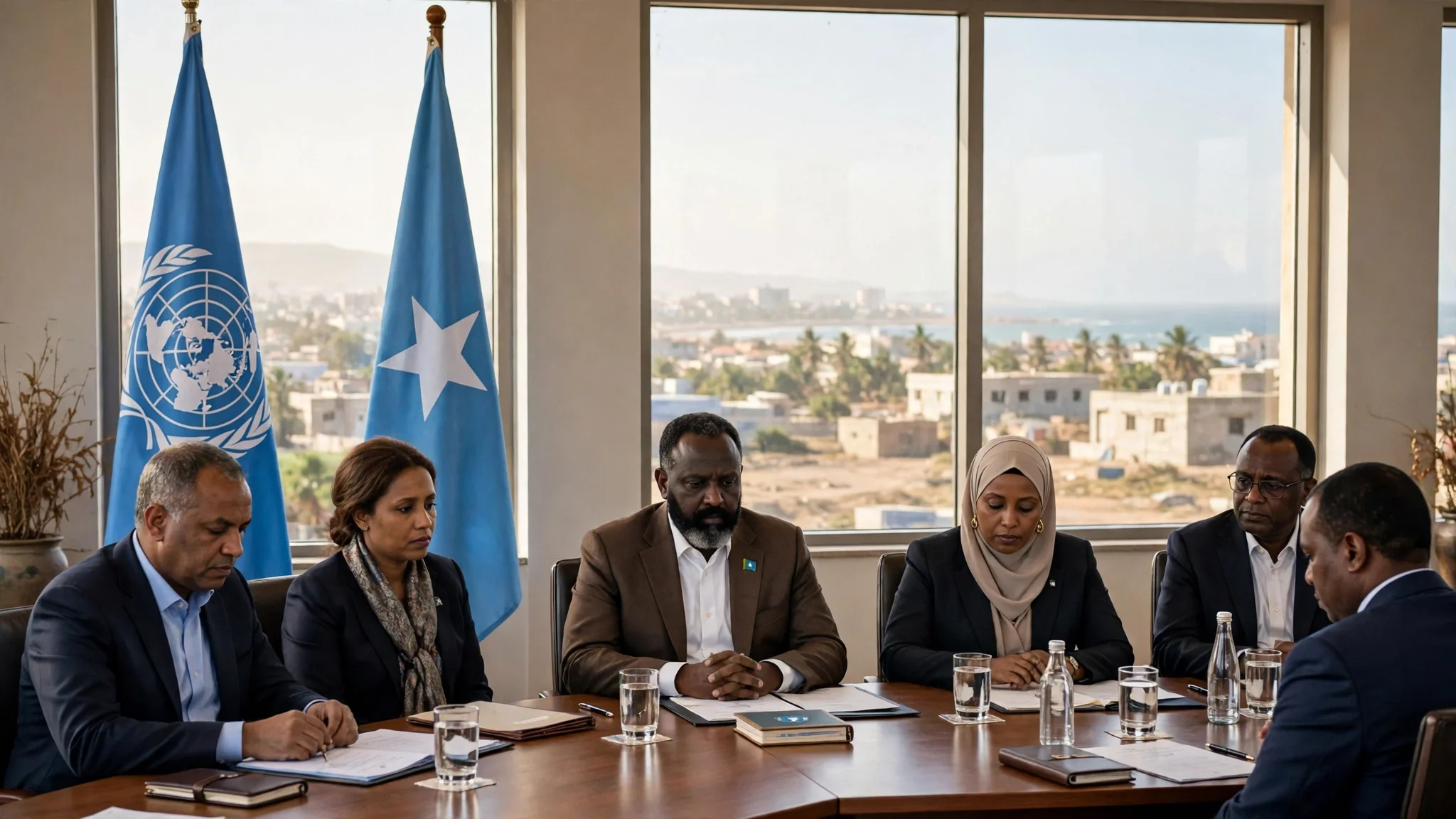
Imagen alusiva al cierre de la misión política en Somalia. · Imagen generada por EPM
Somalia takes charge as UN political mission closes after decades
The UN political mission in Somalia, UNTMIS, closes on 31 October after three decades, and Somali institutions take full responsibility for the recovery with…
UN political mission ends in Somalia as local institutions take over
UNTMIS closes on 31 October after three decades of UN political missions, handing full responsibility for recovery to Somali national and federal institutions…
--- The context ---
Somalia has undergone a profound transformation since the early 1990s, when the collapse of central State institutions and the outbreak of civil war ushered in years of conflict, instability and humanitarian crises. The conflict sparked a major outflow of refugees and internal displacements, compounded by insecurity, contested electoral processes and recurrent climatic shocks including droughts and floods.
--- The facts ---
The UN Transitional Assistance Mission in Somalia, known as UNTMIS, wraps up its work this Saturday and closes on 31 October, ending three decades of UN political missions in the Horn of Africa country. Successive missions accompanied Somalia through critical stages of peacebuilding and State-building, supporting Somali-led efforts to restore governance, rebuild institutions and foster national reconciliation.
With the end of UNTMIS, Somali institutions will now take on the full responsibility for recovery, with support from agencies already working in the country. Some 25 UN entities are still working across Somalia on humanitarian and development support, so the political closure is not a complete departure.
--- The positions ---
Raisedon Zenenga, the Secretary-General's Deputy Special Representative for Somalia, said in attributed remarks that while significant challenges remain, the closure comes after considerable progress since the early years of international efforts. He noted in indirect terms that Somalia today possesses national and federal institutions that did not exist when the engagement began, with progress in State formation, political inclusion, constitutional processes, human rights frameworks and governance enabling Somali-led decision-making. Continued international engagement, he added, will remain important.
In Balcad, a run-down vegetable market received a makeover with 56 sturdy stalls, running water and solar lighting, and about 70 per cent of the stalls went to women-headed households, women-led businesses and small enterprises. In Puntland, a school meals programme links 1,330 local farmers and fisherfolk to schools serving 18,700 children.
--- What remains unknown ---
The humanitarian affairs office calls the situation one of the world's most complex crises, where conflict and climate shocks keep feeding each other. This year, 4.8 million Somalis, out of a population of just under 20 million, need humanitarian help. Aid agencies are asking for $852 million to reach 2.4 million people, just half of those in need, and by mid-October only about 35 per cent of that had arrived.
--- Unanswered questions ---
Can Somali institutions sustain the recovery on their own after the political mission closes? Will the missing humanitarian funding arrive in time to reach the people agencies plan to help? Will a gradual and sustainable security transition advance against the threat from Al-Shabaab? How will leaders tackle poverty in an economy that imports more than 90 per cent of its essential goods?
--- EPM analysis ---
The closure shifts the centre of gravity to full Somali responsibility without ending humanitarian and development support. National guidelines on caring for newborns, mine action teaching in Baidoa for hundreds of students and teachers, and school meals in Puntland all show support continuing on the ground. Poverty, however, stands out as the huge challenge facing the country's leaders after October.
📌 EPM Take: In EPM's view, the end of the political mission should be read not as a departure but as a demanding test of the institutions Somalia has built over three decades. Those institutions did not exist when the engagement began, yet humanitarian needs remain vast and funding is only partly delivered. The new chapter will be judged by whether Somali leadership, backed by continued international engagement, can turn partnership and persistence into effective governance, steadier security and real relief from poverty for ordinary families.
--- The context ---
Since the early 1990s, when central State institutions collapsed and civil war broke out, Somalia endured years of conflict, instability and humanitarian crises that drove a major outflow of refugees and internal displacements. Ongoing insecurity, contested electoral processes and constitutional reform, as well as recurrent climatic shocks including droughts and floods, compounded humanitarian needs and presented formidable challenges to recovery.
--- The facts ---
The UN Transitional Assistance Mission in Somalia, known as UNTMIS, wraps up its work this Saturday, closing on 31 October and bringing three decades of UN political missions in the country to an end. From now on, Somali institutions will take on the full responsibility for recovery, with support from agencies already working in the country.
The United Nations is not leaving altogether: humanitarian and development agencies continue to support Somalia and its people, and some 25 UN entities are still working across the country on humanitarian and development support.
--- The positions ---
Deputy Special Representative Raisedon Zenenga said in attributed remarks that the story of the political engagement has been one of persistence, partnership and adaptation, and that today is not an end to the partnership but the conclusion of one chapter and the beginning of another. He noted in indirect terms that Somalia today possesses national and federal institutions that did not exist when the engagement began, with progress in State formation, political inclusion, constitutional processes, human rights frameworks and governance structures enabling Somali-led decision-making.
The Secretary-General also wants continued support to tackle the threat from the terror group Al-Shabaab and to help Somalia move to a gradual, sustainable security transition. In Baidoa, mine action experts helped Somali authorities teach hundreds of students and teachers how to spot explosive dangers, while national guidelines were launched on caring for newborns, including babies who are small or sick.
--- What remains unknown ---
The humanitarian affairs office calls the situation one of the world's most complex crises. This year, 4.8 million Somalis need humanitarian help, out of a population of just under 20 million, and aid agencies are asking for $852 million to reach 2.4 million people, just half of those in need. By mid-October, only about 35 per cent of that funding had arrived. In Puntland, nearly a million children are out of school.
--- Unanswered questions ---
Will Somali institutions carry the full weight of recovery without a political mission beside them? Will donors deliver the funding still missing to reach at least the 2.4 million people targeted? Can a gradual security transition hold against the threat posed by Al-Shabaab over time? How will the country reduce poverty while importing more than 90 per cent of its essential goods?
--- EPM analysis ---
The central legacy of these three decades is institutional: a State that once lacked national and federal structures now has them, which is precisely what makes an orderly handover possible. The renovated market in Balcad, with 56 stalls and about 70 per cent allocated to women-headed households and women-led businesses, shows concrete development work that remains. Yet the economy is still fragile, leaning on subsistence farming, livestock, remittances and pastoralism.
📌 EPM Take: In EPM's view, handing full responsibility to Somali institutions is the logical outcome of three decades of State-building and should be protected with discipline and well-directed external support. Closing the political mission does not remove the risks: the terror threat, the humanitarian crisis and an economy dependent on imports all demand continuity and measurable results. If international engagement holds and local governance proves capable, this closure can mark the start of a more autonomous and accountable chapter for the country.
Somalia asume su recuperación al cerrar la misión política de la ONU
La misión política de Naciones Unidas en Somalia cierra el 31 de octubre tras tres décadas, y las instituciones somalíes asumen la plena responsabilidad de la…
Cierra la misión política en Somalia tras tres décadas de presencia
Tras tres décadas de misiones políticas, UNTMIS cierra el 31 de octubre y Somalia asume la responsabilidad plena de su recuperación con instituciones…
--- El contexto ---
Somalia ha vivido una transformación profunda desde principios de la década de 1990, cuando el colapso de las instituciones centrales del Estado y el estallido de la guerra civil abrieron años de conflicto, inestabilidad y crisis humanitarias, con una gran salida de refugiados y desplazamientos internos.
--- Los hechos ---
La Misión de Asistencia Transitoria de Naciones Unidas en Somalia, conocida como UNTMIS, concluye su labor este sábado 31 de octubre y con ello terminan tres décadas de misiones políticas en el país. Las misiones sucesivas acompañaron etapas críticas de consolidación de la paz y construcción del Estado, apoyando esfuerzos liderados por somalíes para restaurar la gobernanza, reconstruir instituciones y fomentar la reconciliación nacional.
A partir de ahora, las instituciones somalíes asumen la plena responsabilidad de la recuperación, con el apoyo de los organismos que ya trabajan en el país. Unas 25 entidades siguen presentes en apoyo humanitario y de desarrollo, por lo que el cierre político no significa una salida completa.
--- Las posiciones ---
El representante especial adjunto del secretario general, Raisedon Zenenga, sostuvo en indirecto que, aunque persisten desafíos importantes, el cierre llega tras un progreso considerable. Según explicó, Somalia cuenta hoy con instituciones nacionales y federales que no existían cuando comenzó el compromiso político, con avances en formación del Estado, inclusión política, procesos constitucionales, marcos de derechos humanos y gobernanza que permite decisiones lideradas por somalíes. También advirtió que el compromiso internacional continuo seguirá siendo importante.
En Balcad, un mercado de verduras fue renovado con 56 puestos sólidos, agua corriente e iluminación solar, y cerca del 70 por ciento se destinó a hogares encabezados por mujeres, negocios liderados por mujeres y pequeñas empresas. En Puntland, un programa de comidas escolares vincula a 1.330 agricultores y pescadores locales con escuelas que atienden a 18.700 niños.
--- Lo que falta saber ---
La situación humanitaria sigue siendo una de las crisis más complejas del mundo. Este año, 4,8 millones de somalíes, de una población de algo menos de 20 millones, necesitan ayuda. Las agencias solicitan 852 millones de dólares para llegar a 2,4 millones de personas, apenas la mitad de quienes la necesitan, y a mediados de octubre solo había llegado cerca del 35 por ciento de esa suma.
--- Preguntas sin respuesta ---
¿Podrán las instituciones somalíes sostener por sí solas la recuperación tras el cierre? ¿Llegará el financiamiento humanitario que aún falta para atender a millones de personas? ¿Avanzará la transición de seguridad gradual y sostenible frente a la amenaza de Al-Shabaab? ¿Cómo se reducirá la pobreza en una economía que importa más del 90 por ciento de sus bienes esenciales?
--- Análisis EPM ---
El cierre marca el paso a una responsabilidad plenamente somalí sin que desaparezca el respaldo humanitario y de desarrollo. Las guías nacionales para el cuidado de recién nacidos, las comidas escolares en Puntland y la formación contra peligros explosivos en Baidoa muestran un trabajo que continúa sobre el terreno, mientras la pobreza aparece como el gran desafío posterior a octubre.
📌 Conclusion EPM: A juicio de EPM, el cierre de la misión política no debe leerse como un abandono, sino como una prueba exigente de madurez institucional para Somalia. El país dispone hoy de estructuras que no tenía hace tres décadas, pero la ayuda humanitaria sigue financiada solo en parte y millones de personas dependen de ella. La nueva etapa será creíble si las instituciones somalíes convierten ese respaldo continuo en gobernanza efectiva, seguridad sostenida y alivio real frente a la pobreza que golpea a las familias.
--- El contexto ---
Desde principios de la década de 1990, cuando colapsaron las instituciones centrales del Estado y estalló la guerra civil, Somalia atravesó años de conflicto, inestabilidad y crisis humanitarias. La inseguridad persistente, los procesos electorales disputados, la reforma constitucional y los choques climáticos recurrentes, incluidas sequías e inundaciones, complicaron la recuperación del país.
--- Los hechos ---
La Misión de Asistencia Transitoria de Naciones Unidas en Somalia, conocida como UNTMIS, termina su trabajo este sábado 31 de octubre, fecha que pone fin a tres décadas de misiones políticas en el país. Las misiones sucesivas acompañaron etapas críticas de consolidación de la paz y construcción del Estado, apoyando esfuerzos liderados por somalíes para restaurar la gobernanza, reconstruir instituciones y fomentar la reconciliación nacional.
Con el fin de UNTMIS, las instituciones somalíes toman la responsabilidad completa de la recuperación, apoyadas por los organismos ya presentes. Unas 25 entidades permanecen trabajando en apoyo humanitario y de desarrollo.
--- Las posiciones ---
Raisedon Zenenga, representante especial adjunto del secretario general, afirmó en indirecto que persisten desafíos significativos, pero que el cierre llega tras un progreso considerable desde los primeros años del apoyo internacional. De acuerdo con su valoración, Somalia posee hoy instituciones nacionales y federales inexistentes al inicio del compromiso político, con progresos en formación del Estado, inclusión política, procesos constitucionales, marcos de derechos humanos y estructuras que habilitan decisiones lideradas por somalíes. También señaló que el compromiso internacional continuo seguirá siendo importante.
El secretario general, por su parte, quiere apoyo continuo para enfrentar la amenaza del grupo terrorista Al-Shabaab y avanzar hacia una transición de seguridad gradual y sostenible. En Baidoa, expertos en acción contra minas ayudaron a las autoridades a enseñar a cientos de estudiantes y docentes a identificar peligros explosivos, y se lanzaron guías nacionales para el cuidado de recién nacidos, incluidos bebés pequeños o enfermos.
--- Lo que falta saber ---
La oficina de asuntos humanitarios describe la situación como una de las crisis más complejas del mundo, donde el conflicto y los choques climáticos se refuerzan mutuamente. Este año, 4,8 millones de somalíes necesitan ayuda, de una población de algo menos de 20 millones. Las agencias piden 852 millones de dólares para alcanzar a 2,4 millones de personas, solo la mitad de quienes la necesitan, y a mediados de octubre había llegado apenas en torno al 35 por ciento.
--- Preguntas sin respuesta ---
¿Resistirán las instituciones somalíes la carga completa de la recuperación sin una misión política presente? ¿Se completará el financiamiento para atender al menos a los 2,4 millones de personas previstos? ¿Podrá concretarse una transición de seguridad gradual frente a Al-Shabaab sin retrocesos? ¿Cómo enfrentará el país la pobreza importando más del 90 por ciento de sus bienes esenciales?
--- Análisis EPM ---
El orden institucional construido en tres décadas es el activo central que deja esta etapa. El mercado de Balcad, con 56 puestos y cerca del 70 por ciento para hogares y negocios encabezados por mujeres, y el programa que vincula a 1.330 agricultores y pescadores con escuelas de 18.700 niños en Puntland ilustran el desarrollo concreto que continúa. La economía, sin embargo, sigue frágil.
📌 Conclusion EPM: A juicio de EPM, el traspaso ordenado a las instituciones somalíes es la consecuencia lógica de tres décadas de construcción estatal y debe preservarse con disciplina y respaldo externo bien dirigido. Cerrar la misión política no elimina los riesgos: la amenaza terrorista, la crisis humanitaria y una economía dependiente de las importaciones exigen continuidad y resultados medibles. Si el apoyo internacional se mantiene y la gobernanza local demuestra capacidad, el cierre puede convertirse en el inicio de una etapa de mayor autonomía y responsabilidad compartida.