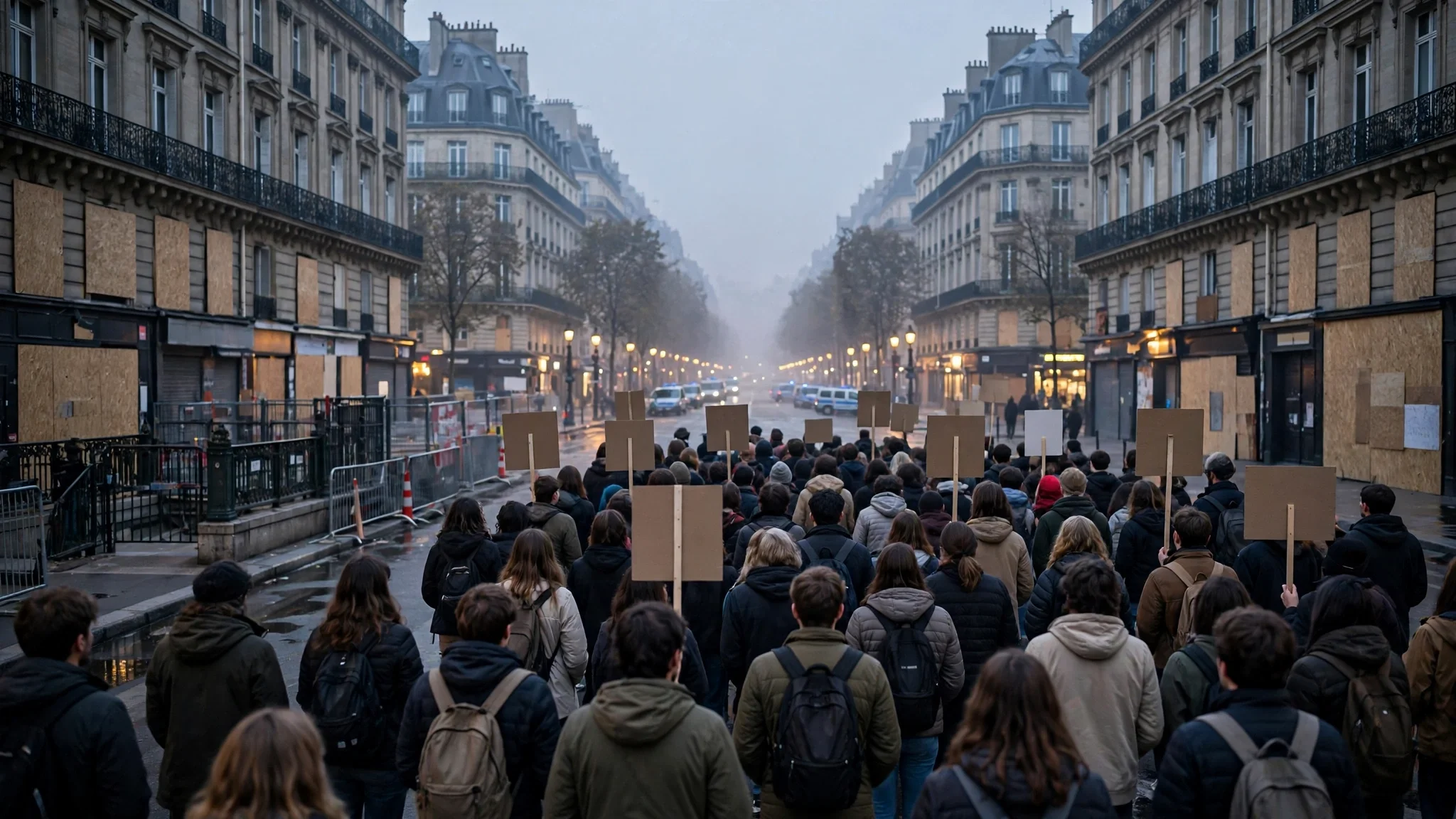
Imagen alusiva: manifestantes en un bulevar parisino con escaparates protegidos durante la jornada de protestas.
France sees another day of protests with clashes and arrests
France lived its third consecutive Saturday of protests over the cost of living and public services, with largely calm marches, clashes late in the day in…
Clashes and arrests mark a new day of protests across France
The third consecutive Saturday of protests in France proceeded generally calmly but ended with clashes in several cities, more than two hundred and ninety…
--- The context --- France went through another nationwide day of mobilization this Saturday, the third in a row, driven by the high cost of living and the deterioration of public services. The wave began in late September with blockades at secondary schools over the decline of public education and later spread to university students, unions and other groups demanding concrete answers from the government.
The main march set off from Porte de Bagnolet, at the eastern edge of Paris, along a limited route. The Council of State ruled in favor of the government and the police prefecture, which opposed a more central route between the Bastille and Nation squares. For student organizations, the limitation seeks to deactivate the protest without answering the demands behind it.
--- The facts --- The marches proceeded in relative calm, but late in the afternoon clashes broke out between police and demonstrators in Paris, Marseille, Rennes, Lyon, Nantes and Toulouse. Security forces used tear gas and water cannons where groups of participants refused to disperse. An international agency reported that some demonstrators used hammers to pull up cobblestones and throw them at the police, and that at least one incendiary device was launched against the security forces.
The turnout figures were again disputed. The Interior Ministry reported that more than two hundred and ninety people were detained across the country. The coalition of youth organizations and unions representing secondary school and university students said almost half a million people demonstrated throughout France, including two hundred thousand in Paris. The Interior Ministry and the police prefecture, by contrast, calculated some three hundred and twenty thousand participants nationwide, of whom seventy thousand were in the capital.
--- The positions --- The general secretary of the National Union of Students of France, Manon Moret, warned before the march that if the government keeps turning a deaf ear and refuses to answer the demands of young people, it will continue to face mobilizations. The student unions added that, with classes resuming on Monday after two weeks of All Saints holidays, they will reorganize the blockades from Tuesday and mobilize on the fifth, when a general strike has been called.
Lawyer David Libeskin, a national spokesperson of the yellow vests movement, also present at the protest, considered the route limitation a disproportionate restriction of the freedom to demonstrate. Interior Minister Laurent Nuñez justified the restrictions by the very high risk of new incidents, such as the chaos of the seventeenth of October, when three thousand shops were looted.
--- What remains unknown --- There is still no definitive account of the injured, of the damage or of how many of those detained will be brought before the courts. The morning in central Paris passed normally, albeit with an enormous police presence, about forty metro stations closed during the day, checks on passengers, aerial surveillance and plywood panels on storefronts of shops and bank branches in the center. There were also weekend curfews in several districts and a deployment of seventy thousand officers.
--- Unanswered questions --- Will the government offer any concrete answer to the demands on the cost of living and public services before the general strike on the fifth? Will the route limitations remain in place for the coming marches, or will more central itineraries be allowed? How will proportionality be ensured in an operation of seventy thousand officers when a largely calm day ends with clashes in several cities?
--- EPM analysis --- The day leaves two readings that coexist. Most marches proceeded for hours without serious incidents, a sign of broad and organized discontent. But the clashes at the end of the day, simultaneous in several cities, show that a minority ready for confrontation is enough to shift the focus from the demands to public order. The gap between the organizers figures and those of the authorities also reflects a political battle over the real size of the discontent.
📌 EPM Take: In EPM's view, the French government can limit routes, close stations and deploy seventy thousand officers, but none of those measures answers the underlying question raised by the students: who bears the cost of an ever more expensive life and of deteriorated public services. As long as the only answer is a police one, every half-orderly Saturday will prepare the next. The proportionality of the operation and respect for the freedom to demonstrate are not minor details; they are the boundary between containing a conflict and feeding it, week after week, before the whole country.
--- The context --- France faced this Saturday its third consecutive weekend of mobilizations, called over the high cost of living and the deterioration of public services,. The government entered the day with the precedent of the seventeenth of October, when three thousand shops were looted around a demonstration, and with warnings of radical calls on social media to provoke unrest during Halloween.
The main demonstration set off from Porte de Bagnolet, at the eastern edge of Paris, along a limited route. The Council of State ruled in favor of the government and the police prefecture against the more central route the organizers wanted. The yellow vests also sought to finish at Concorde.
--- The facts --- The demonstrations proceeded generally calmly for much of the day, but clashes erupted at the end of the marches in Paris, Marseille, Rennes, Lyon, Nantes and Toulouse, when groups of participants refused to disperse. Security forces responded with tear gas and water cannons. An international agency reported that some demonstrators used hammers to pull up cobblestones and throw them at the police, and that at least one incendiary device was launched against the security forces.
The Interior Ministry reported that more than two hundred and ninety people were detained. On turnout, the coalition of youth organizations and student unions said almost half a million people demonstrated throughout France, including two hundred thousand in Paris, while the Interior Ministry and the prefecture calculated some three hundred and twenty thousand participants nationwide, of whom seventy thousand were in the capital. To uphold order, the government deployed seventy thousand officers across the territory.
--- The positions --- Interior Minister Laurent Nuñez justified the restrictions by the very high risk of new incidents, in direct reference to the looting of the seventeenth of October. Along the same preventive line, curfews were imposed in areas such as Place de la République and the Châtelet-Les Halles shopping district, and unaccompanied minors will not be allowed to circulate from nine in the evening.
Against that position, the general secretary of the National Union of Students of France, Manon Moret, warned that if the government keeps turning a deaf ear to the demands of young people, it will continue to face mobilizations. Lawyer David Libeskin, a spokesperson of the yellow vests, considered that limiting the route disproportionately restricts the freedom to demonstrate. The student unions announced that, after classes resume on Monday, they will reorganize the blockades from Tuesday and mobilize on the fifth, in a general strike.
--- What remains unknown --- The definitive account of damage to shops, of the injured and of how many of those detained will be brought before the courts is not yet known. The morning in central Paris passed normally, albeit with an enormous police presence, about forty metro stations closed, checks on passengers in the capital and on the outskirts, aerial surveillance and plywood panels on the storefronts of a significant share of central shops and bank branches.
--- Unanswered questions --- How many of those detained will answer before the courts for the attacks with cobblestones and the incendiary device reported against the police? Will the shops protected with panels and curfews be able to operate without repeating the looting of the seventeenth of October? Will the government maintain the route restrictions if the calls for nighttime unrest are repeated at the coming gatherings?
--- EPM analysis --- The central fact is not only the protest, but its repeated ending: marches that advance calmly and groups that, at the end, refuse to disperse and turn several cities into simultaneous scenes of clashes. That pattern, added to the previous mass looting and the radical calls on social media, explains the scale of the deployment and the preventive measures over districts and shops. The right to demonstrate was exercised by hundreds of thousands of people, but it coexists with the right of residents and shopkeepers not to pay again the material cost of each gathering.
📌 EPM Take: In EPM's view, a protest that ends with cobblestones torn up with hammers and an incendiary device thrown against the police stops being only an expression of discontent and becomes a public order problem that the state has the duty to confront. The route restrictions, backed by the highest administrative institution in the country, and the protection of shops respond to real precedents of looting, not to a whim. Listening to social demands is an obligation, but no grievance gains legitimacy when the street is left in the hands of those seeking a clash.
Francia vive otra jornada de protestas con choques y detenciones
Francia vivió su tercer sábado consecutivo de protestas por el costo de vida y los servicios públicos, con marchas mayoritariamente calmadas, enfrentamientos…
Choques y detenciones marcan la nueva jornada de protestas en Francia
El tercer sábado consecutivo de protestas en Francia transcurrió en general en calma, pero terminó con enfrentamientos en varias ciudades, más de doscientas…
--- El contexto --- Francia vivió este sábado su tercer fin de semana consecutivo de movilizaciones, impulsadas por el alto costo de vida y el deterioro de los servicios públicos. La ola comenzó a finales de septiembre con bloqueos en institutos por el deterioro de la educación pública y se extendió después a estudiantes universitarios, sindicatos y otros colectivos que reclaman respuestas concretas del Gobierno.
La principal manifestación partió de la Puerta de Bagnolet, en el extremo este de París, con un recorrido limitado. El Consejo de Estado falló a favor del Gobierno y de la Prefectura de Policía, opuestos a un trayecto más céntrico entre las plazas de la Bastilla y de Nación. Para las organizaciones estudiantiles, la limitación busca desactivar la protesta sin responder a las reivindicaciones.
--- Los hechos --- Las marchas transcurrieron en general con relativa calma, pero al final de la tarde estallaron enfrentamientos entre policías y manifestantes en París, Marsella, Rennes, Lyon, Nantes y Toulouse. Las fuerzas de seguridad recurrieron a gases lacrimógenos y cañones de agua donde grupos de participantes se negaron a disolverse. Una agencia internacional reportó que algunos manifestantes usaron martillos para arrancar los adoquines y arrojárselos a la policía, y que se lanzó al menos un artefacto incendiario contra las fuerzas de seguridad.
Las cifras de participación volvieron a ser motivo de disputa. El Ministerio del Interior informó de que fueron detenidas más de doscientas noventa personas. La coalición de organizaciones juveniles y sindicatos de estudiantes de secundaria y universitarios indicó que casi medio millón de personas se manifestaron en Francia, incluidas doscientas mil en París. El Ministerio del Interior y la prefectura de policía calcularon en cambio unos trescientos veinte mil participantes en el país, de los cuales setenta mil en la capital.
--- Las posiciones --- La secretaria general de la Unión Nacional de Estudiantes de Francia, Manon Moret, advirtió antes de la marcha que si el Gobierno sigue haciendo oídos sordos y se niega a responder a las reivindicaciones de los jóvenes, seguirá siendo objeto de movilizaciones. Los sindicatos estudiantiles añadieron que, con la vuelta a las clases el lunes, reorganizarán los bloqueos desde el martes y se movilizarán el día cinco, cuando hay convocada una huelga general.
El abogado David Libeskin, portavoz nacional de los chalecos amarillos,, consideró que limitar el recorrido es una restricción desproporcionada de la libertad de manifestación. El ministro del Interior, Laurent Nuñez, justificó las restricciones por el muy alto riesgo de nuevos incidentes, como el caos del diecisiete de octubre, con tres mil comercios saqueados.
--- Lo que falta saber --- No hay todavía un balance definitivo de heridos, de daños ni de cuántas personas detenidas quedarán a disposición judicial. La mañana en el centro de París discurrió con normalidad, aunque con una enorme presencia policial, unas cuarenta estaciones de metro cerradas, controles a pasajeros, medios aéreos de vigilancia y paneles de contrachapado en escaparates de comercios y bancos del centro. Hubo toques de queda en varias zonas y un despliegue de setenta mil agentes.
--- Preguntas sin respuesta --- ¿Dará el Gobierno alguna respuesta concreta a las demandas sobre el costo de vida y los servicios públicos antes de la huelga general del día cinco? ¿Se mantendrán las limitaciones de recorrido en las próximas marchas o se permitirán trayectos más céntricos? ¿Cómo se garantizará la proporcionalidad de un operativo de setenta mil agentes cuando una jornada mayoritariamente calmada termina con enfrentamientos en varias ciudades?
--- Análisis EPM --- La jornada deja dos lecturas que conviven. La mayoría de las marchas transcurrió durante horas sin incidentes graves, señal de un malestar amplio y organizado. Pero los choques del final del día, simultáneos en varias ciudades, muestran que una minoría dispuesta a la confrontación basta para desplazar el foco desde las reivindicaciones hacia el orden público. La brecha entre las cifras de convocantes y autoridades refleja también una batalla política por el tamaño real del descontento.
📌 Conclusion EPM: A juicio de EPM, el Gobierno francés puede limitar recorridos, cerrar estaciones y desplegar setenta mil agentes, pero ninguna de esas medidas responde a la pregunta de fondo que plantean los estudiantes: quién asume el costo de una vida cada vez más cara y de unos servicios públicos deteriorados. Mientras la respuesta siga siendo solo policial, cada sábado ordenado a medias preparará el siguiente. La proporcionalidad del operativo y el respeto a la libertad de manifestación no son detalles menores, son la frontera entre contener un conflicto y alimentarlo semana tras semana ante todo el país.
--- El contexto --- Francia afrontó este sábado su tercer fin de semana consecutivo de movilizaciones, convocadas por el alto costo de vida y el deterioro de los servicios públicos,. El Gobierno llegó a la jornada con el antecedente del diecisiete de octubre, cuando en torno a una manifestación se saquearon tres mil comercios, y con avisos de llamamientos en redes sociales, atribuidos a grupos de extrema izquierda y otros colectivos radicalizados, para provocar disturbios, cometer saqueos y aprovechar Halloween para organizar concentraciones violentas, también por la noche.
La principal manifestación partió de la Puerta de Bagnolet, en el extremo este de París, con un recorrido limitado. El Consejo de Estado falló a favor del Gobierno y de la Prefectura de Policía frente al trayecto más céntrico que pedían los impulsores. Los chalecos amarillos, presentes en la protesta, reclamaban además concluir en Concorde, a los pies de los Campos Elíseos y cerca del Elíseo y de la Asamblea Nacional, pasando por la muy comercial zona de Ópera.
--- Los hechos --- Las manifestaciones transcurrieron en general en calma, pero al final de las marchas estallaron enfrentamientos en París, Marsella, Rennes, Lyon, Nantes y Toulouse, cuando grupos de participantes se negaron a disolverse. Las fuerzas de seguridad respondieron con gases lacrimógenos y cañones de agua. Una agencia internacional reportó que algunos manifestantes usaron martillos para arrancar los adoquines y arrojárselos a la policía, y que se lanzó al menos un artefacto incendiario contra las fuerzas de seguridad.
El Ministerio del Interior informó de que fueron detenidas más de doscientas noventa personas. Sobre la participación, la coalición de organizaciones juveniles y sindicatos de estudiantes indicó que casi medio millón de personas se manifestaron en Francia, incluidas doscientas mil en París, mientras el Ministerio del Interior y la prefectura calcularon unos trescientos veinte mil participantes en el país, de los cuales setenta mil en la capital. Para sostener el orden, el Gobierno desplegó un operativo excepcional de setenta mil agentes, con policías, gendarmes, unidades móviles, vehículos blindados, drones y helicópteros.
--- Las posiciones --- El ministro del Interior, Laurent Nuñez, justificó las restricciones por el muy alto riesgo de nuevos incidentes, en referencia directa a los saqueos del diecisiete de octubre. En la misma línea preventiva, se impusieron toques de queda en zonas como la plaza de la República y el área comercial de Châtelet-Les Halles, escenario de numerosos saqueos el fin de semana del diecisiete y el dieciocho de octubre, y los menores no acompañados no podrán circular desde las nueve de la noche en varios barrios de la capital.
Frente a ello, la secretaria general de la Unión Nacional de Estudiantes de Francia, Manon Moret, advirtió que si el Gobierno sigue haciendo oídos sordos ante las reivindicaciones de los jóvenes, seguirá siendo objeto de movilizaciones. El abogado David Libeskin, portavoz de los chalecos amarillos, consideró que limitar el recorrido restringe de forma desproporcionada la libertad de manifestación. Los sindicatos estudiantiles anunciaron que, tras la vuelta a las clases, reorganizarán los bloqueos desde el martes y se movilizarán el día cinco, en huelga general.
--- Lo que falta saber --- Aún no se conoce el balance definitivo de daños en comercios, de heridos ni de cuántas personas detenidas quedarán a disposición judicial. La mañana en el centro de París discurrió con normalidad, con una enorme presencia policial, unas cuarenta estaciones de metro cerradas, controles a pasajeros, vigilancia aérea y paneles de contrachapado en los escaparates de comercios y bancos del centro, instalados para parapetarse frente a posibles destrozos y saqueos.
--- Preguntas sin respuesta --- ¿Cuántos de los detenidos responderán ante la justicia por los ataques con adoquines y el artefacto incendiario reportados contra la policía? ¿Podrán los comercios protegidos con paneles y toques de queda trabajar sin repetir los saqueos del diecisiete de octubre? ¿Mantendrá el Gobierno las restricciones de recorrido si los llamamientos a disturbios nocturnos se repiten en las próximas convocatorias?
--- Análisis EPM --- El dato central no es solo la protesta, sino su desenlace repetido: marchas que avanzan en calma y grupos que al final se niegan a disolverse y convierten varias ciudades en escenarios simultáneos de choques. Ese patrón, sumado a los saqueos masivos previos y a los llamamientos radicales en redes, explica la dimensión del despliegue y las medidas preventivas sobre barrios y comercios concretos. El derecho a manifestarse se ejerció con cientos de miles de personas en la calle, pero convive con el derecho de vecinos y comerciantes a no pagar el costo material de cada convocatoria.
📌 Conclusion EPM: A juicio de EPM, una protesta que termina con adoquines arrancados a martillazos y un artefacto incendiario contra la policía deja de ser solo una expresión de malestar y se convierte en un problema de orden público que el Estado tiene el deber de enfrentar. Las restricciones de recorrido, avaladas por la más alta institución administrativa del país, y la protección de los comercios responden a antecedentes reales de saqueo, no a un capricho. Escuchar las demandas sociales es obligado, pero ninguna reivindicación gana legitimidad cuando la calle queda en manos de quienes buscan el choque.