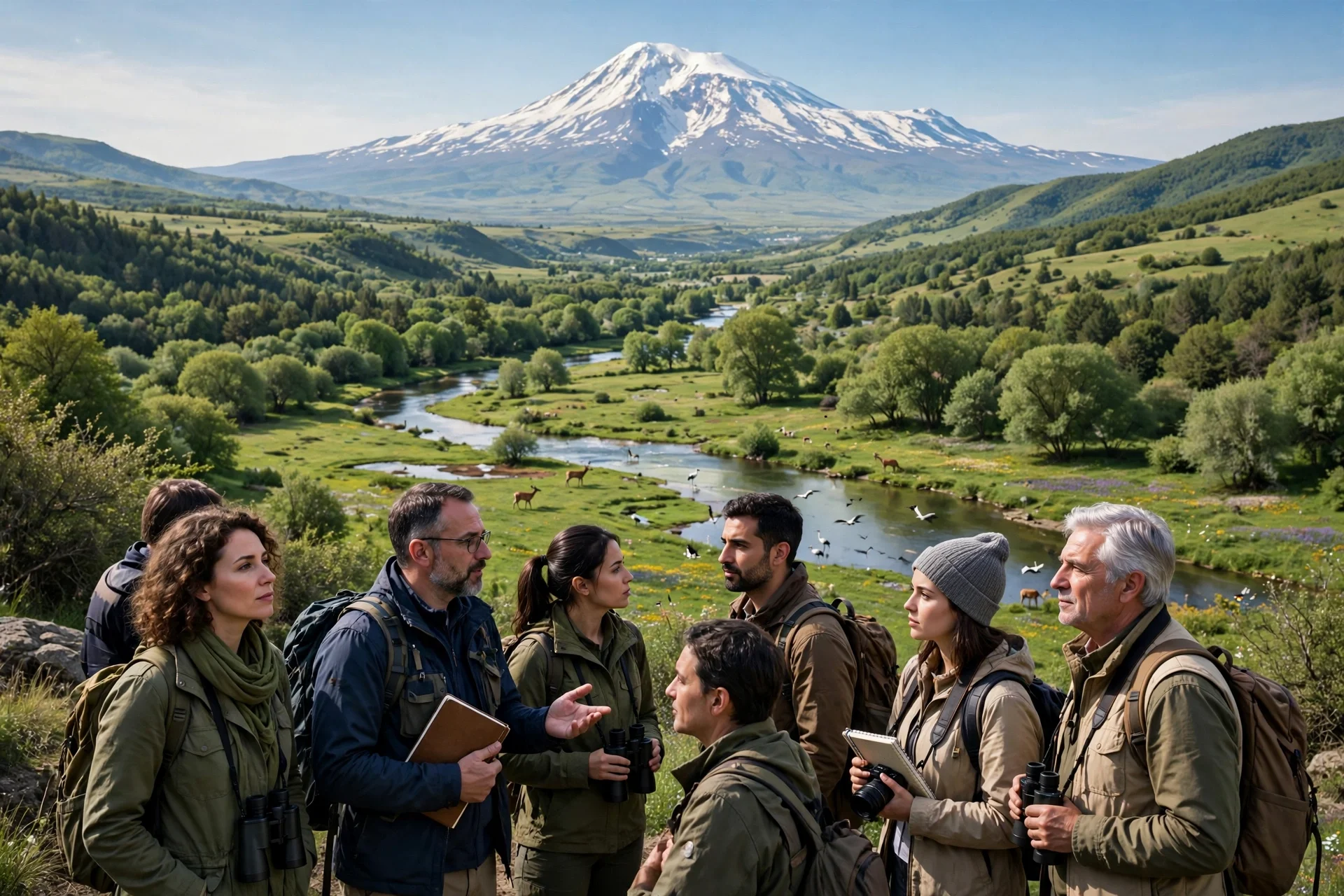
Valle fluvial con bosques y fauna bajo una montaña nevada, escena alusiva a la protección de la biodiversidad acordada en Ereván. · EPM
Yerevan Pathway sets priorities to deliver the 23 biodiversity targets
COP17 closed in Yerevan with the Yerevan Pathway setting priorities for the 23 biodiversity targets to 2030, nearly 50 decisions, the Sevan Guidelines, and…
Yerevan adopts nearly 50 decisions; the test is what changes at home
COP17 closed in Yerevan with nearly 50 decisions, the Yerevan Pathway for the 23 targets to 2030, new monitoring indicators, and nearly $2 billion in announced…
--- The context ---
At the halfway mark to 2030, a global review found the world off track to meet its biodiversity targets. Against that diagnosis, countries meeting in Armenia agreed on a roadmap to accelerate action for nature during the four years left to deliver the framework they had already adopted.
--- The facts ---
The COP17 conference closed in Yerevan on Saturday and the agreement was formalised through the Yerevan Pathway, setting priorities to deliver the 23 targets of the Kunming-Montreal Global Biodiversity Framework. Parties adopted nearly 50 decisions covering protected areas and forests, wildlife management, invasive alien species, marine and coastal biodiversity, and synthetic biology.
--- The facts ---
After intensive negotiations, parties also agreed the Sevan Guidelines, which set the operating rules for a new permanent body strengthening the role of Indigenous Peoples and local communities in shaping global biodiversity policy. Nearly $2 billion in new funding was announced: $560 million under the latest replenishment of the global environment facility, $500 million through a species recovery alliance, and $330 million for a fund that aims to mobilise private capital for nature.
--- The positions ---
The executive secretary of the biodiversity convention, Astrid Schomaker, warned in her remarks that nature cannot be protected while its destruction continues to be financed. COP17 President Hambardzum Matevosyan said the two weeks had shown that differences can be bridged and commitments can become decisions. The head of the UN environment programme, Inger Andersen, said environmental multilateralism had prevailed once again and that the compromise reached would support real progress for people and for planet.
--- What remains unknown ---
The pathway calls for tackling subsidies that harm nature, increasing financial, scientific and technical support for developing countries, aligning national budgets and economic decisions with the framework, and strengthening monitoring and reporting. How each government will translate those calls into its own budget lines has not yet been spelled out.
--- Unanswered questions ---
How will each government withdraw the subsidies that are harming nature today? Will the promised support reach developing countries in a timely and verifiable way? What real weight will the new Indigenous Peoples body carry when national policies are decided?
--- EPM analysis ---
The agreement combines money, rules and participation. Without correcting the incentives that finance destruction, no target holds; without the communities who live in these territories, protection stays on paper. The next conference, COP18, will be held in Ecuador, with two years remaining to achieve the targets.
📌 EPM Take: In EPM's view, the Yerevan Pathway is right to put money at the centre of the debate, because protecting nature while financing its destruction was the contradiction holding back the whole global framework. Strengthening Indigenous Peoples and local communities adds a piece that global biodiversity governance had been missing. The demand now must be public follow-up, comparable reporting and effective support for developing countries, so that the nearly $2 billion announced becomes recovered species, cared-for forests and living rivers before 2030 arrives.
--- The context ---
At the halfway mark to 2030, a global review found the world off track to meet its biodiversity targets. Countries meeting in Armenia answered with a roadmap to speed up action for nature, knowing that only four years remain to deliver what the current framework promised.
--- The facts ---
The COP17 conference closed in Yerevan on Saturday and formalised the Yerevan Pathway, with priorities to deliver the 23 targets of the Kunming-Montreal Global Biodiversity Framework. Parties adopted nearly 50 decisions spanning protected areas and forests, wildlife management, invasive alien species, marine and coastal biodiversity, and synthetic biology, along with new indicators to improve biodiversity monitoring and accountability.
--- The facts ---
After intensive negotiations, parties agreed the Sevan Guidelines, setting the operating rules for a new permanent body strengthening the role of Indigenous Peoples and local communities. Nearly $2 billion in new funding was announced: $560 million under the latest replenishment of the global environment facility, $500 million through a species recovery alliance, and $330 million to mobilise private capital, alongside a new biodiversity bond and investment incubator launched by an Asian development bank.
--- The positions ---
The executive secretary of the biodiversity convention, Astrid Schomaker, warned that nature cannot be protected while its destruction continues to be financed, and at the close she stressed that the test will not be what governments agreed in Yerevan, but what they change when they return home. COP17 President Hambardzum Matevosyan highlighted that cooperation had turned commitments into decisions, and the head of the UN environment programme, Inger Andersen, welcomed that multilateralism had prevailed.
--- What remains unknown ---
The pathway calls for national budgets and economic decisions to be aligned with the framework, for subsidies that harm nature to be tackled, and for monitoring and reporting to be strengthened. Which specific budget lines each country will change, and on what timetable, remains to be seen.
--- Unanswered questions ---
Which concrete subsidies will each government remove, and by when? How will anyone verify that the $560 million, the $500 million and the $330 million announced produce measurable results? Will each country publish comparable reports before COP18 in Ecuador?
--- EPM analysis ---
The agreement usefully orders priorities and adds indicators, two tools for demanding accounts. Its weak point is familiar: conferences produce decisions easily, but change happens in budgets and in day-to-day management on the ground, where oversight is harder and postponement is tempting.
📌 EPM Take: In EPM's view, the Yerevan Pathway earns its value from what it orders and what it makes measurable, not from the ceremony of its approval. Nearly 50 decisions and new indicators create a public yardstick against which every government can be checked between now and 2030. The executive secretary's closing warning sets the right criterion: the test begins when delegations return home. If budgets do not change and reporting does not harden, this document will become one more filed commitment, and that should be said as plainly as its approval is recorded today.
La Ruta de Ereván fija prioridades para cumplir las 23 metas de biodiversidad
La COP17 cerró en Ereván con la Ruta de Ereván, que fija prioridades para cumplir las 23 metas de biodiversidad hacia 2030, casi 50 decisiones, las Directrices…
Ereván aprueba casi 50 decisiones y la prueba será lo que cambie en casa
La COP17 cerró en Ereván con casi 50 decisiones, la Ruta de Ereván para las 23 metas hacia 2030, nuevos indicadores de seguimiento y financiación anunciada por…
--- El contexto ---
A mitad de camino hacia 2030, una revisión global concluyó que el mundo va fuera de ruta para cumplir sus metas de biodiversidad. Con ese diagnóstico sobre la mesa, los países reunidos en Armenia buscaron una forma de acelerar la acción por la naturaleza en los cuatro años que quedan del decenio.
--- Los hechos ---
La conferencia COP17 cerró el sábado en Ereván y el acuerdo quedó formalizado en la Ruta de Ereván, que fija las prioridades para entregar las 23 metas del marco global de Kunming-Montreal. Las partes adoptaron casi 50 decisiones sobre áreas protegidas y bosques, gestión de la vida silvestre, especies exóticas invasoras, biodiversidad marina y costera y biología sintética.
--- Los hechos ---
Tras negociaciones intensas se acordaron además las Directrices de Sevan, que regulan un nuevo órgano permanente para reforzar el papel de los pueblos indígenas y las comunidades locales en la política mundial de biodiversidad. Se anunció financiación nueva por casi 2 mil millones de dólares: 560 millones bajo la última reposición del fondo ambiental mundial, 500 millones mediante una alianza de recuperación de especies y 330 millones para un fondo que busca movilizar capital privado.
--- Las posiciones ---
La secretaria ejecutiva del convenio de diversidad biológica, Astrid Schomaker, advirtió en su intervención que no se puede proteger la naturaleza mientras se sigue financiando su destrucción. El presidente de la COP17, Hambardzum Matevosyan, sostuvo que en dos semanas se demostró que las diferencias pueden salvarse y que los compromisos pueden volverse decisiones. La directora del programa ambiental, Inger Andersen, valoró que el multilateralismo ambiental prevaleció de nuevo y que el compromiso alcanzado apoyará un progreso real para las personas y el planeta.
--- Lo que falta saber ---
La ruta pide enfrentar los subsidios que dañan la naturaleza, aumentar el apoyo financiero, científico y técnico a los países en desarrollo y alinear los presupuestos nacionales y las decisiones económicas con el marco, con un seguimiento y una rendición de informes más fuertes. Todavía no se conoce cómo se traducirá cada compromiso en los presupuestos de cada país.
--- Preguntas sin respuesta ---
¿Cómo retirará cada gobierno los subsidios que hoy dañan la naturaleza? ¿Llegará el apoyo prometido a los países en desarrollo en tiempo y forma verificable? ¿Qué peso real tendrá el nuevo órgano de pueblos indígenas cuando se definan las políticas nacionales?
--- Análisis EPM ---
El valor del acuerdo está en que combina dinero, reglas y participación: sin corregir los incentivos que financian la destrucción, ninguna meta se sostiene, y sin las comunidades que habitan los territorios, la protección queda en papel. La próxima conferencia, COP18, se celebrará en Ecuador, cuando queden dos años para alcanzar las metas.
📌 Conclusion EPM: A juicio de EPM, la Ruta de Ereván acierta al poner el dinero en el centro del debate, porque proteger la naturaleza mientras se financia su destrucción era la contradicción que frenaba todo el marco global. El refuerzo de los pueblos indígenas y de las comunidades locales suma una pieza que faltaba en la gobernanza mundial de la biodiversidad. Ahora la exigencia debe ser seguimiento público, informes comparables y apoyo efectivo a los países en desarrollo, para que los casi 2 mil millones anunciados se conviertan en especies recuperadas, bosques cuidados y ríos vivos antes de 2030.
--- El contexto ---
A mitad de camino hacia 2030, una revisión global encontró al mundo fuera de ruta para cumplir sus metas de biodiversidad. Los países reunidos en Armenia respondieron con una hoja de ruta para acelerar la acción por la naturaleza, conscientes de que quedan solo cuatro años para entregar lo prometido en el marco vigente.
--- Los hechos ---
La conferencia COP17 cerró el sábado en Ereván y formalizó la Ruta de Ereván, con prioridades para cumplir las 23 metas del marco global de Kunming-Montreal. Las partes adoptaron casi 50 decisiones que abarcan áreas protegidas y bosques, gestión de la vida silvestre, especies exóticas invasoras, biodiversidad marina y costera y biología sintética, además de nuevos indicadores para mejorar el seguimiento y la rendición de cuentas.
--- Los hechos ---
Tras negociaciones intensas se acordaron las Directrices de Sevan, que fijan las reglas de un nuevo órgano permanente para reforzar el papel de los pueblos indígenas y las comunidades locales. Se anunció financiación nueva por casi 2 mil millones de dólares: 560 millones bajo la última reposición del fondo ambiental mundial, 500 millones mediante una alianza de recuperación de especies y 330 millones para movilizar capital privado, junto a un bono de biodiversidad y una incubadora de inversión lanzados por un banco asiático de desarrollo.
--- Las posiciones ---
La secretaria ejecutiva del convenio de diversidad biológica, Astrid Schomaker, advirtió que no se puede proteger la naturaleza mientras se sigue financiando su destrucción, y al cierre subrayó que la prueba no será lo acordado en Ereván, sino lo que cada gobierno cambie al volver a casa. El presidente de la COP17, Hambardzum Matevosyan, destacó que la cooperación convirtió compromisos en decisiones, y la directora del programa ambiental, Inger Andersen, celebró que prevaleciera el multilateralismo.
--- Lo que falta saber ---
La ruta pide alinear los presupuestos nacionales y las decisiones económicas con el marco, enfrentar los subsidios que dañan la naturaleza y reforzar el seguimiento y los informes. Falta ver qué partidas concretas cambiará cada país y con qué calendario, porque sin esa traducción presupuestaria el acuerdo queda en declaración.
--- Preguntas sin respuesta ---
¿Qué subsidios concretos eliminará cada gobierno y en qué plazo? ¿Cómo se medirá que los 560 millones, los 500 millones y los 330 millones anunciados lleguen a resultados comprobables? ¿Publicará cada país informes comparables que permitan verificar avances antes de la COP18 en Ecuador?
--- Análisis EPM ---
El acuerdo ordena prioridades y suma indicadores, dos piezas útiles para exigir cuentas. Su punto débil es conocido: las conferencias producen decisiones con facilidad, pero los cambios ocurren en los presupuestos y en la gestión diaria de cada territorio, donde el control es más difícil y la tentación de postergar, mayor.
📌 Conclusion EPM: A juicio de EPM, la Ruta de Ereván vale por lo que ordena y por lo que permite medir, no por la ceremonia de su aprobación. Casi 50 decisiones y nuevos indicadores crean una vara pública contra la que contrastar a cada gobierno de aquí a 2030. La advertencia final de la propia secretaria ejecutiva marca el criterio correcto: la prueba empieza cuando las delegaciones vuelven a casa. Si los presupuestos no cambian y los informes no se endurecen, el documento será otro compromiso archivado, y convendrá decirlo con la misma claridad con que hoy se registra su aprobación.