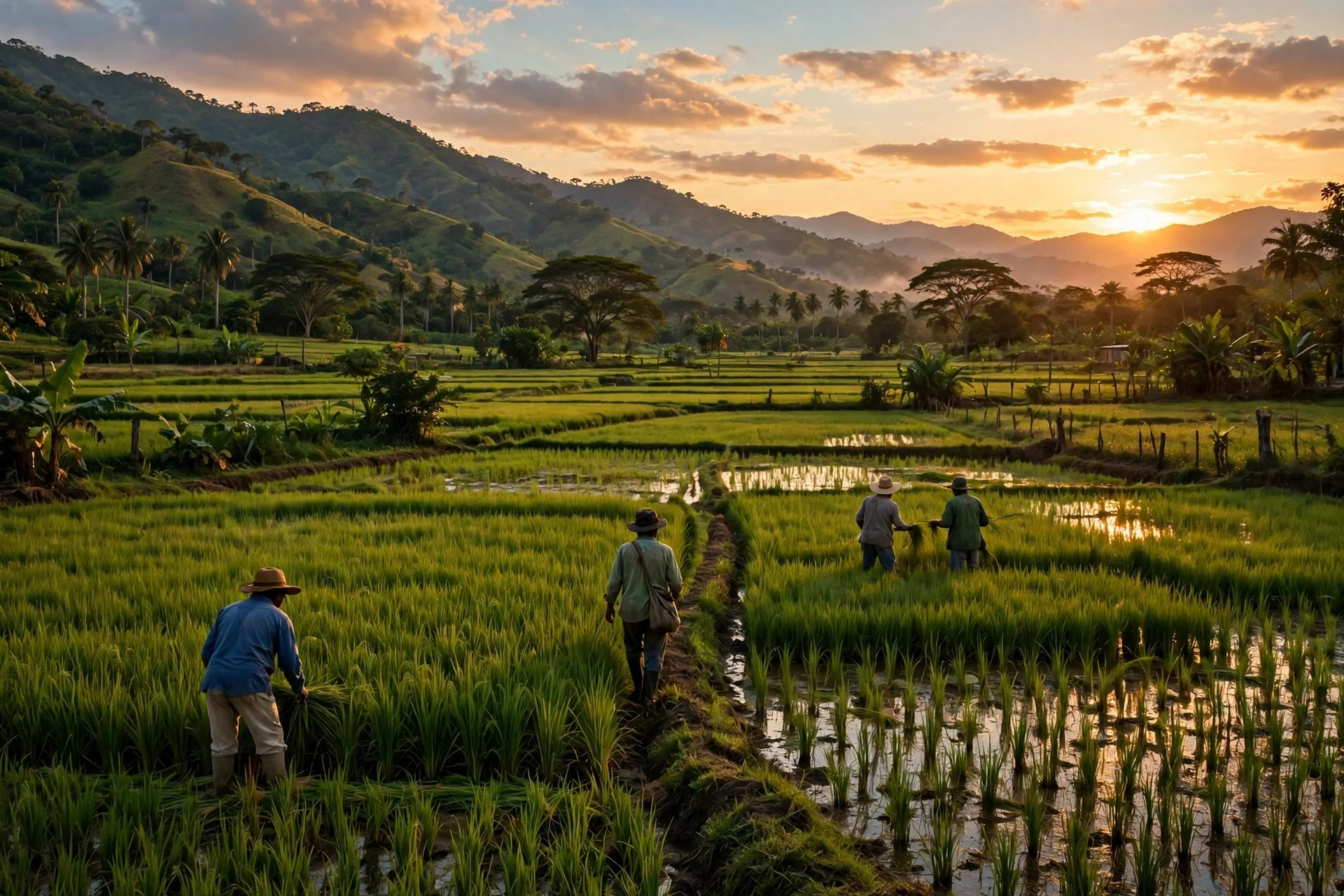
Arrozales en el Cibao dominicano al atardecer, en medio del debate sobre la protección de la producción arrocera nacional. · EPM
Fernández accuses government of demagoguery over rice
According to Leonel Fernández, the Government acted with demagoguery by issuing a rice decree he described as vulnerable under DR-CAFTA.
Fernández questions rice decree, urges U.S. dialogue
Leonel Fernández maintained in Santiago that the rice decree was legally vulnerable under DR-CAFTA and accused the Government of demagoguery.
--- The context ---
Rice production is central to the Dominican Republic, with thousands of producers and workers tied to the crop. According to Leonel Fernández, former president and president of the Fuerza del Pueblo party, protection of that sector ended up at the center of a trade and diplomatic controversy with the United States, stemming from a presidential decree and DR-CAFTA obligations.
The former president made his statements in Santiago, answering journalists' questions during his activities there, ahead of a meeting with the board of the Asociación de Promotores y Constructores de Viviendas del Cibao (APROCOVICI), held at the Edificio Empresarial.
--- The facts ---
Fernández maintained that during 2024 the Government authorized a considerable increase in rice imports without paying tariffs. According to the figures he presented, the country went from some 500 thousand quintals that were normally imported to more than four million quintals, coming from countries such as Pakistan and Uruguay, among others.
The former president explained that, even though the DR-CAFTA tariff reduction for rice was set to enter into force in January 2025, the Executive Branch issued a decree that, in his judgment, sought to make producers believe they were protected against imports. Fernández questioned that those measures prompted United States trade representatives to demand the decree's annulment.
--- The positions ---
Fernández accused the Government of the Partido Revolucionario Moderno of acting with demagoguery by making rice producers believe they were protected through a presidential decree he described as legally vulnerable under DR-CAFTA. He considered the decision revealed a contradiction in Government trade policy, because a presidential decree could not override an international treaty's obligations.
The former president warned that the authorities should have foreseen the legal and diplomatic consequences of the decision, instead of a measure that, he maintained, lacked the strength to guarantee the promised protection. He also pointed out that the United States ambassador's recent statements about her country's willingness to dialogue on rice imports show, in his reading, that diplomatic mechanisms existed to address the problem.
--- What remains unknown ---
Fernández insisted on seeking, through dialogue with the United States, conditions that preserve Dominican rice production. His statements include no official Government response to his claims, nor the steps Fuerza del Pueblo will take on this issue.
--- Unanswered questions ---
What response will the Government offer to the import figures Fernández attributes to 2024? What conditions could be negotiated with the United States to preserve Dominican rice production? What effects would a change in the treatment of the questioned decree have on producers?
--- EPM analysis ---
Fernández's argument combines trade, legal and diplomatic critiques, all attributed to his reading of the events. His emphasis on dialogue shifts the debate from the questioned decree toward negotiation with the United States as the viable way out, in his view.
📌 EPM Take: In EPM's view, the value of this controversy is that it forces a look at rice policy with data on the table and with clear attribution of each claim. The figures Fernández attributes to 2024 imports and his reading of the decree deserve an official contrast, because producers' confidence depends on that contrast. The diplomatic path he demands with the United States seems the ground where protection of the crop can be discussed without fragile promises or gestures that later have to be reversed before trade partners.
--- The context ---
Dominican rice production sustains thousands of producers and workers, and its protection is part of a trade debate with the United States under DR-CAFTA. According to Leonel Fernández, former president and president of Fuerza del Pueblo, that debate was marked by a presidential decree he considers legally vulnerable and by decisions that, in his judgment, exposed the country internationally.
The statements were offered in Santiago, during the three-day schedule the former president is carrying out in that city, from Friday, October 30 to Sunday, November 1, with meetings with productive, business, professional and social sectors, and activities to strengthen his party's structures.
--- The facts ---
Fernández maintained that during 2024 the Government authorized a considerable increase in rice imports without paying tariffs, going from some 500 thousand quintals that were normally imported to more than four million quintals, coming from countries such as Pakistan and Uruguay, among others. To that decision he attributed the origin of the controversy that later surrounded the protection decree.
He explained that, even though the DR-CAFTA tariff reduction for rice was set to enter into force in January 2025, the Executive Branch issued a decree that sought to make producers believe they were protected. Fernández questioned that the authorities adopted measures that prompted United States trade representatives to demand the annulment of a presidential decree.
--- The positions ---
The Fuerza del Pueblo president accused the Government of the Partido Revolucionario Moderno of acting with demagoguery in this case and considered that the decision revealed a contradiction in official trade policy, because a presidential decree could not override an international treaty's obligations. In his argument, the promised protection lacked legal strength.
Leonel warned that the authorities should have foreseen the legal and diplomatic consequences of the decision. He also pointed out that the United States ambassador's recent statements about her country's willingness to dialogue on rice imports show that diplomatic mechanisms existed to address the problem without the confrontation scenario he attributed to the Government's decisions.
--- What remains unknown ---
The former president insisted on seeking, through dialogue with the United States, conditions that make it possible to preserve Dominican rice production. His statements detail no specific negotiating proposal nor an official Government response to the figures and criticisms he set out in Santiago.
--- Unanswered questions ---
What room for negotiation exists with the United States on rice import conditions? How can the protection promised to producers be reconciled with the DR-CAFTA obligations he invokes? What response will the Government give to the former president's accusation of demagoguery?
--- EPM analysis ---
Fernández's critique rests on a principle of legal certainty: according to his argument, no sectoral protection holds up if it contradicts a treaty in force. From that premise, his call for dialogue presents negotiation as productive defense, not as a concession.
📌 EPM Take: In EPM's view, the discussion Fernández opens touches a principle that goes beyond rice: the word of the State and its international commitments must walk together. If, as he maintains, a decree promised protection that DR-CAFTA did not allow to stand, the damage is not only commercial, but one of institutional credibility. The way out he proposes, negotiating with the United States conditions that preserve national production, demands technical seriousness and foresight, two qualities that the former president demands and that the country needs to verify in deeds.
Fernández acusa al Gobierno de demagogia por el arroz
Según Leonel Fernández, el Gobierno actuó con demagogia al emitir un decreto arrocero que calificó de vulnerable frente al DR-CAFTA.
Fernández cuestiona el decreto arrocero y pide diálogo
Leonel Fernández sostuvo en Santiago que el decreto arrocero era jurídicamente vulnerable frente al DR-CAFTA y acusó al Gobierno de demagogia.
--- El contexto ---
La producción de arroz es central en la República Dominicana, con miles de productores y trabajadores vinculados al cultivo. Según Leonel Fernández, expresidente y presidente de la Fuerza del Pueblo, la protección de ese sector quedó en el centro de una controversia comercial y diplomática con Estados Unidos, por un decreto presidencial y las obligaciones del DR-CAFTA.
El exmandatario declaró en Santiago, al responder preguntas durante su agenda, previo a un encuentro con la directiva de la Asociación de Promotores y Constructores de Viviendas del Cibao (APROCOVICI), celebrado en el Edificio Empresarial.
--- Los hechos ---
Fernández sostuvo que en 2024 el Gobierno autorizó un incremento considerable de las importaciones de arroz sin pago de aranceles. Según las cifras que expuso, el país pasó de unos 500 mil quintales que normalmente se importaban a más de cuatro millones de quintales, procedentes de países como Pakistán y Uruguay.
El expresidente explicó que, pese a conocerse que a partir de enero de 2025 entraría en vigor la desgravación arancelaria prevista en el DR-CAFTA para el arroz, el Poder Ejecutivo emitió un decreto que, a su juicio, pretendía hacer creer a los productores que estaban protegidos. Fernández cuestionó que esas medidas provocaran que representantes comerciales de Estados Unidos exigieran anular el decreto.
--- Las posiciones ---
Fernández acusó al Gobierno del Partido Revolucionario Moderno de actuar con demagogia al hacer creer a los productores de arroz que estaban protegidos mediante un decreto que calificó de jurídicamente vulnerable frente al DR-CAFTA. Consideró que la decisión evidenció una contradicción en la política comercial oficial, porque un decreto no podía imponerse a las obligaciones de un tratado internacional.
El exmandatario advirtió que las autoridades debieron prever las consecuencias jurídicas y diplomáticas de la decisión, en lugar de una disposición que, según sostuvo, carecía de fortaleza para garantizar la protección prometida. También señaló que las declaraciones de la embajadora de Estados Unidos sobre la disposición de su país a dialogar sobre la importación del arroz demuestran, en su lectura, que existían mecanismos diplomáticos para abordar el problema.
--- Lo que falta saber ---
Fernández insistió en procurar, mediante el diálogo con Estados Unidos, condiciones que preserven la producción arrocera dominicana. No consta una respuesta oficial del Gobierno a sus señalamientos ni los pasos que seguirá la Fuerza del Pueblo.
--- Preguntas sin respuesta ---
¿Qué respuesta dará el Gobierno a las cifras de importación que Fernández atribuye a 2024? ¿Qué condiciones podrían negociarse con Estados Unidos para preservar la producción arrocera? ¿Qué efectos tendría para los productores un cambio en el tratamiento del decreto?
--- Análisis EPM ---
El planteamiento de Fernández combina una crítica comercial, jurídica y diplomática, atribuida a su lectura de los hechos. Su énfasis en el diálogo traslada el debate del decreto a la negociación con Estados Unidos como salida viable a su juicio.
📌 Conclusion EPM: A juicio de EPM, el valor de esta controversia está en que obliga a mirar la política arrocera con datos sobre la mesa y con atribución clara de cada señalamiento. Las cifras que Fernández atribuye a las importaciones de 2024 y su lectura del decreto merecen contraste oficial, porque de ese contraste depende la confianza de los productores. La vía diplomática que él reclama con Estados Unidos parece el terreno donde la protección del cultivo puede discutirse sin promesas frágiles ni gestos que luego deban revertirse.
--- El contexto ---
La producción arrocera dominicana sostiene a miles de productores y trabajadores, y su protección forma parte de un debate comercial con Estados Unidos bajo el DR-CAFTA. Según Leonel Fernández, expresidente y presidente de la Fuerza del Pueblo, ese debate quedó marcado por un decreto que él considera jurídicamente vulnerable y por decisiones que, a su juicio, expusieron al país internacionalmente.
Las declaraciones fueron ofrecidas en Santiago, durante la agenda de tres días del expresidente, desde el viernes 30 de octubre hasta el domingo 1 de noviembre, con reuniones con sectores productivos, empresariales y sociales, y actividades de fortalecimiento de su partido.
--- Los hechos ---
Fernández sostuvo que en 2024 el Gobierno autorizó un incremento considerable de las importaciones de arroz sin pago de aranceles, al pasar de unos 500 mil quintales que normalmente se importaban a más de cuatro millones de quintales, procedentes de países como Pakistán y Uruguay. A esa decisión atribuyó el origen de la controversia que luego rodeó al decreto de protección.
Explicó que, pese a conocerse que a partir de enero de 2025 entraría en vigor la desgravación arancelaria prevista en el DR-CAFTA para el arroz, el Poder Ejecutivo emitió un decreto que pretendía hacer creer a los productores que estaban protegidos. Fernández cuestionó que las autoridades adoptaran medidas que provocaron que representantes comerciales de Estados Unidos exigieran anular un decreto presidencial.
--- Las posiciones ---
El presidente de la Fuerza del Pueblo acusó al Gobierno del PRM de actuar con demagogia y consideró que la decisión evidenció una contradicción en la política comercial oficial, debido a que un decreto presidencial no podía imponerse a las obligaciones de un tratado internacional. A su juicio, la protección prometida carecía de fortaleza jurídica.
Leonel advirtió que las autoridades debieron prever las consecuencias jurídicas y diplomáticas de la decisión. Señaló además que las declaraciones de la embajadora de Estados Unidos sobre la disposición de su país a dialogar sobre la importación del arroz demuestran que existían mecanismos diplomáticos para abordar el problema sin el escenario de confrontación que atribuyó al Gobierno.
--- Lo que falta saber ---
El exmandatario insistió en buscar, vía diálogo con Estados Unidos, condiciones que preserven la producción arrocera dominicana. Sus declaraciones no detallan una propuesta negociadora ni recogen respuesta oficial del Gobierno a sus cifras y críticas.
--- Preguntas sin respuesta ---
¿Qué margen de negociación existe con Estados Unidos sobre la importación del arroz? ¿Cómo se compatibiliza la protección prometida con las obligaciones del DR-CAFTA que Fernández invoca? ¿Qué respuesta dará el Gobierno a la acusación de demagogia del expresidente?
--- Análisis EPM ---
La crítica de Fernández descansa en un principio de certeza jurídica: según su argumento, ninguna protección se sostiene si contradice un tratado vigente. Desde esa premisa, su reclamo plantea la negociación como defensa productiva, no como concesión.
📌 Conclusion EPM: A juicio de EPM, la discusión que abre Fernández toca un principio que trasciende al arroz: la palabra del Estado y sus compromisos internacionales deben caminar juntos. Si, como él sostiene, un decreto prometió una protección que el DR-CAFTA no permitía sostener, el daño no es solo comercial, sino de credibilidad institucional. La salida que él propone, negociar con Estados Unidos condiciones que preserven la producción nacional, exige seriedad técnica y previsión, dos cualidades que el expresidente reclama y que el país necesita verificar en hechos.