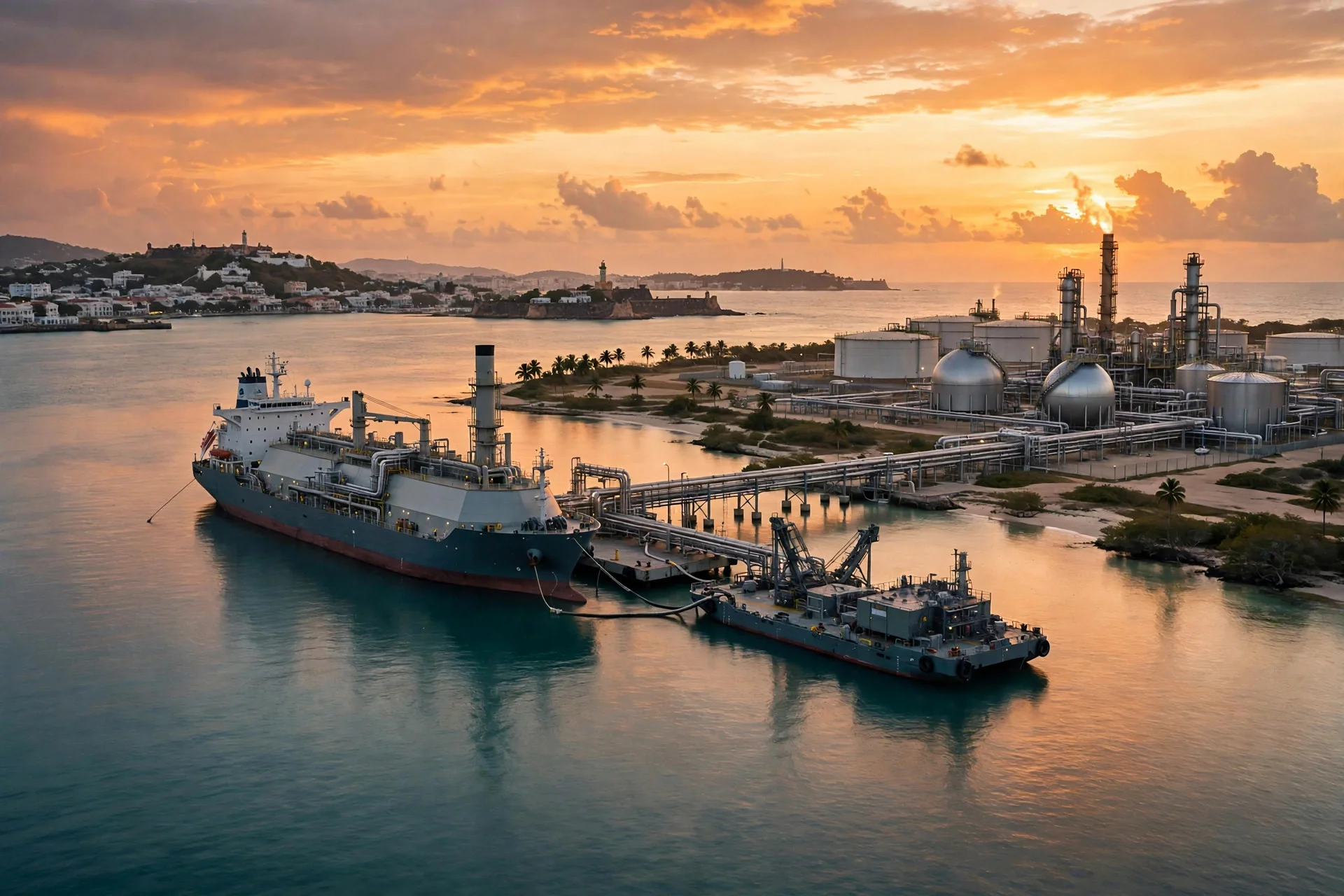
Terminal marítima de regasificación de gas al atardecer: la infraestructura de importación sostiene el suministro colombiano. · Imagen generada por EPM
Colombia ends gas rationing, but its single-terminal dependence remains
The government lifted the gas limitation after the Cartagena terminal recovered its 533 million cubic feet per day capacity.
Gas rationing ends in Colombia: emergency over, vulnerability remains
Resolution 40596 of 2026 ended the gas limitation after the early repair at the Cartagena terminal, which returned to 533 million cubic feet per day.
--- The context ---
Colombia has ended another round of natural gas rationing with a lesson that goes beyond a single technical failure: the country depends on one regasification terminal to import fuel it no longer produces in sufficient quantity. The contingency began with a technical fault at the Cartagena terminal, which forced the government to limit scheduled supply while repairs were carried out.
The backdrop is a structural deficit built up over years. Domestic production is falling, reserves are being depleted and no new projects have come online to offset that decline, so every breakdown in the existing infrastructure becomes a nationwide problem.
--- The facts ---
The Ministry of Mines and Energy announced the lifting of the scheduled natural gas limitation, effective from 11:59 p.m. on Saturday, October 31. Through Resolution 40596 of 2026, the government declared the contingency over and ended the extraordinary measures adopted to guarantee natural gas supply.
The decision came after the terminal confirmed the recovery of its available regasification capacity of 533 million cubic feet per day, having completed ahead of schedule the corrective work on one of the four trains of its floating storage and regasification unit. During the intervention it operated at 400 million cubic feet per day, and even so, according to the Ministry, supply to essential demand was guaranteed: households, hospitals, schools and other priority users.
--- The positions ---
The government maintains that the contingency has been overcome and that ordinary market operating conditions are restored, including the usual supply and marketing rules. The energy ministry also said it will keep monitoring supply conditions to detect possible difficulties in the provision and transport of the fuel.
Sector data points to a deeper problem. According to the hydrocarbons sector chamber, proven reserves fell 16.8% in 2025, to 1,717 gigacubic feet, enough for 5.9 years at the current pace of production.
--- What remains unknown ---
Imports are growing fast: in August, 341.4 million cubic feet per day entered the country, 126.9% more than a year earlier, equivalent to 32.3% of the gas marketed. In the first eight months of 2026, the average share of imports was 26.1%, compared with 17.4% in the same period of 2025. And all of that flow enters through a single door: the terminal whose capacity was expanded from 475 to 533 million cubic feet per day has already suffered two recent technical contingencies, one in September and this latest one.
--- Unanswered questions ---
When will Colombia have a second operational regasification terminal to reduce its dependence on a single facility? What concrete projects can reverse the fall in domestic production before reserves run out in 5.9 years? How much more can the import bill grow if imports already account for 32.3% of the gas marketed in the country?
--- EPM analysis ---
The exit was swift and essential demand was never interrupted, but the relief is administrative, not structural: the entire system rests on a single terminal and shrinking reserves. Until that changes, every technical failure will keep producing nationwide rationing effects.
📌 EPM Take: In EPM's view, lifting the rationing is good operational news that should not be mistaken for a solution: Colombia overcame the emergency because the repair finished ahead of schedule, not because its gas system is any stronger today. With reserves for 5.9 years, imports already covering 32.3% of the market and a single operational regasification terminal, the country remains one breakdown away from the next rationing. The pending task is to diversify infrastructure and recover production, with decisions that take years to mature.
--- The context ---
The natural gas rationing Colombia experienced in recent days is over, and it ended well: essential demand was never left unattended and the repair was completed ahead of schedule. The contingency stemmed from a technical failure at the Cartagena regasification terminal, the only one operating in the country, and forced temporary scheduled limitations while corrective work was carried out.
Behind the episode lies an uncomfortable reality that no government created overnight: years of falling domestic production, declining reserves and an absence of new projects left the country increasingly dependent on imported gas.
--- The facts ---
The Ministry of Mines and Energy lifted the scheduled limitation effective from 11:59 p.m. on Saturday, October 31. Resolution 40596 of 2026 declared the contingency over and ended the extraordinary measures adopted to guarantee natural gas supply.
The terminal confirmed the recovery of its available regasification capacity of 533 million cubic feet per day, after completing ahead of schedule the work on one of the four trains of its floating storage and regasification unit. During the intervention it worked at 400 million cubic feet per day and, according to the Ministry, supply to households, hospitals, schools and other priority users was guaranteed.
--- The positions ---
The government presents the closing of the contingency as the restoration of ordinary market conditions, with the usual supply and marketing rules, and pledged to keep monitoring the supply and transport of the fuel to detect difficulties in time.
The hydrocarbons sector provides the figure that explains the fragility: according to its industry chamber, proven reserves fell 16.8% in 2025, to 1,717 gigacubic feet, sufficient for 5.9 years at the current pace of production.
--- What remains unknown ---
External dependence is now quantifiable. In August, 341.4 million cubic feet per day entered the country, 126.9% more than a year earlier, equivalent to 32.3% of the gas marketed in the country. In the first eight months of 2026, the average share of imports was 26.1%, compared with 17.4% in the same period of 2025. The terminal's capacity was expanded from 475 to 533 million cubic feet per day, but the facility has already chained two recent technical contingencies, one of them in September.
--- Unanswered questions ---
Will a second regasification terminal finally be authorized so the country does not depend on just one? What real incentives will exploration have to halt the fall in reserves before the 5.9-year margin runs out? Who bears the growing cost of importing 32.3% of the gas Colombia consumes?
--- EPM analysis ---
The emergency was managed in an orderly way: essential users were protected first and normality returned as soon as capacity was restored. But a serious energy system cannot run at the limit of a single facility. Security of supply requires redundant infrastructure and domestic production, not only good crisis management.
📌 EPM Take: In EPM's view, the end of rationing confirms the contingency was handled with the right priorities, protecting households, hospitals and schools, but it also leaves a warning the country cannot keep postponing: depending on a single regasification terminal, with reserves for 5.9 years and imports at 32.3% of the market, is a strategic vulnerability. Colombia needs more infrastructure, more exploration and stable rules that attract investment, because the next technical failure should not again strain the supply of an entire country.
Termina el racionamiento de gas en Colombia, pero la dependencia sigue intacta
El Gobierno levantó la limitación de gas tras recuperarse la capacidad de 533 millones de pies cúbicos diarios de la terminal de Cartagena.
Fin del racionamiento de gas: la emergencia pasó, la vulnerabilidad queda
La Resolución 40596 de 2026 puso fin a la limitación de gas tras la reparación anticipada en la terminal de Cartagena, que volvió a 533 millones de pies…
--- El contexto ---
Colombia cerró otra semana de racionamiento de gas con una lección que va más allá de la falla puntual: el país depende de una sola terminal de regasificación para importar el combustible que ya no produce en cantidad suficiente. La contingencia se originó en un problema técnico en la terminal de Cartagena, que obligó a limitar el suministro durante las reparaciones.
El telón de fondo es un déficit estructural: la producción nacional cae, las reservas se agotan y no han entrado proyectos nuevos que compensen esa disminución, así que cada avería se convierte en un problema nacional.
--- Los hechos ---
El Ministerio de Minas y Energía anunció el levantamiento de la limitación programada de gas natural, con efectos desde las 11:59 de la noche del sábado 31 de octubre. Mediante la Resolución 40596 de 2026, el Gobierno declaró superada la contingencia y puso fin a las medidas extraordinarias adoptadas para garantizar el suministro.
La decisión llegó después de que la terminal confirmara la recuperación de su capacidad disponible de regasificación de 533 millones de pies cúbicos diarios, tras concluir anticipadamente los trabajos en uno de los cuatro trenes de su unidad flotante de regasificación. Durante la intervención operó con 400 millones de pies cúbicos diarios, y aun así el Ministerio garantizó el abastecimiento de la demanda esencial: hogares, hospitales, colegios y otros usuarios prioritarios.
--- Las posiciones ---
El Gobierno sostiene que la contingencia quedó superada y que se restablecen las condiciones ordinarias de operación del mercado, incluidas las reglas habituales de abastecimiento y comercialización. La cartera anunció además que seguirá vigilando el abastecimiento para detectar dificultades en el suministro y el transporte del combustible.
Según la cámara del sector de hidrocarburos, las reservas probadas se redujeron 16,8 % en 2025, hasta 1.717 gigapies cúbicos, y alcanzan para 5,9 años al ritmo actual de producción.
--- Lo que falta saber ---
Las importaciones crecen con fuerza: en agosto ingresaron 341,4 millones de pies cúbicos diarios, un 126,9 % más que un año atrás, equivalentes al 32,3 % del gas comercializado. En los primeros ocho meses de 2026, su participación promedio fue del 26,1 %, frente al 17,4 % del mismo periodo de 2025. Y todo ese flujo entra por una sola puerta: la terminal, cuya capacidad se amplió de 475 a 533 millones de pies cúbicos diarios, ya sufrió dos contingencias técnicas recientes, una en septiembre y esta última.
--- Preguntas sin respuesta ---
¿Cuándo contará Colombia con una segunda terminal de regasificación operativa que reduzca la dependencia de una sola instalación? ¿Qué proyectos concretos pueden revertir la caída de la producción nacional antes de que las reservas se agoten en 5,9 años? ¿Cuánto más puede crecer la factura de las importaciones si ya representan el 32,3 % del gas comercializado en el país?
--- Análisis EPM ---
La salida fue rápida y la demanda esencial no se interrumpió, pero el alivio es administrativo, no estructural: el sistema entero descansa sobre una única terminal y unas reservas en descenso. Mientras eso no cambie, cada falla técnica seguirá teniendo efectos nacionales.
📌 Conclusion EPM: A juicio de EPM, el levantamiento del racionamiento es una buena noticia operativa que no debe confundirse con una solución: Colombia superó la emergencia porque la reparación terminó antes de lo previsto, no porque su sistema de gas sea hoy más sólido. Con reservas para 5,9 años, importaciones que ya cubren el 32,3 % del mercado y una sola regasificadora operativa, el país sigue a una avería de distancia del próximo racionamiento. La tarea pendiente es diversificar la infraestructura y recuperar producción, con decisiones que tardan años en madurar.
--- El contexto ---
El racionamiento de gas natural que vivió Colombia en los últimos días terminó, y terminó bien: la demanda esencial nunca dejó de atenderse y la reparación se completó antes de lo previsto. La contingencia nació de una falla técnica en la terminal de regasificación de Cartagena, la única operativa del país, y obligó a programar limitaciones temporales mientras se ejecutaban los trabajos correctivos.
Detrás del episodio hay una realidad incómoda que ningún gobierno creó de la noche a la mañana: años de caída de la producción nacional, reservas en descenso y ausencia de nuevos proyectos dejaron al país dependiendo cada vez más del gas importado.
--- Los hechos ---
El Ministerio de Minas y Energía levantó la limitación programada con efectos desde las 11:59 de la noche del sábado 31 de octubre. La Resolución 40596 de 2026 declaró superada la contingencia y puso fin a las medidas extraordinarias adoptadas para garantizar el suministro de gas natural.
La terminal confirmó la recuperación de su capacidad disponible de regasificación de 533 millones de pies cúbicos diarios, después de concluir anticipadamente los trabajos en uno de los cuatro trenes de su unidad flotante de almacenamiento y regasificación. Durante la intervención trabajó con 400 millones de pies cúbicos diarios y, según el Ministerio, se garantizó el abastecimiento de hogares, hospitales, colegios y otros usuarios prioritarios.
--- Las posiciones ---
El Gobierno presenta el cierre de la contingencia como el restablecimiento de las condiciones ordinarias del mercado, con las reglas habituales de abastecimiento y comercialización, y se comprometió a seguir vigilando el suministro y el transporte del combustible para detectar dificultades a tiempo.
El sector de hidrocarburos aporta la cifra que explica la fragilidad: según su cámara gremial, las reservas probadas cayeron 16,8 % en 2025, hasta 1.717 gigapies cúbicos, suficientes para 5,9 años al ritmo actual de producción.
--- Lo que falta saber ---
La dependencia externa ya es cuantificable. En agosto ingresaron 341,4 millones de pies cúbicos diarios, un 126,9 % más que un año atrás, equivalentes al 32,3 % del gas comercializado en el país. En los primeros ocho meses de 2026, la participación promedio de las importaciones fue del 26,1 %, frente al 17,4 % del mismo periodo de 2025. La capacidad de la terminal se amplió de 475 a 533 millones de pies cúbicos diarios, pero la instalación ya encadenó dos contingencias técnicas recientes, una de ellas en septiembre.
--- Preguntas sin respuesta ---
¿Se autorizará por fin una segunda terminal de regasificación para que el país no dependa de una sola? ¿Qué incentivos reales tendrá la exploración para detener la caída de las reservas antes de agotar el margen de 5,9 años? ¿Quién asume el costo creciente de importar el 32,3 % del gas que consume Colombia?
--- Análisis EPM ---
La gestión de la emergencia fue ordenada: se protegió primero a los usuarios esenciales y la normalidad volvió en cuanto la capacidad se restableció. Pero un sistema energético serio no puede funcionar al límite de una sola instalación. La seguridad del suministro exige infraestructura redundante y producción propia, no solo buena administración de crisis.
📌 Conclusion EPM: A juicio de EPM, el fin del racionamiento confirma que la contingencia se manejó con prioridad correcta, protegiendo hogares, hospitales y colegios, pero también deja una advertencia que el país no puede seguir aplazando: depender de una sola regasificadora, con reservas para 5,9 años e importaciones en el 32,3 % del mercado, es una vulnerabilidad estratégica. Colombia necesita más infraestructura, más exploración y reglas estables que atraigan inversión, porque la próxima falla técnica no debería volver a poner en tensión el suministro de todo un país.