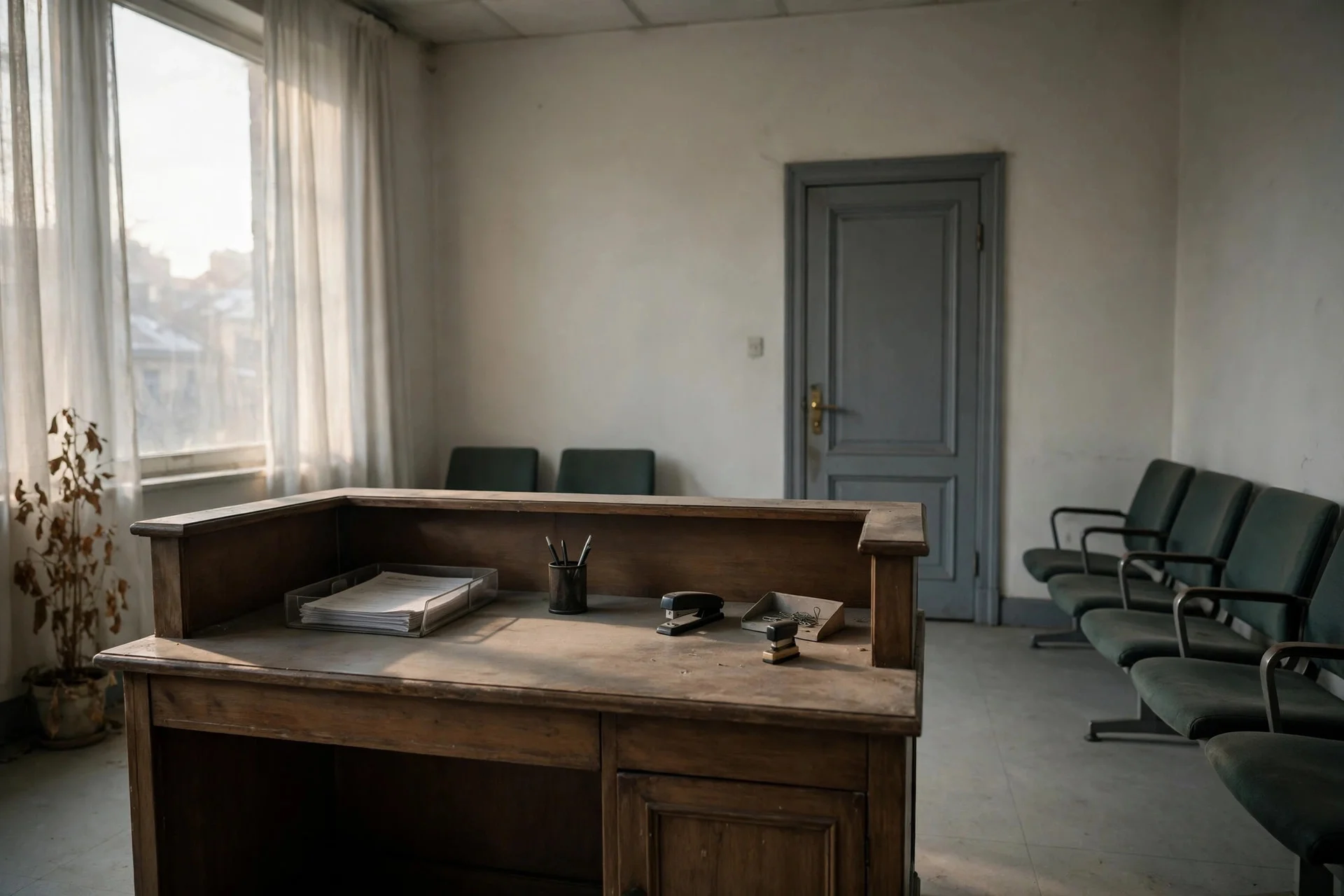
Imagen alusiva: una oficina de atención consular vacía, con el mostrador sin personal y la sala de espera desocupada. · Imagen generada por EPM
Tijuana consulate cancelled after 153,000 dollars paid without opening
According to the information revealed, the government cancelled Colombia's Consulate in Tijuana, created in 2024, which never opened and had no operational…
Order in Tijuana: consulate that never opened is cancelled
According to the information revealed, the Tijuana consulate, created by Decree 1405 in 2024, was cancelled after it was verified that it never operated.
The cancellation of the Colombian Consulate in Tijuana raises a basic question about public money, because according to the information revealed the office never opened, never provided regular services and still generated payments and obligations that are now under review by oversight authorities in Colombia.
--- The context ---
According to the report, the consulate was created by Decree 1405 of November 22, 2024, during the previous government, together with new offices in Monterrey and Tuxtla Gutierrez. Its formal purpose was to serve Colombians on Mexico's northern border, an area with heavy migration flows and an estimated population of 1,500 Colombians in Tijuana, according to the information revealed.
--- The facts ---
According to the information revealed, the government of Abelardo de la Espriella cancelled the office after confirming that it had no operational headquarters and did not provide regular services. The Foreign Ministry referred the case to the Prosecutor's Office and the Inspector General's Office on August 27, the ministry reported, so that responsibility for the alleged irregularities can be established through the proper channels.
According to the report, the state paid more than 153,000 dollars, equivalent to 500 million pesos, to provisional consul Maryory Ecinedth Pabon Gavilan. The official received a monthly allowance of 14,700 dollars between January 20 and October 30, 2026, plus 20,338 dollars in travel and household moving expenses, even though Mexico only authorized her appointment on March 27, according to the information revealed.
The cancellation left an outstanding rent debt for office 202 in the Torela Corporativo building, in Tijuana's Zona Dorada. According to the report, the Colombian Embassy in Mexico received the claim on September 30 and the next day the ministry's Administrative and Financial Directorate verified that there was a lease payment without a budget allocation, a fact at the center of the alleged irregularities now under review.
--- The positions ---
According to the report, a statement dated August 17 addressed to Colombians in Baja California mentioned contracts with an architect and with people responsible for graphic design and institutional image, and noted that economic obligations remained pending. The embassy requested a copy of the lease and a report on the office on October 6 without receiving a reply, and the consul resigned on October 30, according to the information revealed.
In her management report, according to the report, the former official listed visits to Colombians detained in Baja California and a three-day mobile consulate that completed 211 procedures and collected close to 10,000 dollars. She also said, in reported speech, that she keeps the traceability of her work in her institutional email. Former foreign minister Luis Gilberto Murillo said, according to the report, that every consulate opening was preceded by studies and budget availability, although the ministry stated it has no proof of a prior study in this case.
--- What remains unknown ---
It remains for the Prosecutor's Office and the Inspector General's Office to confirm the scope of their review and whether individual decisions will follow. The final total of the rent debt and the full detail of the contracts mentioned in August are also unknown. According to the report, former foreign minister Rosa Villavicencio explained that she received an instruction about the hiring when she took office, but the precise origin of that order and the chain of decisions about office 202 have not been fully clarified.
--- Unanswered questions ---
Who authorized payments and commitments without an operational headquarters in place? Why was a structure kept for months that sent procedures to the consulate in Mexico City, some 2,700 kilometers away? How much is owed in total and who should answer for these alleged irregularities?
--- EPM analysis ---
The case matters for what it reveals about prior controls: opening an office abroad requires a study, a budget and a verifiable headquarters before appointing staff and signing contracts. When that sequence is reversed, the cost is not only financial, because citizens are left without nearby service and must travel thousands of kilometers. The cancellation and the referral to oversight bodies, as reported, close the questioned operation and place the file in the hands of the instances tasked with establishing responsibility without prejudging anyone.
📌 EPM Take:
In EPM's view, closing the Tijuana consulate was the coherent step in the face of an office that never opened and that accumulated payments of 153,000 dollars, travel expenses and a rent debt without a clear budget backing. What matters now is not repeating outrage, but demanding that prosecutors establish with documents who ordered each step, how much is owed in total and which controls failed since Decree 1405. Serious foreign policy is also measured by its ability to correct course in time, protect the 1,500 Colombians in the area and ensure that no procedure depends on a phantom office.
Cancelling a consular office that never opened is, above all, an act of administrative order, because according to the information revealed the state sustained for months a unit without regular services, with high payments and with rent obligations that are now under review by prosecutors and oversight authorities.
--- The context ---
According to the report, the Tijuana office was created by Decree 1405 of November 22, 2024, under the previous administration, together with consulates in Monterrey and Tuxtla Gutierrez. Tijuana is home to an estimated 1,500 Colombians and is a border point with the United States, so any office there had to be born with a prior study, an assigned budget and a real capacity to serve people, conditions that the Foreign Ministry says it cannot find documented.
--- The facts ---
According to the information revealed, the government of Abelardo de la Espriella cancelled the consulate after verifying that the unit never opened its doors, had no operational headquarters and referred its requests to the Colombian Consulate in Mexico City. The Foreign Ministry referred the case to the Prosecutor's Office and the Inspector General's Office on August 27, the ministry itself reported, so that investigations into alleged irregularities can proceed.
According to the report, provisional consul Maryory Ecinedth Pabon Gavilan received a monthly allowance of 14,700 dollars between January 20 and October 30, 2026, for a total above 153,000 dollars, plus 20,338 dollars in travel and moving expenses. The report also notes that Mexico only authorized her appointment on March 27, a timing gap that forms part of the facts that those responsible at the time will have to explain.
An outstanding debt also remained for office 202 in the Torela Corporativo building. According to the information revealed, the embassy received the claim on September 30 and the Administrative and Financial Directorate confirmed the next day a lease payment without a budget allocation. Added to this, according to an August 17 statement cited in the report, are adaptation and institutional image contracts with obligations still pending payment.
--- The positions ---
The embassy asked on October 6 for the lease contract and a management report, without a reply according to the report, and the official resigned on October 30. In her report, the official listed visits to detainees and a three-day mobile consulate with 211 procedures and close to 10,000 dollars collected, and said in reported speech that she keeps traceability in her institutional email, according to the information revealed.
Former foreign minister Luis Gilberto Murillo said, according to the report, that every opening was preceded by studies and budget availability, although the ministry stated it found no proof of a prior study. Former foreign minister Rosa Villavicencio explained, according to the report, that she found the matter already advanced and received an instruction to hire, and she defended appointing a consul before opening to advance installation, a practice that in this case produced no opening at all.
--- What remains unknown ---
The outcome of the proceedings before prosecutors remains unknown, as does the consolidated amount of all obligations and the detail of each signed contract. It also remains to be established who decided to sustain the structure between January and October 2026 without a functional headquarters and why Mexico's Foreign Ministry had to ask informally what had happened with the office after granting its approval, according to the report.
--- Unanswered questions ---
Who should answer for a lease contracted without a verified budget allocation? Which internal controls allowed monthly payments of 14,700 dollars without regular consular service? Will any funds be recovered and will Colombians who now depend on an office 2,700 kilometers away be served effectively?
--- EPM analysis ---
Order in public spending is not a minor detail: it is the condition for a foreign ministry to serve its citizens instead of sustaining empty structures. This case shows the cost of appointing and contracting before securing a study, a headquarters and a budget. The decision to cancel and refer the file to oversight bodies protects public funds and draws a clear line, without implying guilt for any person while formal investigations move forward as required by law and due process.
📌 EPM Take:
In EPM's view, cancelling Tijuana's phantom consulate defends order and taxpayers' money against a creation of the previous era that never delivered the promised service. The file must run its course before prosecutors with full traceability of Decree 1405, of the payments of 153,000 dollars and of the debt for office 202, so that every decision has an identified person responsible. At the same time, the state must guarantee real service for Colombians in Baja California, because correcting an irregularity cannot leave the community unprotected or without a clear channel for procedures.
Consulado en Tijuana cierra sin abrir tras pagos por 153.000 dólares
Según la información revelada, el Gobierno canceló el Consulado de Colombia en Tijuana, creado en 2024, que nunca abrió ni tuvo sede operativa.
Orden en Tijuana: cancelan consulado que nunca abrió sus puertas
De acuerdo con la información revelada, el consulado de Tijuana, creado por el Decreto 1405 de 2024, fue cancelado tras comprobarse que nunca funcionó.
La decisión de cancelar el Consulado de Colombia en Tijuana coloca en el centro una pregunta básica sobre el uso de los recursos públicos, porque según la información revelada la sede nunca abrió, nunca tuvo operación regular y aun así generó pagos y obligaciones que ahora revisan las autoridades de control.
--- El contexto ---
Según el reporte, el consulado fue creado mediante el Decreto 1405 del 22 de noviembre de 2024, durante el gobierno anterior, junto con nuevas oficinas en Monterrey y Tuxtla Gutiérrez. La idea formal era atender a connacionales en la frontera norte de México, una zona con alto flujo migratorio y con una población estimada de 1.500 colombianos en Tijuana, según la información revelada.
--- Los hechos ---
De acuerdo con la información revelada, el Gobierno de Abelardo de la Espriella canceló esa dependencia después de constatar que no contó con sede operativa ni prestó servicios de forma regular. El Ministerio de Relaciones Exteriores trasladó el caso a la Fiscalía y la Procuraduría el 27 de agosto, según informó la Cancillería, para que se establezcan las responsabilidades que correspondan por las presuntas irregularidades detectadas.
Según el reporte, el Estado pagó más de 153.000 dólares, equivalentes a 500 millones de pesos, a la cónsul provisional Maryory Ecinedth Pabón Gavilán. La señalada recibió una asignación mensual de 14.700 dólares entre el 20 de enero y el 30 de octubre de 2026, además de 20.338 dólares en viáticos y transporte de menaje, pese a que México solo autorizó su nombramiento el 27 de marzo, según la información revelada.
La cancelación dejó pendiente una deuda por el alquiler de la oficina 202 del edificio Torela Corporativo, en la Zona Dorada de Tijuana. Según el reporte, la Embajada de Colombia en México recibió el requerimiento el 30 de septiembre y al día siguiente la Dirección Administrativa y Financiera verificó que existía un canon de arrendamiento sin asignación presupuestal, un dato que forma parte del núcleo de las presuntas irregularidades bajo revisión.
--- Las posiciones ---
Según el reporte, un comunicado del 17 de agosto dirigido a colombianos en Baja California mencionó contratos con un arquitecto y con responsables de diseño gráfico e imagen institucional, y señaló que existían obligaciones económicas pendientes de pago. La embajada solicitó el 6 de octubre copia del contrato y un informe sobre la sede, sin obtener respuesta, y la cónsul presentó su renuncia el 30 de octubre, según la información revelada.
En su informe de gestión, según el reporte, la exfuncionaria señaló visitas a colombianos detenidos en Baja California y un consulado móvil de tres días que completó 211 trámites y recaudó cerca de 10.000 dólares. También expresó, en indirecto, que conserva la trazabilidad de su gestión en el correo institucional. Por su parte, el excanciller Luis Gilberto Murillo sostuvo, según el reporte, que toda apertura era precedida de estudios y disponibilidad presupuestal, aunque la Cancillería afirmó que no tiene pruebas de un estudio previo para este caso.
--- Lo que falta saber ---
Todavía falta que la Fiscalía y la Procuraduría confirmen el alcance de su revisión y si habrá decisiones individuales. Tampoco se conoce el monto total final de la deuda por alquiler ni el detalle completo de los contratos mencionados en agosto. Según el reporte, la excanciller Rosa Villavicencio explicó que recibió una instrucción sobre la contratación al llegar al cargo, pero el origen preciso de esa orden y la cadena de decisiones sobre la oficina 202 siguen sin aclararse por completo.
--- Preguntas sin respuesta ---
¿Quién autorizó pagos y compromisos sin una sede operativa en funcionamiento? ¿Por qué se mantuvo durante meses una estructura que derivaba los trámites al consulado en Ciudad de México, a unos 2.700 kilómetros? ¿Cuánto suma en total la deuda pendiente y quién deberá responder por esas presuntas irregularidades?
--- Análisis EPM ---
El caso importa por lo que revela sobre los controles previos: abrir una sede en el exterior exige estudio, presupuesto y sede verificable antes de nombrar personal y firmar contratos. Cuando esa secuencia se invierte, el costo no es solo financiero, porque los ciudadanos quedan sin atención cercana y deben desplazarse miles de kilómetros. La cancelación y el traslado a los órganos de control, según lo informado, cierran la operación cuestionada y dejan el expediente en manos de las instancias llamadas a depurar responsabilidades sin anticipar culpabilidades.
📌 Conclusion EPM:
A juicio de EPM, el cierre del consulado de Tijuana era la medida coherente frente a una sede que nunca abrió y que acumuló pagos por 153.000 dólares, viáticos y una deuda de alquiler sin respaldo presupuestal claro. Lo relevante ahora no es repetir la indignación, sino exigir que Fiscalía y Procuraduría establezcan con documentos quién ordenó cada paso, cuánto se debe en total y qué controles fallaron desde el Decreto 1405. Una política exterior seria se mide también por su capacidad de corregir a tiempo, proteger a los 1.500 colombianos de la zona y garantizar que ningún trámite dependa de una oficina fantasma.
Cancelar una sede consular que nunca abrió es, ante todo, un acto de orden administrativo, porque según la información revelada el Estado sostuvo durante meses una dependencia sin servicios regulares, con pagos elevados y con obligaciones de alquiler que hoy están bajo revisión de Fiscalía y Procuraduría.
--- El contexto ---
Según el reporte, la oficina de Tijuana fue creada por el Decreto 1405 del 22 de noviembre de 2024, en la administración anterior, junto con consulados en Monterrey y Tuxtla Gutiérrez. Tijuana concentra una población estimada de 1.500 colombianos y es un punto fronterizo con Estados Unidos, por lo que cualquier sede allí debía nacer con estudio previo, presupuesto asignado y capacidad real de atención, condiciones que la Cancillería dice no encontrar acreditadas.
--- Los hechos ---
De acuerdo con la información revelada, el Gobierno de Abelardo de la Espriella canceló el consulado tras verificar que la dependencia no abrió sus puertas, no contó con sede operativa y derivaba sus requerimientos al Consulado de Colombia en Ciudad de México. El Ministerio de Relaciones Exteriores trasladó el caso a la Fiscalía y la Procuraduría el 27 de agosto, según informó la propia Cancillería, para que avancen las investigaciones por presuntas irregularidades.
Según el reporte, la cónsul provisional Maryory Ecinedth Pabón Gavilán recibió una asignación mensual de 14.700 dólares entre el 20 de enero y el 30 de octubre de 2026, para un total superior a 153.000 dólares, además de 20.338 dólares en viáticos y menaje. El reporte señala además que México solo autorizó su nombramiento el 27 de marzo, un desfase temporal que forma parte de los hechos que deberán explicar los responsables de la época.
También quedó una deuda por la oficina 202 del edificio Torela Corporativo. Según la información revelada, la embajada recibió el requerimiento el 30 de septiembre y la Dirección Administrativa y Financiera constató al día siguiente un canon de arrendamiento sin asignación presupuestal. A ello se suman, según un comunicado del 17 de agosto citado en el reporte, contratos de adecuación y de imagen institucional con obligaciones pendientes de pago.
--- Las posiciones ---
La embajada pidió el 6 de octubre el contrato de arrendamiento y un informe de gestión, sin respuesta según el reporte, y la funcionaria renunció el 30 de octubre. En su informe, la señalada reportó visitas a detenidos y un consulado móvil de tres días con 211 trámites y cerca de 10.000 dólares recaudados, y afirmó en indirecto que guarda trazabilidad en su correo institucional, según la información revelada.
El excanciller Luis Gilberto Murillo sostuvo, según el reporte, que toda apertura era precedida de estudios y disponibilidad presupuestal, aunque la Cancillería afirmó que no halló pruebas de estudio previo. La excanciller Rosa Villavicencio explicó, según el reporte, que al llegar encontró el tema avanzado y recibió la instrucción de contratar, y defendió nombrar cónsul antes de abrir para adelantar la instalación, una práctica que en este caso no produjo apertura alguna.
--- Lo que falta saber ---
Falta conocer el resultado de las actuaciones en Fiscalía y Procuraduría, el monto consolidado de todas las obligaciones y el detalle de cada contrato firmado. También falta establecer quién decidió sostener la estructura entre enero y octubre de 2026 sin sede funcional y por qué la Secretaría de Relaciones Exteriores de México tuvo que consultar de manera informal qué había ocurrido con la oficina tras otorgar el beneplácito, según señala el reporte.
--- Preguntas sin respuesta ---
¿Quién debe responder por un alquiler contratado sin asignación presupuestal verificada? ¿Qué controles internos permitieron pagar 14.700 dólares mensuales sin atención consular regular? ¿Se recuperará algún recurso y se atenderá de forma efectiva a los colombianos que hoy dependen de una sede a 2.700 kilómetros?
--- Análisis EPM ---
El orden en el gasto público no es un detalle menor: es la condición para que una cancillería sirva a sus ciudadanos en vez de sostener estructuras vacías. Este caso muestra el costo de nombrar y contratar antes de asegurar estudio, sede y presupuesto. La decisión de cancelar y remitir el expediente a los órganos de control protege el erario y marca una línea clara, sin que ello implique anticipar culpabilidad de persona alguna mientras avanzan las investigaciones formales correspondientes.
📌 Conclusion EPM:
A juicio de EPM, la cancelación del consulado fantasma de Tijuana defiende el orden y el dinero de los contribuyentes frente a una creación de la era anterior que nunca prestó el servicio prometido. El expediente debe seguir su curso en Fiscalía y Procuraduría con plena trazabilidad del Decreto 1405, de los pagos por 153.000 dólares y de la deuda de la oficina 202, para que cada decisión tenga un responsable identificado. Al mismo tiempo, el Estado debe garantizar atención real a los colombianos en Baja California, porque corregir una irregularidad no puede dejar desprotegida a la comunidad.