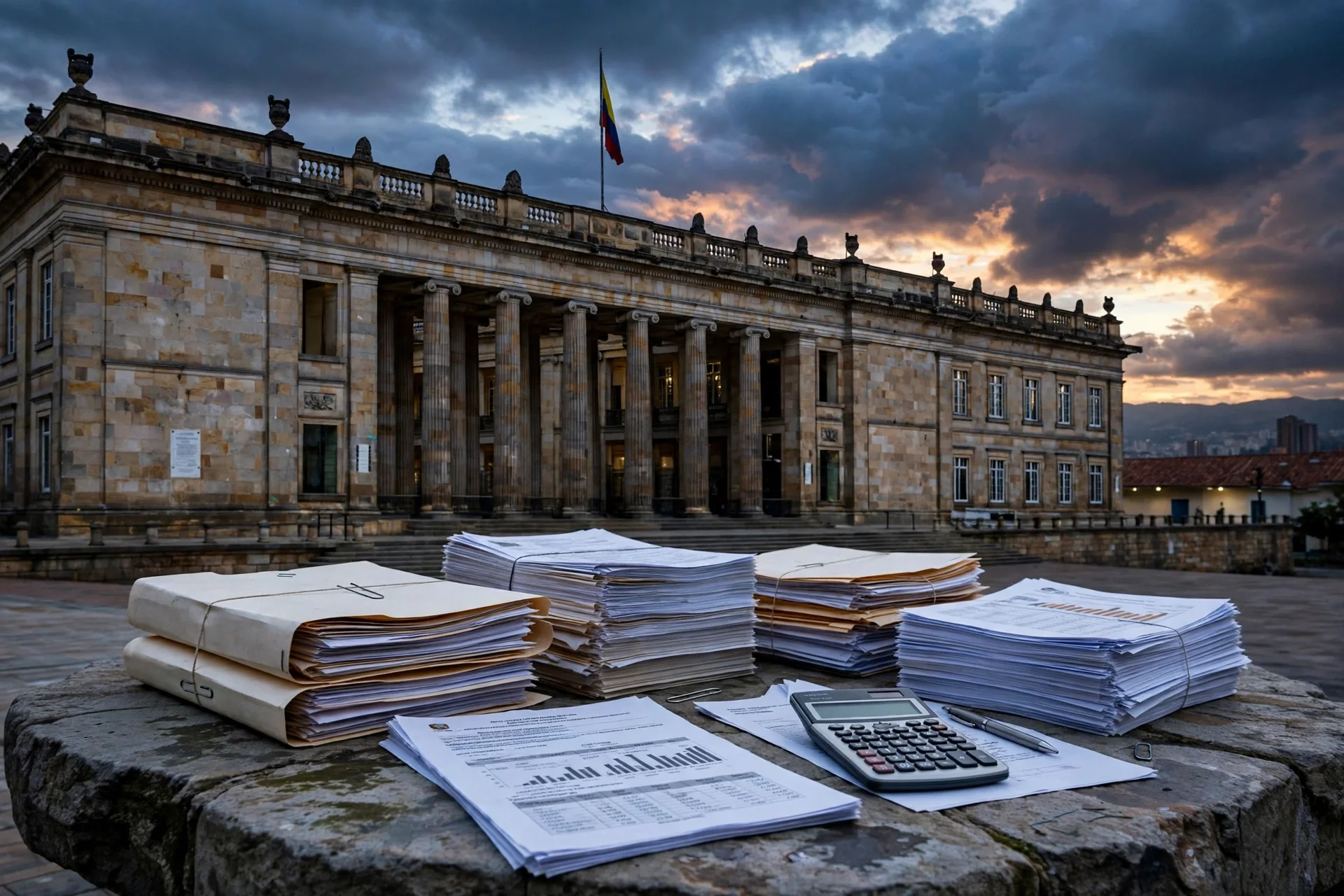
El Capitolio Nacional en Bogotá, con documentos fiscales en primer plano. · Imagen generada por EPM
Carrasquilla Backs Fiscal Adjustment and Diesel Subsidy Review
Former minister Alberto Carrasquilla backed a gradual fiscal adjustment of between 4 and 5 points of GDP, a gradual public spending cut of 20 percent and debt…
Carrasquilla Supports Spending Cuts and a Lower Corporate Tax
Former minister Alberto Carrasquilla backed a gradual spending cut of 20 percent and an adjustment of between 4 and 5 points of GDP, proposed a corporate…
--- The context ---
Colombia is debating a far-reaching fiscal reform at a moment that former minister Alberto Carrasquilla described as more delicate than previous crises. As he explained, if the adjustment is not made, the country could face what happened at the end of the last century, when lenders stopped lending and the adjustment arrived the hard way, with a gigantic recession borne by the private sector. Against that background, he valued that this time the Government proposes an orderly adjustment led by the public sector, protecting private activity and employment.
The former minister said he is almost certain the country is on the verge of having its financing cut. As a sign, he pointed out that the interest rates charged by international markets are now higher than those of other countries in the region, against which Colombia traditionally enjoyed better conditions. In his view, that symptom warns that financiers may tire and end up imposing a rapid adjustment, a path that, he recalled, many other countries have already gone through in similar situations.
--- The facts ---
The official proposal, as he described it, combines spending cuts and higher revenues in a six-pillar reform that would allow a gradual adjustment of between 4 and 5 points of GDP, a magnitude the former minister considers necessary. In his reading, markets would thus receive a signal of commitment to fiscal order and to stabilizing debt toward 2030, and approval of the reform, even with modifications, would help restore confidence, lower rates, reactivate investment and accelerate growth in the following years.
On spending, the former minister explained that, according to the Government, service provision contracts grew by close to 70 percent in recent years, and he considered that this spending could be cut in half without affecting the quality of services, because its increase did not translate into greater state efficiency. He added that the Government proposes gradually cutting public spending by 20 percent and requesting extraordinary powers to reorganize the State within six months, including through mergers of ministries and public entities.
On fuels, the former minister said the diesel subsidy exceeds 14 trillion pesos a year and must be adjusted now. He explained that the Government can do so by decree, without going through Congress, as it does every month with fuel price decrees, and he proposed ending that subsidy as was done before with gasoline. He also argued that unifying VAT rates could adjust some prices only once, without generating inflation, while a deficit financed monetarily could indeed be inflationary for the economy.
--- The positions ---
To protect households, the former minister backed the EfectIVA program as a compensation mechanism. According to his calculations, the difference is seven to one: 7 pesos are collected for every peso returned, so that, even while returning resources to the vulnerable population, the net leaves a very significant collection. On the middle class, he said there is no doubt there will be an effect, because taxes must be paid by everyone except the poorest and most vulnerable population, and that this contribution must be made progressively.
The former minister specified that if the middle class today pays 1 percent, it would end up paying 5 or 10 percent more, a higher burden that, in his view, is not necessarily bad if its counterpart is the stabilization of public finances. He warned that this sector would fare much worse if nothing is done and the country faces a crisis like the one at the end of the last century. He also held that the rescue bill will be a combination: the State, with a smaller payroll and fewer contracts; companies, with contributions they do not pay today; and households as the main contributors through taxes.
--- What remains unknown ---
Several fronts of the debate remain open. The former minister observed that the corporate income tax cut seems timid to him: lowering the rate from 35 to 33 percent and then to 31 percent in 2028 still leaves it high compared with other countries, and he proposed rates of 25 percent, eliminating exemptions, to stimulate investment and growth. He also warned that it is not clear who ultimately pays that tax, because a high rate can be shifted into lower wages, higher prices or changes in payments to suppliers, depending on the sector.
On labor matters, the former minister recalled that the 2012 law exempted companies from health and parafiscal contributions for workers earning up to ten minimum wages and created a tax intended to replace those resources. As he explained, removing part of those exemptions without sufficiently reducing the corporate tax strengthens the argument for lowering that rate further, and he expressed concern about losing advances, albeit limited ones, in reducing informality, which remains the main problem of the Colombian labor market today.
--- Unanswered questions ---
Will Congress manage to approve a reform of this magnitude in the little time left in the legislative session? Will the different political sectors accept a frank and open discussion on broadening the VAT and income tax bases? Will the diesel subsidy be reviewed in time, despite its enormous political cost? Will the corporate income tax rate fall beyond what is planned, to gain competitiveness against the countries Colombia competes with for investment?
--- EPM analysis ---
The value of this conversation lies in the technical consensus it reveals: a former minister who saw his own reform stopped in 2021 today backs the need for an orderly and gradual adjustment, with the State first doing its part on spending and with protection for the most vulnerable through VAT refunds. His observations on corporate taxation and the diesel subsidy are design contributions to enrich the debate in Congress, not objections to the direction: the direction, fiscal order, was backed without ambiguity by someone who knows its costs.
📌 EPM Take: In EPM's view, the former minister's backing confirms that an orderly adjustment is the responsible path: cutting spending that grew without improving services, stabilizing debt toward 2030 and sharing the effort progressively protects jobs and avoids a greater crisis. Debating a more competitive corporate tax and reviewing the diesel subsidy strengthens the reform without changing its course. Colombia gains when fiscal order is discussed with data, with effective social protection and with the decision to act before markets impose the adjustment the hard way on everyone.
--- The context ---
Colombia's fiscal discussion has entered a decisive phase and former minister Alberto Carrasquilla stated it bluntly: the public finances situation is serious and, if the adjustment is not made, the country could face what happened at the end of the last century, when lenders stopped lending and the adjustment was made the hard way, with a gigantic recession. As he explained, this time the Government proposes the opposite: an orderly adjustment, led fundamentally by the public sector, protecting private activity and jobs.
The former minister said he is almost certain Colombia is on the verge of having its financing cut. The sign he cited is concrete: the interest rates charged by international markets are now higher than those of other countries in the region, against which the country traditionally had better conditions. In his view, when financiers tire, they impose a rapid adjustment, and that outcome, which many countries have already gone through, is precisely what a timely reform makes it possible to avoid.
--- The facts ---
According to the former minister's description, the reform has six pillars and would allow a gradual adjustment of between 4 and 5 points of GDP, which he considers necessary. The sequence he laid out is clear: the Government warns it inherited an underfunded budget, presents a new one with resources secured for 2027 and the following years, markets receive a signal of commitment to fiscal order and debt stabilization toward 2030, and that credibility makes it possible to lower rates, reactivate investment and accelerate growth.
The spending chapter is central to his support. According to the Government, cited by the former minister, service provision contracts grew by close to 70 percent in recent years, and that spending could be cut in half without affecting service quality, because its increase did not translate into greater state efficiency. Added to this is the proposal to gradually cut public spending by 20 percent and to request extraordinary powers to reorganize the State within six months, including through mergers of ministries and public entities.
On the diesel subsidy, the former minister was categorical: it exceeds 14 trillion pesos a year and must be adjusted. He explained that the Government can do so by decree, without going through Congress, as it does every month with fuel price decrees, and that this subsidy must be ended as the previous government did with gasoline. On VAT, he held that unifying rates could adjust some prices only once, without generating inflation, while a deficit that must be financed monetarily can indeed be inflationary.
--- The positions ---
The former minister backed the EfectIVA program to compensate households: according to his calculations, 7 pesos are collected for every peso returned, a seven-to-one difference that leaves a very significant net collection. On the middle class, he said everyone must contribute, except the poorest and most vulnerable population, and progressively: if it pays 1 percent today, it would end up paying 5 or 10 percent more. That burden, he held, has a clear counterpart: stabilizing public finances, far better than facing a crisis like last century's.
His main technical observation concerns business competitiveness. The income tax reduction seems timid to him: lowering the rate from 35 to 33 percent and then to 31 percent in 2028 still leaves it high compared with other countries, and it is a mistake, he said, to justify that burden with the argument that companies are rich, because there are large and small ones, profitable or not. He also warned that it is not clear who finally pays that tax: a high rate can be shifted into lower wages, higher prices or changes in payments to suppliers.
--- What remains unknown ---
The former minister proposed that, given the countries Colombia competes with and the investment it needs, the corporate income tax rate should approach 25 percent, eliminating exemptions. He also offered a labor clarification: the 2012 law exempted health and parafiscal contributions for workers earning up to ten minimum wages and created a substitute tax to finance social entities; removing part of those exemptions without sufficiently lowering the corporate rate reinforces, in his view, the case for a lower rate, and he worries about losing ground against informality.
It also remains to be seen how the bill is finally shared. According to the former minister, it will be a combination: people who work for the State today could lose their jobs through payroll and contract reductions, companies will assume contributions they do not pay today even though their income tax is slightly reduced, and households will be those who contribute the most, through taxes, to fixing the public finances. And he warned that the probability of the reform being approved as it stands is very close to zero, because the tax part will be the hardest in Congress.
--- Unanswered questions ---
Will Congress have the time and the will to approve the reform before the legislature ends in the middle of next month? Will the debate dare to lower the corporate tax toward 25 percent to compete for investment? Will the diesel subsidy be ended by decree, as was done with gasoline? Will the Government make good use of the extraordinary powers to reorganize the State within six months, as the former minister anticipates it will?
--- EPM analysis ---
The interview leaves a lesson in fiscal realism: the adjustment is not an ideological option but an arithmetic necessity, and doing it on time, with the State first cutting its own swollen spending, is what separates an orderly correction from an imposed crisis. That a former finance minister backs the cut, debt stabilization and the signal to markets, and that his debate is how to lower the business burden further, shows a country finally arguing on the ground of order and responsibility rather than denial.
📌 EPM Take: In EPM's view, fiscal order is not negotiated: it is built by cutting spending that grew by close to 70 percent without improving services, stabilizing debt toward 2030 and restoring confidence to lower rates and attract investment. The former minister's backing of the adjustment and his call for a more competitive corporate tax and an end to the diesel subsidy point in the same direction: a leaner, more efficient State and a private sector with rules that reward investing, producing and creating formal jobs in Colombia.
Carrasquilla respalda el ajuste fiscal y pide revisar el diésel
El exministro Alberto Carrasquilla respaldó el ajuste fiscal gradual de entre 4 y 5 puntos del PIB, el recorte gradual del gasto en un 20 por ciento y la…
Orden fiscal: Carrasquilla apoya el recorte y menor renta a empresas
El exministro Alberto Carrasquilla respaldó el recorte gradual del gasto en un 20 por ciento y el ajuste de entre 4 y 5 puntos del PIB, propuso una tarifa de…
--- El contexto ---
Colombia discute una reforma fiscal de fondo en un momento que el exministro Alberto Carrasquilla describe como más delicado que crisis anteriores. Según explicó, si no se hace el ajuste, al país podría pasarle lo que le ocurrió a finales del siglo pasado, cuando dejaron de prestarle plata y el ajuste llegó a las malas, con una recesión gigantesca que recayó sobre el sector privado. Frente a ese antecedente, valoró que esta vez el Gobierno proponga un ajuste ordenado, encabezado por el sector público y protegiendo la actividad privada y el empleo.
El exministro afirmó que está casi seguro de que el país está ad portas de que le recorten la financiación. Como señal, señaló que las tasas de interés que cobran los mercados internacionales ya son más altas que las de otros países de la región, frente a los cuales Colombia tradicionalmente tenía mejores condiciones. A su juicio, ese síntoma anticipa que los financiadores pueden cansarse y terminar imponiendo un ajuste rápido, un camino por el que, recordó, ya han pasado muchos otros países en situaciones parecidas.
--- Los hechos ---
La propuesta oficial, según la describió, combina recorte del gasto y aumento de los ingresos en una reforma de seis pilares que permitiría un ajuste gradual de entre 4 y 5 puntos del PIB, una magnitud que el exministro considera necesaria. En su lectura, los mercados recibirían así una señal de compromiso con el orden fiscal y con la estabilización de la deuda hacia 2030, y la aprobación de la reforma, incluso con modificaciones, contribuiría a recuperar la confianza, bajar las tasas, reactivar la inversión y acelerar el crecimiento.
En el frente del gasto, el exministro explicó que, según el Gobierno, los contratos de prestación de servicios crecieron cerca del 70 por ciento en los últimos años, y consideró que ese gasto podría reducirse a la mitad sin afectar la calidad de los servicios, porque su aumento no se tradujo en mayor eficiencia estatal. Añadió que el Gobierno propone recortar gradualmente el gasto público en un 20 por ciento y pedir facultades extraordinarias para reorganizar el Estado en seis meses, incluso mediante fusiones de ministerios y entidades.
Sobre los combustibles, el exministro afirmó que el subsidio al diésel supera los 14 billones de pesos anuales y que debe ajustarse ya. Explicó que el Gobierno puede hacerlo por decreto, sin pasar por el Congreso, como ocurre cada mes con los decretos de precios de los combustibles, y planteó acabar ese subsidio como se hizo antes con el de la gasolina. También señaló que unificar las tarifas del IVA podría ajustar algunos precios por una sola vez, sin generar inflación, mientras que un déficit financiado monetariamente sí podría resultar inflacionario.
--- Las posiciones ---
Para proteger a los hogares, el exministro respaldó el programa EfectIVA como mecanismo de compensación. Según sus cuentas, la diferencia es de siete a uno: se recaudan 7 pesos por cada peso que se devuelve, de modo que, aun devolviendo recursos a la población vulnerable, el neto deja un recaudo muy importante. Sobre la clase media, afirmó que no tiene duda de que habrá un efecto, porque los impuestos deben pagarlos todos salvo la población más pobre y más vulnerable, y que ese aporte debe hacerse de forma progresiva.
El exministro precisó que, si la clase media hoy paga 1 por ciento, terminaría pagando 5 o 10 por ciento más, una carga mayor que, a su juicio, no es necesariamente mala si tiene como contrapartida la estabilización de las finanzas públicas. Advirtió que mucho peor le iría a ese sector si no se hace nada y el país enfrenta una crisis como la de finales del siglo pasado. También sostuvo que la factura del rescate será una combinación: el Estado, con menor nómina y menos contratos; las empresas, con aportes que hoy no pagan; y los hogares, como principales contribuyentes vía impuestos.
--- Lo que falta saber ---
Quedan abiertos varios frentes del debate. El exministro observó que la reducción del impuesto de renta a las empresas le parece tímida: bajar la tarifa del 35 al 33 por ciento y luego al 31 por ciento en 2028 la sigue dejando alta frente a otros países, y propuso tarifas del 25 por ciento, eliminando exenciones, para estimular la inversión y el crecimiento. También advirtió que no está claro quién termina pagando ese impuesto, porque una tarifa elevada puede trasladarse a menores salarios, mayores precios o cambios en los pagos a proveedores, según el sector.
En materia laboral, el exministro recordó que la ley de 2012 exoneró a las empresas de aportes a salud y parafiscales por trabajadores que ganaban hasta diez salarios mínimos y creó un impuesto destinado a sustituir esos recursos. Según explicó, eliminar parte de esas exoneraciones sin reducir suficientemente la renta empresarial refuerza el argumento de bajar más esa tarifa, y manifestó su preocupación por perder avances, aunque limitados, en la reducción de la informalidad, que sigue siendo el principal problema del mercado laboral colombiano.
--- Preguntas sin respuesta ---
¿Logrará el Congreso aprobar una reforma de esta magnitud en el poco tiempo que queda de legislatura? ¿Aceptarán los distintos sectores políticos una discusión franca y abierta sobre la ampliación de las bases del IVA y de la renta? ¿Se revisará a tiempo el subsidio al diésel, pese a su enorme costo político? ¿Bajará la tarifa de renta de las empresas más allá de lo previsto para ganar competitividad frente a los países con los que compite Colombia?
--- Análisis EPM ---
El valor de esta conversación está en el consenso técnico que revela: un exministro que vivió el freno de su propia reforma en 2021 respalda hoy la necesidad de un ajuste ordenado y gradual, con el Estado haciendo primero su parte en gasto y con protección para los más vulnerables mediante la devolución del IVA. Sus observaciones sobre la renta empresarial y el subsidio al diésel son aportes de diseño para enriquecer el debate en el Congreso, no objeciones al rumbo: el rumbo, el orden fiscal, quedó respaldado sin ambigüedad.
📌 Conclusion EPM: A juicio de EPM, el respaldo del exministro confirma que el ajuste ordenado es el camino responsable: recortar un gasto que creció sin mejorar los servicios, estabilizar la deuda hacia 2030 y repartir el esfuerzo con progresividad protege el empleo y evita una crisis mayor. Debatir una renta empresarial más competitiva y revisar el subsidio al diésel fortalece la reforma sin cambiar su norte. Colombia gana cuando el orden fiscal se discute con datos, con protección social efectiva y con la decisión de actuar antes de que los mercados impongan el ajuste a las malas.
--- El contexto ---
La discusión fiscal colombiana entró en una fase decisiva y el exministro Alberto Carrasquilla la planteó sin rodeos: la situación de las finanzas públicas es grave y, si no se hace el ajuste, al país podría pasarle lo que le ocurrió a finales del siglo pasado, cuando dejaron de prestarle plata y el ajuste se hizo a las malas, con una recesión gigantesca. Según explicó, esta vez el Gobierno propone lo contrario: un ajuste ordenado, en cabeza del sector público fundamentalmente, protegiendo la actividad privada y el empleo.
El exministro afirmó que está casi seguro de que Colombia está ad portas de que le recorten la financiación. La señal que citó es concreta: las tasas de interés que cobran los mercados internacionales son ahora más altas que las de otros países de la región, frente a los cuales el país tradicionalmente tenía mejores condiciones. A su juicio, cuando los financiadores se cansan, imponen un ajuste rápido, y ese desenlace, por el que ya han pasado muchos países, es precisamente el que una reforma a tiempo permite evitar.
--- Los hechos ---
Según la descripción del exministro, la reforma tiene seis pilares y permitiría un ajuste gradual de entre 4 y 5 puntos del PIB, que él considera necesario. La secuencia que planteó es clara: el Gobierno advierte que heredó un presupuesto desfinanciado, presenta uno nuevo con recursos asegurados para 2027 y los años siguientes, los mercados reciben una señal de compromiso con el orden fiscal y la estabilización de la deuda hacia 2030, y esa credibilidad permite bajar las tasas, reactivar la inversión y acelerar el crecimiento.
El capítulo de gasto es central en su respaldo. Según el Gobierno, citado por el exministro, los contratos de prestación de servicios crecieron cerca del 70 por ciento en los últimos años, y ese gasto podría reducirse a la mitad sin afectar la calidad de los servicios, porque su aumento no se tradujo en mayor eficiencia estatal. A eso se suma la propuesta de recortar gradualmente el gasto público en un 20 por ciento y de solicitar facultades extraordinarias para reorganizar el Estado en seis meses, incluso mediante fusiones de ministerios y entidades públicas.
Sobre el subsidio al diésel, el exministro fue tajante: supera los 14 billones de pesos anuales y debe ajustarse. Explicó que el Gobierno puede hacerlo por decreto, sin pasar por el Congreso, como lo hace cada mes con los decretos de precios de los combustibles, y que debe acabar ese subsidio como el Gobierno anterior hizo con el de la gasolina. En cuanto al IVA, sostuvo que unificar tarifas podría ajustar algunos precios por una sola vez, sin generar inflación, mientras que un déficit que deba financiarse monetariamente sí puede ser inflacionario.
--- Las posiciones ---
El exministro respaldó el programa EfectIVA para compensar a los hogares: según sus cuentas, se recaudan 7 pesos por cada peso que se devuelve, una diferencia de siete a uno que deja un recaudo neto muy importante. Sobre la clase media, afirmó que todos deben poner, salvo la población más pobre y más vulnerable, y de forma progresiva: si hoy paga 1 por ciento, terminaría pagando 5 o 10 por ciento más. Esa carga, sostuvo, tiene una contrapartida clara: estabilizar las finanzas públicas, algo mucho mejor que enfrentar una crisis como la del siglo pasado.
Su principal observación técnica apunta a la competitividad empresarial. La reducción del impuesto de renta le parece tímida: bajar la tarifa del 35 al 33 por ciento y luego al 31 por ciento en 2028 la sigue dejando alta frente a otros países, y es un error, afirmó, justificar esa carga con el argumento de que las empresas son ricas, porque las hay grandes y pequeñas, rentables o no. Además, advirtió que no está claro quién paga finalmente ese impuesto: una tarifa elevada puede trasladarse a menores salarios, mayores precios o cambios en pagos a proveedores.
--- Lo que falta saber ---
El exministro propuso que, dados los países con los que compite Colombia y la inversión que necesita, la tarifa de renta empresarial debería acercarse al 25 por ciento, eliminando exenciones. También planteó una precisión laboral: la ley de 2012 exoneró aportes a salud y parafiscales por trabajadores de hasta diez salarios mínimos y creó un impuesto sustituto para financiar entidades sociales; eliminar parte de esas exoneraciones sin bajar suficientemente la renta refuerza, a su juicio, el caso de una tarifa menor, y le preocupa perder avances contra la informalidad.
También queda por verse el reparto final de la factura. Según el exministro, será una combinación: personas que hoy trabajan para el Estado podrían perder sus empleos por la reducción de nómina y contratos, las empresas asumirán aportes que hoy no pagan aunque se les reduzca ligeramente la renta, y los hogares serán quienes más contribuyan, a través de los impuestos, a arreglar las finanzas públicas. Y advirtió que la probabilidad de que la reforma se apruebe tal como está es muy cercana a cero, porque la parte de impuestos será la más difícil en el Congreso.
--- Preguntas sin respuesta ---
¿Tendrá el Congreso tiempo y voluntad para aprobar la reforma antes de que termine la legislatura a mediados del mes entrante? ¿Se atreverá el debate a bajar la renta empresarial hacia el 25 por ciento para competir por inversión? ¿Se acabará por decreto el subsidio al diésel, como se hizo con el de la gasolina? ¿Usará bien el Gobierno las facultades extraordinarias para reorganizar el Estado en seis meses, como anticipa el exministro?
--- Análisis EPM ---
La entrevista deja una lección de realismo fiscal: el ajuste no es una opción ideológica sino una necesidad aritmética, y hacerlo a tiempo, con el Estado recortando primero su propio gasto desbordado, es lo que separa una corrección ordenada de una crisis impuesta. Que un exministro de Hacienda respalde el recorte, la estabilización de la deuda y la señal a los mercados, y que su debate sea cómo bajar más la carga empresarial, muestra un país discutiendo por fin dentro del terreno del orden y la responsabilidad.
📌 Conclusion EPM: A juicio de EPM, el orden fiscal no se negocia: se construye recortando el gasto que creció cerca del 70 por ciento sin mejorar servicios, estabilizando la deuda hacia 2030 y recuperando la confianza para bajar las tasas y atraer inversión. El respaldo del exministro al ajuste y su llamado a una renta empresarial más competitiva y a terminar el subsidio al diésel apuntan en la misma dirección: un Estado más austero y eficiente y un sector privado con reglas que premien invertir, producir y generar empleo formal en Colombia.