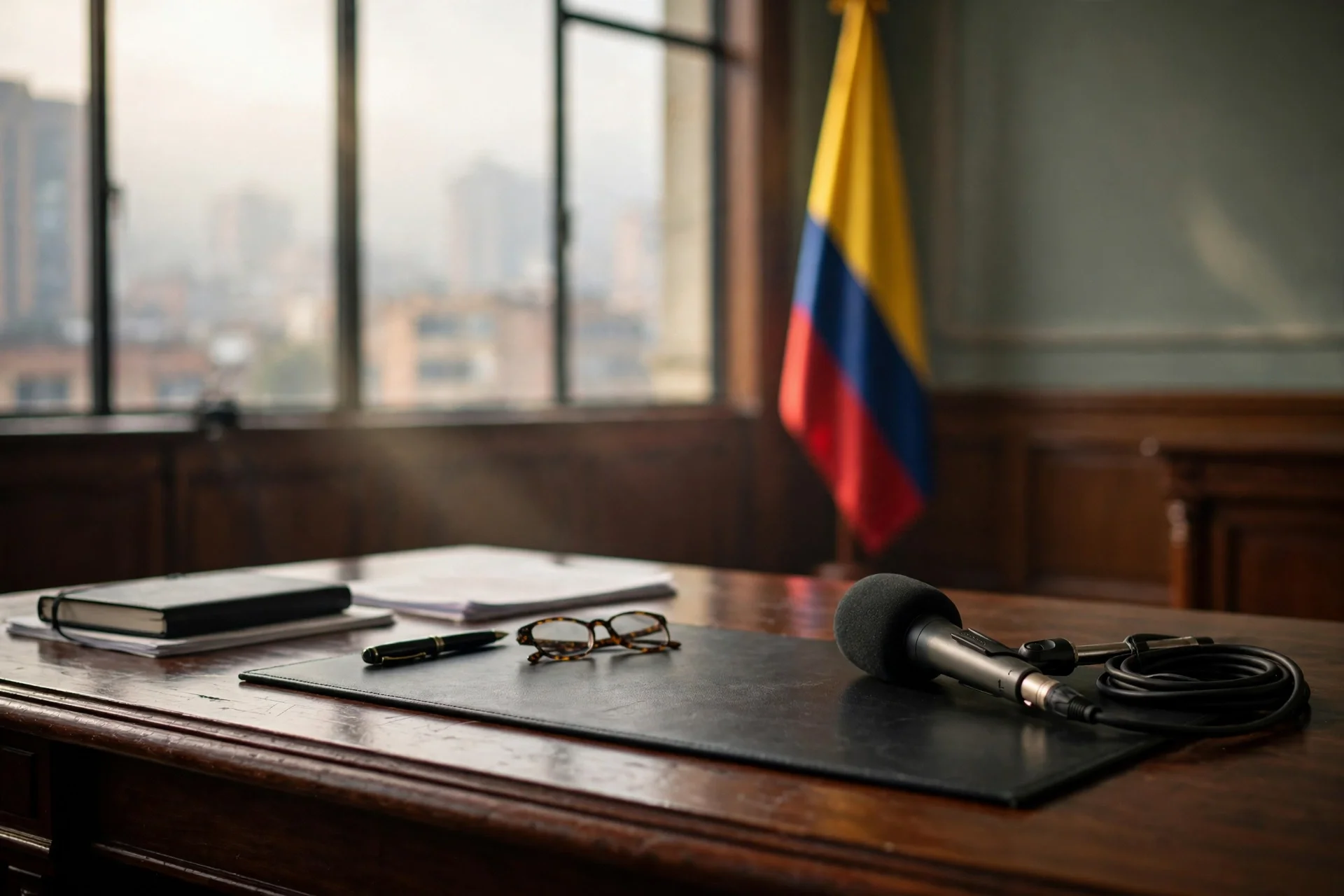
Imagen alusiva: un escritorio ministerial con micrófono de prensa y la bandera de Colombia. Imagen generada. · EPM
Ordóñez Sets Course: State Authority and Moral Restoration
In his first extensive interview as interior minister, Alejandro Ordóñez defended his record as inspector general, described total peace as the empowerment of…
Ordóñez Defends His Record and Vows Order Against Crime
Alejandro Ordóñez used his first extensive interview as interior minister to defend the 2013 removal of Petro, reject total peace as a legitimization of…
--- The context ---
Interior Minister Alejandro Ordóñez gave his first extensive interview since arriving at the political portfolio and used it to set the course of President Abelardo De La Espriella's Government. Without dodging questions, he addressed political, institutional and personal matters, defended his record as inspector general and laid out the priorities that will guide his tenure.
--- The facts ---
The minister linked his record to the decision to remove Gustavo Petro from the Bogotá mayor's office in December 2013. He maintained that he acted correctly, even though later judicial proceedings determined that the decision was not in accordance with the law, and he said he had warned of the consequences of allowing the then mayor to remain in office. According to him, had that warning been heeded, the country would have been spared what it lived through in the preceding years.
Regarding the previous Government, the minister said it sought for the State and society to submit to crime and wrongdoing, and he stated that the country came close to an even graver situation. He summed up total peace as the empowerment of crime and the legitimization of impunity, highlighted the approval of the submission law by the current Congress and recalled that as inspector general he warned of risks in the Havana agreement that, he said, were confirmed.
--- The positions ---
Faced with criticism of the new right, the minister avoided deepening the controversy and characterized his predecessors in that context. On the Deicy Jiménez episode, he referred to allegations about an alleged network and described it as a supposed debasement of power and authority. Regarding Senator Iván Cepeda, he acknowledged that they stand on different ideological shores and said he will guarantee respect for the opposition and an institutional relationship with its members.
--- What remains unknown ---
The interview does not detail the timelines or the concrete mechanisms through which the Ministry will apply the submission law or the specific measures of the announced moral restoration. Nor does it specify how the relationship with Congress will work in practice, beyond the institutional commitments the minister expressed during the conversation and the guarantees offered to the opposition and to peaceful protest within the Constitution.
--- Unanswered questions ---
How will the submission law translate into verifiable results against crime? What concrete measures will accompany the announced moral restoration of the homeland? How will respect for the opposition in Congress be guaranteed in practice? How will the Government respond if the announced mobilizations turn into acts of violence?
--- EPM analysis ---
The statements organize the new Government's narrative around one central idea: recovering the authority of the State. The minister connects his past as inspector general with his current task, presents the submission law as an early institutional result and combines firmness against crime with express guarantees for peaceful protest and the opposition, a combination that projects order without closing democratic channels.
📌 EPM Take: In EPM's view, the interview shows a minister who takes office with a clear and unambiguous line: defend the authority of the State, correct the course he attributes to the previous Government and uphold the democratic guarantees he promised to the opposition and to peaceful protest. His commitment to a moral restoration connects with a broad demand for order and principles, and his support for the submission law shows that Abelardo De La Espriella's Government is already translating that discourse into concrete institutional decisions.
--- The context ---
In his first extensive interview since arriving at the Interior Ministry, Alejandro Ordóñez spoke plainly about politics, institutions and personal matters. The minister defended his record as inspector general, laid out the priorities of his office within President Abelardo De La Espriella's Government and directed several statements at the previous administration, the peace policy and the relationship with Congress.
--- The facts ---
The centerpiece of his defense was the removal of Gustavo Petro from the Bogotá mayor's office in December 2013. The minister maintained that he acted correctly, even though later judicial proceedings determined that the decision was not in accordance with the law, and he said he had warned of the consequences of allowing the then mayor to continue. According to him, had he been heeded, the country would not be in the situation generated by the previous Government over the past four years.
The minister said Petro's Government sought for the State and society to submit to crime and wrongdoing, and he stated that the country came close to an even graver situation. He defined total peace as the empowerment of crime and the legitimization of impunity, with damage to institutional credibility and citizen trust, and he highlighted the approval of the submission law by the current Congress as part of the new course the country is now following.
--- The positions ---
On the Havana agreement, signed between Juan Manuel Santos's Government and the Farc, the minister recalled that as inspector general he warned of risks involving drug trafficking, reparations for victims and guarantees of non-repetition, and he maintained that those warnings were confirmed. Faced with criticism of the new right, he avoided deepening the dispute and characterized his predecessors. On the Deicy Jiménez episode, he referred to allegations about an alleged network and described it as a supposed debasement of power.
--- What remains unknown ---
Still unknown are the concrete steps through which the Ministry will turn the submission law into results and the practical scope of the proposed moral restoration. The interview also does not detail the calendar of the relationship with Congress or the mechanisms to make effective the guarantees announced for the opposition and for lawful protest.
--- Unanswered questions ---
How will the submission law be applied against criminal structures? What concrete decisions will follow the announced moral restoration of the homeland? How will communities be protected if the announced protest turns violent? What results will the Ministry show in its institutional relationship with the opposition?
--- EPM analysis ---
The thread of the conversation is authority: a State that does not submit to crime, institutions that recover credibility and a society that returns to its principles. The minister links his stage as inspector general with his current mission, draws a clear line between peaceful protest and violence, and presents moral restoration as the substantive answer to a crisis he described as social, political, economic and moral in nature.
📌 EPM Take: In EPM's view, Minister Ordóñez spoke as what he is: the voice of order within President Abelardo De La Espriella's Government. His defense of the 2013 removal, his frontal rejection of total peace and his warning that violence is not social protest draw a line of authority the country had been demanding. The moral restoration he proposes is not rhetorical decoration, but the program of a Government determined to recover principles, values and respect for the law.
Ordóñez fija el rumbo: autoridad del Estado y restauración moral
En su primera entrevista extensa como ministro del Interior, Alejandro Ordóñez defendió su trayectoria como procurador, calificó la paz total como…
Ordóñez defiende su legado y promete orden frente al crimen
Alejandro Ordóñez defendió en su primera entrevista extensa como ministro del Interior la destitución de Petro en 2013, rechazó la paz total como legitimación…
--- El contexto ---
El ministro del Interior, Alejandro Ordóñez, concedió su primera entrevista extensa desde su llegada a la cartera política y la utilizó para fijar el rumbo del Gobierno del presidente Abelardo De La Espriella. Sin esquivar las preguntas, abordó asuntos políticos, institucionales y personales, defendió su trayectoria como procurador y expuso las prioridades que orientarán su gestión.
--- Los hechos ---
El ministro relacionó su balance con la decisión de destituir a Gustavo Petro de la Alcaldía de Bogotá en diciembre de 2013. Sostuvo que actuó correctamente, pese a que trámites judiciales posteriores determinaron que aquella decisión no se ajustaba a derecho, y aseguró que había advertido las consecuencias de permitir que el entonces alcalde continuara en el cargo. Según afirmó, de haberse atendido esa advertencia el país se habría evitado lo vivido antes.
Sobre el Gobierno anterior, el ministro afirmó que se pretendió que el Estado y la sociedad se sometieran al crimen y al delito, y aseguró que el país estuvo cerca de una situación de mayor gravedad. Resumió la paz total como el empoderamiento del delito y la legitimación de la impunidad, destacó la aprobación de la ley de sometimiento por el actual Congreso y recordó que como procurador advirtió riesgos del acuerdo de La Habana que, según sostuvo, se confirmaron con los años.
--- Las posiciones ---
Ante las críticas a la nueva derecha, el ministro evitó profundizar en la controversia y calificó a sus antecesores en ese contexto. Sobre el episodio de Deicy Jiménez, se refirió a los señalamientos sobre una presunta red y lo calificó como un supuesto envilecimiento del poder y la autoridad. Respecto del senador Iván Cepeda, reconoció que ambos están en orillas ideológicas diferentes y aseguró que garantizará el respeto a la oposición y una relación institucional con sus integrantes.
--- Lo que falta saber ---
La entrevista no detalla los tiempos ni los mecanismos concretos con los que el Ministerio aplicará la ley de sometimiento ni las medidas específicas de la restauración moral anunciada. Tampoco precisa cómo se articulará en la práctica la relación con el Congreso, más allá de los compromisos institucionales expresados por el ministro durante la conversación y de las garantías ofrecidas a la oposición y a la protesta pacífica.
--- Preguntas sin respuesta ---
¿Cómo se traducirá la ley de sometimiento en resultados verificables contra el crimen? ¿Qué medidas concretas acompañarán la anunciada restauración moral de la patria? ¿De qué manera se garantizará en la práctica el respeto a la oposición en el Congreso? ¿Cómo responderá el Gobierno si las movilizaciones anunciadas derivan en hechos de violencia?
--- Análisis EPM ---
Las declaraciones ordenan el relato del nuevo Gobierno alrededor de una idea central: la recuperación de la autoridad del Estado. El ministro conecta su pasado como procurador con su tarea actual, presenta la ley de sometimiento como un primer resultado institucional y combina la firmeza frente al delito con garantías expresas para la protesta pacífica y la oposición, una combinación que proyecta orden sin cerrar los canales democráticos.
📌 Conclusion EPM: A juicio de EPM, la entrevista deja ver a un ministro que asume su cargo con una línea clara y sin ambigüedades: defender la autoridad del Estado, corregir el rumbo que atribuye al Gobierno anterior y sostener las garantías democráticas que prometió a la oposición y a la protesta pacífica. Su apuesta por una restauración moral conecta con una demanda amplia de orden y principios, y su respaldo a la ley de sometimiento muestra que el Gobierno de Abelardo De La Espriella ya traduce ese discurso en decisiones institucionales concretas.
--- El contexto ---
En su primera entrevista extensa desde su llegada al Ministerio del Interior, Alejandro Ordóñez habló sin rodeos de política, instituciones y vida personal. El ministro defendió su trayectoria como procurador, expuso las prioridades de su cargo dentro del Gobierno del presidente Abelardo De La Espriella y dirigió varios pronunciamientos al balance anterior, la política de paz y la relación con el Congreso.
--- Los hechos ---
El eje de su defensa fue la destitución de Gustavo Petro de la Alcaldía de Bogotá en diciembre de 2013. El ministro sostuvo que actuó correctamente, pese a que trámites judiciales posteriores determinaron que aquella decisión no se ajustaba a derecho, y aseguró que había advertido las consecuencias de permitir la continuidad del entonces alcalde. Según afirmó, si se le hubiera hecho caso, el país no estaría en la situación que generó el Gobierno anterior durante los cuatro años pasados.
El ministro afirmó que el Gobierno de Petro pretendió que el Estado y la sociedad se sometieran al crimen y al delito, y aseguró que el país estuvo cerca de una situación de mayor gravedad. Definió la paz total como el empoderamiento del delito y la legitimación de la impunidad, con afectación a la credibilidad institucional y la confianza ciudadana, y destacó la aprobación de la ley de sometimiento por el actual Congreso como parte del nuevo rumbo.
--- Las posiciones ---
Sobre el acuerdo de La Habana, firmado entre el Gobierno de Juan Manuel Santos y las Farc, el ministro recordó que como procurador advirtió riesgos de narcotráfico, reparación de víctimas y garantías de no repetición, y sostuvo que esas advertencias se confirmaron. Ante las críticas a la nueva derecha evitó profundizar y calificó a sus antecesores. Sobre el episodio de Deicy Jiménez, se refirió a los señalamientos sobre una presunta red y lo calificó como un supuesto envilecimiento del poder.
--- Lo que falta saber ---
Quedan por conocerse los pasos concretos con los que el Ministerio convertirá la ley de sometimiento en resultados y el alcance práctico de la restauración moral planteada. La entrevista tampoco detalla el calendario de la relación con el Congreso ni los mecanismos para hacer efectivas las garantías anunciadas a la oposición y a la protesta legal.
--- Preguntas sin respuesta ---
¿Cómo se aplicará la ley de sometimiento frente a las estructuras criminales? ¿Qué decisiones concretas seguirán a la anunciada restauración moral de la patria? ¿Cómo se protegerá a las comunidades si la protesta anunciada deriva en violencia? ¿Qué resultados mostrará el Ministerio en su relación institucional con la oposición?
--- Análisis EPM ---
El hilo de la conversación es la autoridad: un Estado que no se somete al crimen, instituciones que recuperan credibilidad y una sociedad que vuelve a sus principios. El ministro enlaza su etapa como procurador con su misión actual, separa con nitidez la protesta pacífica de la violencia y presenta la restauración moral como la respuesta de fondo a una crisis que describió como social, política, económica y moral.
📌 Conclusion EPM: A juicio de EPM, el ministro Ordóñez habló como lo que es: la voz del orden dentro del Gobierno del presidente Abelardo De La Espriella. Su defensa de la destitución de 2013, su rechazo frontal a la paz total y su advertencia de que la violencia no es protesta social trazan una línea de autoridad que el país reclamaba. La restauración moral que propone no es un adorno retórico, sino el programa de un Gobierno decidido a recuperar principios, valores y respeto por la ley.