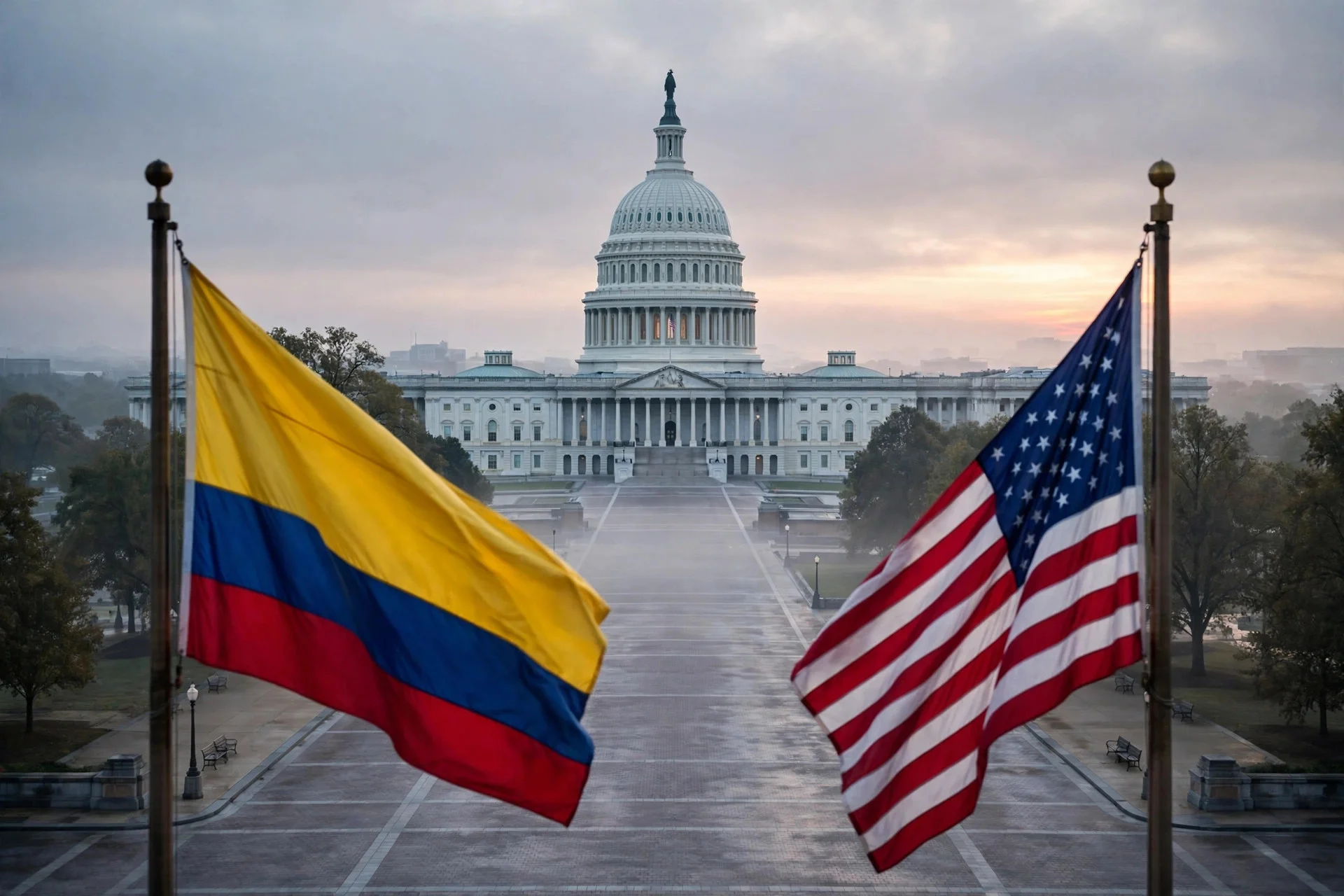
Imagen alusiva: el Capitolio de Estados Unidos con las banderas de Colombia y Estados Unidos. Imagen generada. · EPM
Nichols: a Democratic Congress reshapes the Colombia agenda
Brian Nichols, a former assistant secretary of state, said in an interview that a Democratic Congress would use hearings, spending power and the courts to…
Colombia and a Democratic Congress, in Nichols's reading
In an interview, Brian Nichols argued that a Democratic Congress would oversee Trump foreign policy, control spending and possibly litigate over tariffs…
--- The context ---
In an interview, Brian Nichols, who served as United States assistant secretary of state for Western Hemisphere affairs under President Joe Biden, described what could change for Colombia and Latin America if Democrats control Congress after the midterm elections. The White House still defines foreign policy, but a Democratic Congress, he argued, would use its oversight, spending and litigation powers to challenge the Trump administration across the hemisphere.
--- The facts ---
Nichols said Democrats would use their authority to schedule hearings and investigate the actions and foreign policy of the Trump administration. In Latin America and the Caribbean, he expected a focus on the use of military strikes against fast boats suspected of carrying narcotics in the Caribbean, on the departure of Nicolás Maduro from power, and on how the United States manages Venezuelan assets and revenue, along with the agreements reached with that country's acting president. He also pointed to a transition toward elections in Venezuela, to Haiti, and to how the administration has handled Brazil and Flavio Bolsonaro.
--- The facts ---
On Colombia specifically, Nichols said some Democrats would be concerned about President De La Espriella's backing of María Elvira Salazar and about accusations of interference in United States domestic politics. He presented that point as a concern attributed to some Democrats, not as an established fact. He added that those lawmakers would also watch how Trump has backed candidates in other countries, with Brazil as the most prominent example.
--- The positions ---
Congressional power, Nichols recalled, goes well beyond oversight hearings. The legislature can demand documents and it controls the budget process, so over the medium term it can apply pressure through spending decisions. On tariffs, he explained that the president can impose them relatively quickly, while Congress takes time to oppose them, meaning Democrats would have to negotiate them with the administration or go to court to ask that they be blocked. With a Democratic majority, he added, Congress itself could become a plaintiff against the administration.
--- The positions ---
Assistance for counternarcotics programs and for strengthening the rule of law, together with resources for migration management, will be matters on which Democrats will have a great deal to say, according to Nichols. He stressed, however, that they will have to negotiate those issues with Trump, because the president still holds the power to veto legislation, so the negotiations will need to be handled carefully. He also warned about the use of so-called pocket rescissions, when the president does not spend money approved for a given purpose and at times directs it elsewhere without congressional authorization. Democrats, he anticipated, will look for ways to stop that practice, and the Senate can block political ambassadorial nominees.
--- What remains unknown ---
What remains unknown is how that legislative control will translate into concrete decisions on funding, hearings and litigation, and how much room will exist for negotiation with a White House that keeps the veto. It is also unclear which diplomatic nominations will advance and how Trump might react if other governments move closer to Democrats, a balance Nichols described as delicate.
--- Unanswered questions ---
What specific hearings will the new Congress convene on the Caribbean strikes and on Venezuela? How will Democratic control of spending affect counternarcotics assistance and rule of law programs for Colombia? Will Congress manage to negotiate the White House tariffs or to block them in the courts? Can Colombia strengthen its ties with Democrats and Republicans in time without provoking an adverse reaction from Trump?
--- EPM analysis ---
Nichols's central recommendation was that Colombia cultivate relationships with people in both parties and present the bond as a relationship between nations, not between individuals. He recalled that Joe Biden used to say he was the father of Plan Colombia, and that Gregory Meeks and Tim Kaine both take a great interest in the country. He proposed that the embassy, the president and the foreign minister invite members of Congress to visit Colombia, travel to the United States and meet with key lawmakers. To size the shift, he said Democrats already hold 54 seats in the Senate, with a possibility of winning two more, and that in the House they had passed more than 240, with up to 250 according to his count that morning. He also recalled that Colombians fought alongside Americans in the Korean War 75 years ago. On the Republican defeat, he pointed to the economy, the cost of living and inflation, to war fatigue, to a war against Iran without congressional authorization or funding and without a prior explanation, to concern about artificial intelligence and data centers, to the Texas case of Greg Abbott against Gina Hinojosa, to a perception of Trump focused on construction and the wealthy, to a crucial Hispanic vote, to Democrats winning all border districts with Mexico and to discontent over aggressive immigration enforcement.
📌 EPM Take:
In EPM's view, Nichols's reading sets Colombia a clear and demanding diplomatic task, namely to build verifiable bridges with Democrats and Republicans alike without turning the bilateral relationship into a bet on a single person or a single party. Budget control, hearings and the courts will give Democrats a real voice on counternarcotics, the rule of law and migration, even though the presidential veto will still mark the limit of any agreement. Preparing that conversation now, with presence in Washington and with concrete invitations, is the most prudent way to protect a historic partnership.
--- The context ---
Brian Nichols, who served as United States assistant secretary of state for Western Hemisphere affairs in the Biden administration, explained in an interview what could change for Colombia and Latin America if Democrats control Congress after the midterm elections. The White House still defines foreign policy, he noted, but a Democratic Congress holds hearing, budget and litigation tools that can condition executive action.
--- The facts ---
Nichols said Democrats would use their powers to schedule hearings and investigate the actions and foreign policy of the Trump administration. In Latin America and the Caribbean, he expected attention on military strikes against fast boats suspected of transporting narcotics in the Caribbean, on the departure of Nicolás Maduro from power, on how the United States administers Venezuelan assets and revenue, and on the agreements reached with that country's acting president. He also cited the transition toward elections and democracy in Venezuela, the situation in Haiti, which could lead to a specific hearing, and how the administration has approached Brazil and the presence of Flavio Bolsonaro in the United States.
--- The facts ---
In the specific case of Colombia, Nichols said some Democrats would be worried about President De La Espriella's support for María Elvira Salazar and about accusations that he is interfering in United States domestic politics. The former official framed that unease as a perception attributed to some Democrats, not as a proven fact. In the same answer, he added that those lawmakers would be attentive to how Trump has also supported candidates in other countries and attempted to intervene in their elections, with Brazil as the most notable example, and he mentioned Colombia as well within that general concern about mutual political interventions.
--- The positions ---
Congress, Nichols recalled, can demand documents and controls the budget process, so beyond oversight hearings it can apply pressure over the medium term through appropriations. On tariffs, he said the president can impose them relatively quickly, while Congress takes time to oppose them, so Democrats would have to negotiate them with the administration or go to the courts to ask that they be blocked. Now that Democrats hold the majority, he added, Congress itself could be the plaintiff in a case against the administration, something that, according to him, the Republican-controlled Congress has not been willing to do.
--- The positions ---
Assistance for counternarcotics programs and for strengthening the rule of law, as well as resources devoted to migration management, will be issues on which Democrats will have much to say, according to Nichols. He made clear, however, that they will have to negotiate them with Trump, since the president still has the authority to veto laws, and those negotiations will therefore need careful handling. He also pointed to the use of so-called pocket rescissions, when the president does not spend money approved for a particular purpose and at times directs it to other ends without congressional authorization, a practice Democrats will seek ways to prevent. The Senate, he added, can block Trump's political ambassadorial picks.
--- What remains unknown ---
It remains to be seen how power will be shared in practice between a Democratic Congress determined to oversee and a president who retains the veto and who, in Nichols's account, has shown a willingness to stretch budget provisions to their limit. Still unknown are which nominations will clear the Senate and whether Colombia can broaden its interlocutors without the White House reading that move as a political slight.
--- Unanswered questions ---
How far will Democratic hearings actually reach on the Caribbean, Venezuela and counternarcotics policy? How much can Congress condition assistance to Colombia on security and the rule of law through the budget? Will the tariffs be negotiated with the administration or decided in the courts? Can Colombia sustain an institutional relationship with both parties without being trapped by the United States domestic dispute?
--- EPM analysis ---
Nichols advised Colombia to cultivate ties with both parties, invite members of Congress to visit, travel and meet key figures such as Gregory Meeks and Tim Kaine, and insist that the bond is between nations, not persons, recalling that Joe Biden used to say he was the father of Plan Colombia and that Colombians fought alongside Americans in the Korean War 75 years ago. To size the shift, he said Democrats hold 54 seats in the Senate, possibly two more, and more than 240 in the House, with up to 250 by his count. On the Republican defeat, Nichols pointed first to the economy, arguing that average Americans felt frustrated by the cost of living, gasoline and food prices, and inflation eroding wages. He also cited fatigue with foreign wars, a war against Iran launched, in his account, without congressional authorization or funding and without a prior explanation to the public, concern about artificial intelligence, jobs and data centers, the Texas governor race between Greg Abbott and Gina Hinojosa, a perception of a president focused on construction projects and the wealthy, a crucial Hispanic vote, Democrats winning all border districts with Mexico, and discontent with aggressive immigration enforcement.
📌 EPM Take:
In EPM's view, the core of Nichols's message is institutional and should be read without alarm. A Democratic Congress will oversee, demand documents and condition resources, but none of those powers removes the presidential veto or replaces negotiation with the White House. For Colombia, the prudent response is the one the former official himself described, a state to state diplomacy that is broad and bipartisan, able to defend counternarcotics cooperation, the rule of law and migration management before any majority. That consistency, more than any personal alignment, is what protects the relationship over time.
Nichols: un Congreso demócrata cambia el pulso con Colombia
Brian Nichols, exsubsecretario de Estado, explicó en una entrevista que un Congreso demócrata usaría audiencias, presupuesto y tribunales para condicionar la…
Colombia ante un Congreso demócrata, según Brian Nichols
En una entrevista, Brian Nichols sostuvo que un Congreso demócrata supervisaría la política exterior de Trump, controlaría el presupuesto y podría litigar por…
--- El contexto ---
La entrevista a Brian Nichols, exsubsecretario de Estado de Estados Unidos para el Hemisferio Occidental durante el gobierno de Joe Biden, parte de un cambio de fondo en Washington. Según explicó Nichols, los demócratas se encaminan a controlar ambas cámaras del Congreso tras las elecciones de medio término, mientras la Casa Blanca sigue definiendo la política exterior. En ese escenario, advirtió, la relación con América Latina y con Colombia entrará en una etapa de mayor escrutinio.
--- Los hechos ---
Nichols afirmó que, con el control demócrata, el Congreso utilizará sus facultades para programar audiencias e investigar las acciones y la política exterior de la administración de Donald Trump. En América Latina y el Caribe, según su previsión, el foco estará en el uso de ataques militares contra embarcaciones rápidas sospechosas de transportar narcóticos en el Caribe, en la salida de Nicolás Maduro del poder y en la manera en que Estados Unidos administra los activos y los ingresos de Venezuela. También mencionó los acuerdos con la presidenta encargada y la transición hacia unas elecciones. Añadió que la situación de Haití es otro asunto de interés demócrata, que podría convocarse una audiencia sobre lo que ocurre allí y que también se examinará la manera en que la administración ha abordado la situación de Brasil y la presencia de Flavio Bolsonaro en Estados Unidos.
--- Los hechos ---
En el caso específico de Colombia, Nichols dijo que algunos demócratas estarían preocupados por el respaldo del presidente De La Espriella a María Elvira Salazar y por acusaciones de interferencia en la política interna estadounidense. Esa valoración fue presentada por Nichols como una preocupación atribuida a algunos demócratas, no como un hecho demostrado. Agregó que esos legisladores estarán atentos a cómo Trump también ha respaldado candidatos en otros países, con Brasil como ejemplo más destacado.
--- Las posiciones ---
Nichols recordó que las facultades del Congreso van más allá de las audiencias. Según explicó, el Legislativo puede exigir documentos y controla el proceso presupuestal, por lo que a mediano plazo podrá ejercer presión a través del presupuesto. Sobre los aranceles, sostuvo que el presidente puede imponerlos de manera relativamente rápida, mientras que al Congreso le toma tiempo oponerse, por lo que los demócratas tendrían que negociarlos con la administración o acudir a los tribunales para pedir que se bloqueen. Añadió que el propio Congreso podría ser demandante contra la administración.
--- Las posiciones ---
La asistencia antinarcóticos, el Estado de derecho y la gestión migratoria serán asuntos en los que los demócratas tendrán mucho que decir, según Nichols. Subrayó, sin embargo, que tendrán que negociarlos con Trump, porque el presidente conserva la facultad de vetar las leyes. También advirtió sobre el uso de las llamadas pocket rescissions, cuando el presidente no gasta el dinero aprobado para un propósito determinado y en ocasiones lo destina a otros fines sin autorización del Congreso, una práctica que, según anticipó, Trump intentará seguir usando y los demócratas buscarán impedir. En el Senado, además, podrán bloquearse las nominaciones de embajadores de perfil político designados por Trump.
--- Lo que falta saber ---
Todavía falta saber cómo se traducirá ese control legislativo en decisiones concretas sobre fondos, audiencias y litigios, y cuánto margen real tendrá la negociación con una Casa Blanca que conserva el veto. Tampoco está claro qué nominaciones diplomáticas avanzarán ni cómo responderá Trump si percibe que otros gobiernos estrechan lazos con los demócratas, un equilibrio que Nichols describió como delicado.
--- Preguntas sin respuesta ---
¿Qué audiencias concretas convocará el nuevo Congreso sobre los ataques en el Caribe y sobre Venezuela? ¿Cómo afectará el control presupuestal demócrata a la asistencia antinarcóticos y a los programas de Estado de derecho para Colombia? ¿Logrará el Congreso negociar o frenar en los tribunales los aranceles impulsados por la Casa Blanca? ¿Conseguirá Colombia fortalecer a tiempo sus vínculos con demócratas y republicanos sin provocar una reacción adversa de Trump?
--- Análisis EPM ---
La recomendación central de Nichols fue que Colombia cultive relaciones con ambos partidos y que presente el vínculo como una relación entre naciones y no entre personas. Recordó que Joe Biden solía decir que era el padre del Plan Colombia y que Gregory Meeks y Tim Kaine mantienen un gran interés en el país. Propuso que la Embajada, el presidente y el canciller inviten a miembros del Congreso a visitar Colombia, viajen a Estados Unidos y se reúnan con legisladores clave. Sobre la magnitud del cambio, Nichols señaló que los demócratas ya tienen 54 escaños en el Senado, con posibilidad de conseguir dos más, y que en la Cámara superaban los 240, con hasta 250 según su recuento. También recordó que los colombianos combatieron junto a los estadounidenses en la guerra de Corea hace 75 años. Sobre la derrota republicana, atribuyó el resultado a la economía, el costo de vida y la inflación, al cansancio de las guerras, a la guerra contra Irán sin autorización ni financiación del Congreso y sin explicación previa, a la preocupación por la inteligencia artificial y los centros de datos, al caso de Texas entre Greg Abbott y Gina Hinojosa, a la percepción de un Trump concentrado en construcciones y en los ricos, al voto hispano crucial, a que los demócratas ganaron todos los distritos fronterizos con México y al malestar por la aplicación migratoria agresiva.
📌 Conclusion EPM:
A juicio de EPM, la lectura de Nichols deja una tarea diplomática clara y exigente para Colombia, consistente en construir puentes verificables con demócratas y republicanos sin convertir la relación bilateral en una apuesta por una sola persona o por un solo partido. El control del presupuesto, las audiencias y los tribunales dará a los demócratas una voz real sobre narcotráfico, Estado de derecho y migración, aunque el veto presidencial seguirá marcando el límite de cualquier acuerdo. Preparar esa conversación desde ahora, con presencia en Washington y con invitaciones concretas, es la forma más prudente de proteger una cooperación histórica.
--- El contexto ---
En una entrevista, Brian Nichols, exsubsecretario de Estado de Estados Unidos para el Hemisferio Occidental en el gobierno de Joe Biden, explicó qué podría cambiar para Colombia y América Latina si los demócratas controlan el Congreso tras las elecciones de medio término. Aunque la Casa Blanca sigue definiendo la política exterior, un Congreso demócrata dispone, según recordó, de herramientas de supervisión, presupuesto y litigio capaces de condicionar al Ejecutivo.
--- Los hechos ---
Nichols sostuvo que los demócratas utilizarán sus facultades para programar audiencias e investigar las acciones y la política exterior de la administración Trump. Para América Latina y el Caribe, anticipó un foco en los ataques militares contra embarcaciones rápidas sospechosas de transportar narcóticos en el Caribe, en la salida de Nicolás Maduro del poder, en la administración estadounidense de los activos y los ingresos de Venezuela y en los acuerdos alcanzados con la presidenta encargada de ese país. También mencionó la transición hacia elecciones en Venezuela, la situación de Haití y la presencia de Flavio Bolsonaro en Estados Unidos.
--- Los hechos ---
Sobre Colombia, Nichols dijo que algunos demócratas estarían preocupados por el respaldo del presidente De La Espriella a María Elvira Salazar y por acusaciones de interferencia en la política interna estadounidense. Esa inquietud fue formulada por el exfuncionario como una percepción atribuida a algunos demócratas, y no como un hecho establecido. Agregó que esos legisladores estarán atentos a cómo Trump también ha respaldado candidatos en otros países, con Brasil como ejemplo más destacado.
--- Las posiciones ---
El Congreso, recordó Nichols, puede exigir documentos y controla el proceso presupuestal, por lo que a mediano plazo podrá ejercer presión a través del presupuesto, además de las audiencias de supervisión. En materia de aranceles, explicó que el presidente puede imponerlos de manera relativamente rápida, mientras que al Congreso le toma tiempo oponerse, de modo que los demócratas tendrían que negociarlos con la administración o acudir a los tribunales para pedir que los bloqueen. Con la mayoría, añadió, el propio Congreso podría presentarse como demandante contra la administración.
--- Las posiciones ---
De acuerdo con Nichols, la asistencia para programas de lucha contra el narcotráfico y de fortalecimiento del Estado de derecho, junto con los recursos destinados a la gestión migratoria, serán asuntos en los que los demócratas tendrán mucho que decir. Precisó, no obstante, que deberán negociarlos con Trump, porque el presidente todavía tiene la facultad de vetar las leyes, por lo que esas negociaciones deberán manejarse con cuidado. También señaló el uso de las llamadas pocket rescissions, cuando el presidente no gasta el dinero aprobado para un propósito determinado y en ocasiones lo destina a otros fines sin autorización del Congreso. Los demócratas, anticipó, buscarán maneras de impedirlo, y el Senado podrá bloquear nominaciones de embajadores de perfil político.
--- Lo que falta saber ---
Queda por verse cómo se repartirá en la práctica el poder entre un Congreso demócrata decidido a supervisar y un presidente que conserva el veto y que, según Nichols, ha mostrado disposición a estirar al máximo las disposiciones presupuestales. Falta saber qué nominaciones superarán el Senado, cómo evolucionarán los litigios por aranceles y si Colombia logrará ampliar sus interlocutores sin que la Casa Blanca lo interprete como un desaire.
--- Preguntas sin respuesta ---
¿Qué alcance real tendrán las audiencias demócratas sobre el Caribe, Venezuela y la política antinarcóticos? ¿Hasta dónde podrá el Congreso condicionar con el presupuesto la asistencia a Colombia en seguridad y Estado de derecho? ¿Se negociarán los aranceles con la administración o terminarán definiéndose en los tribunales? ¿Podrá Colombia sostener una relación institucional con ambos partidos sin quedar atrapada en la disputa interna estadounidense?
--- Análisis EPM ---
Nichols recomendó que Colombia trabaje para cultivar relaciones con personas de ambos partidos, sin ignorar a los republicanos por el nuevo peso demócrata. Recordó que Joe Biden solía decir que era el padre del Plan Colombia y que Gregory Meeks y Tim Kaine tienen un gran interés en el país. Su propuesta concreta fue que la Embajada, el presidente y el canciller inviten a miembros del Congreso a visitar Colombia, viajen a Estados Unidos y se reúnan con congresistas clave, insistiendo en que se trata de una relación entre naciones y no entre personas. Para dimensionar el cambio, afirmó que los demócratas ya tienen 54 escaños en el Senado, con posibilidad de conseguir dos más, y que en la Cámara superaban los 240, con hasta 250 según su recuento de esa mañana. Como ancla histórica, recordó que los colombianos combatieron junto a los estadounidenses en la guerra de Corea hace 75 años. Sobre la derrota republicana, Nichols la explicó por la economía, el costo de vida y la inflación, por el cansancio de las guerras y una guerra contra Irán sin autorización ni financiación del Congreso y sin explicación previa, por la preocupación ante la inteligencia artificial y los centros de datos, por el caso de Texas entre Greg Abbott y Gina Hinojosa, por la percepción de un Trump concentrado en construcciones y en los ricos, por el voto hispano crucial, porque los demócratas ganaron todos los distritos fronterizos con México y por el malestar ante la aplicación migratoria agresiva.
📌 Conclusion EPM:
A juicio de EPM, el mensaje de fondo de Nichols es institucional y debe leerse sin alarmismo. Un Congreso demócrata supervisará, exigirá documentos y condicionará recursos, pero ninguna de esas facultades elimina el veto presidencial ni sustituye la negociación con la Casa Blanca. Para Colombia, la respuesta prudente es la que el propio exfuncionario describió, una diplomacia de Estado, amplia y bipartidista, capaz de defender la cooperación antinarcóticos, el Estado de derecho y la gestión migratoria ante cualquier mayoría. Esa constancia, más que cualquier alineamiento personal, es lo que protege la relación en el tiempo.