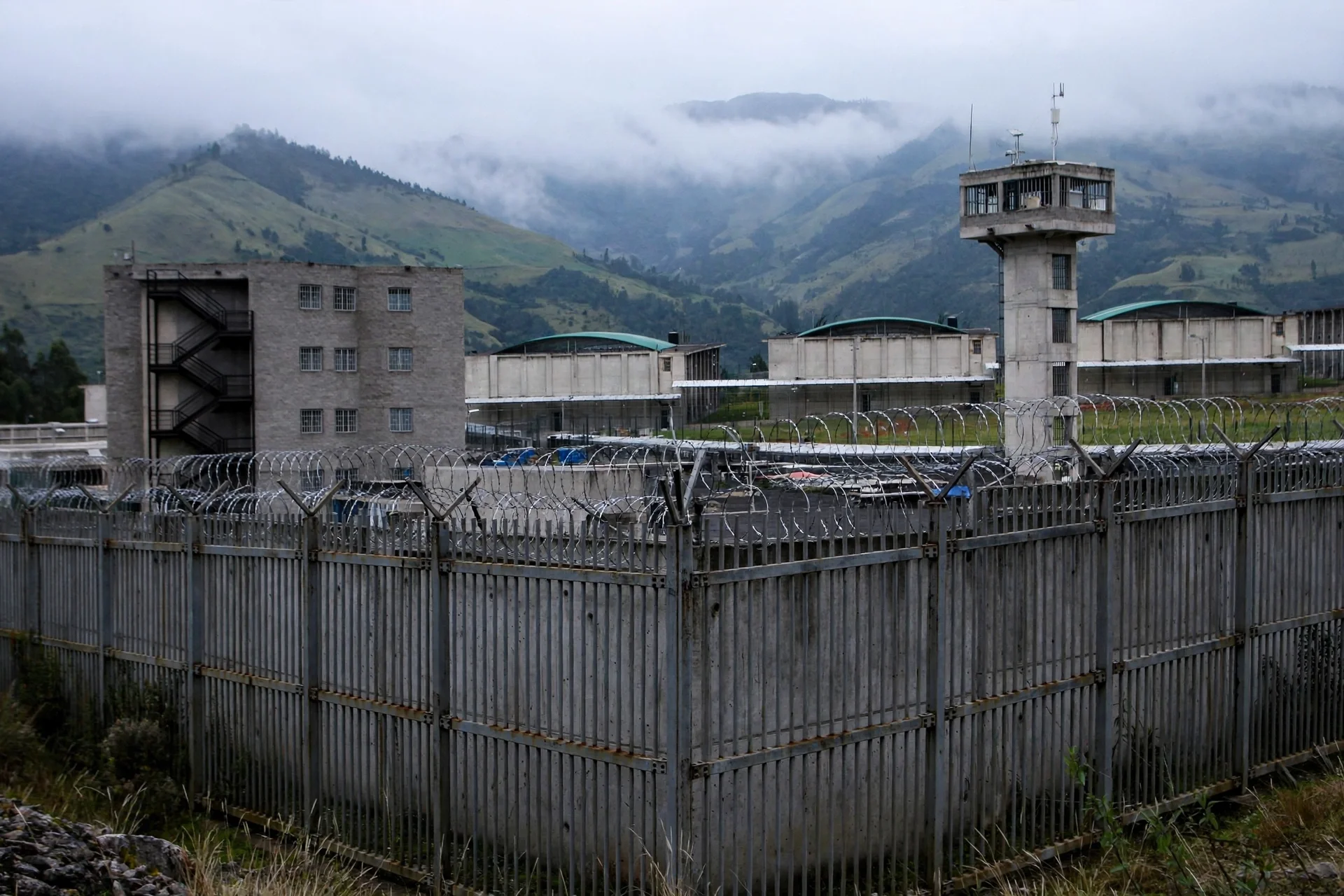
Centro penitenciario en Boyacá, en el contexto de las medidas de traslado de internos anunciadas para Cómbita. · Imagen generada
De la Espriella orders Boyacá inmates moved out of Cómbita prison
President Abelardo de la Espriella ordered progress on transferring prisoners who come from Boyacá and are held at Cómbita to prisons in other regions, after a…
Boyacá-born prisoners to leave Cómbita for prisons in other regions
After the Security Council in Boyacá, the president ordered officials to characterize Cómbita inmates who come from the department so they can be transferred…
--- The context ---
The Cómbita prison, known as El Barne, in the department of Boyacá, has become the focal point of the government's prison policy after a large registration and control operation and a Security Council held in the department with the military and police leadership and the departmental commanders of the security forces. In that setting, President Abelardo de la Espriella announced a measure that changes the placement rule for part of the inmate population: those who come from Boyacá will no longer remain held there and will be transferred to facilities in other regions of the country.
--- The facts ---
The president said he had ordered progress on transferring prisoners who come from Boyacá and are held at Cómbita to prisons in other regions. As a first step, he asked the governor and the mayors of Boyacá to identify and characterize the detainees in that facility who originate from the region, in order to arrange their departure from the department and their relocation. The announcement came two days after the results of the November 7 operation were released, and the president did not specify how many inmates will be transferred, which prisons will receive them, or on what date the procedure will begin.
In that same framework, the president linked the transfer order to stronger controls inside Cómbita, arguing that detention facilities cannot become spaces from which criminal activities are maintained or strengthened. The instruction to reinforce surveillance was issued during the Security Council and was presented as a complement to the characterization work that must precede any relocation of inmates to other regions.
--- The positions ---
As the president explained it, the policy behind the decision seeks to ensure that people accused of committing crimes do not remain held in the same territories where they carried out their criminal activities or in the places they come from. In his remarks, he argued in general terms that he will not allow those deprived of liberty to keep sowing terror, that he will strengthen controls and fight corruption, and that he will work to fully restore authority inside prisons. He also said he had issued instructions to block the networks that continue extorting, threatening and coordinating crimes from inside detention facilities.
--- What remains unknown ---
The operation's tally helps gauge the problem the government says it faces inside El Barne. With 300 officials from Inpec and the National Police deployed, authorities seized 264 cell phones, 456 SIM cards and 24 wifi devices, along with 91 sharp weapons and 7,028,000 pesos in cash. They also reported 3.5 kilograms of marijuana, 2.6 kilograms of cocaine and 800 liters of artisanal liquor. The search also found 232 chargers, 25 Bluetooth earbuds, seven speakers, one tablet, two projectors, one microSD card, one smartwatch, three chains and two rings said to be gold.
--- Unanswered questions ---
Several central questions about implementation remain open. How many inmates from Boyacá currently meet that condition inside Cómbita, and how many will actually be transferred? Which facilities in other regions will receive them, and what available capacity will they have to do so? Will the measure cover every inmate who originates from the department, or will additional criteria be applied to decide each relocation? Without those answers, it is still not possible to measure the real scope of the announcement or its timetable for delivery.
--- EPM analysis ---
The decision combines two levels that should be kept distinct. The first is operational: removing from a prison the objects that allow inmates to communicate, coordinate and sustain illegal economies from inside, as shown by the seized cell phones, SIM cards and wifi devices. The second is territorial: moving an inmate away from the environment where, under the policy set out by the president, that person built local ties and carried out criminal activity. If the characterization work by the governor's office and the mayors is rigorous and the transfers are carried out with defined destinations, the measure can change the conditions that made internal control so difficult. If identification drags on or destinations remain unspecified, the announcement risks remaining an intention with no verifiable effect on daily life inside the prison.
📌 EPM Take:
In EPM's view, transferring inmates who come from Boyacá out of Cómbita targets a concrete logic: the closeness between the place of detention, the territory of origin and the criminal network the measure seeks to break up. The earlier operation showed in figures why internal control was under debate, and treating those two levels separately would miss the full diagnosis behind the decision. The measure will be judged when the number of people transferred, the destinations and the dates are known, because that is where it will become clear whether the characterization advances, whether the receiving prisons are prepared, and whether the control regained at El Barne holds over time without moving the problem to another facility.
--- The context ---
Order inside prisons returned to the center of the security agenda with the case of Cómbita, in Boyacá. The facility known as El Barne operates there, and a recent operation exposed the scale of prohibited items circulating among inmates. After that procedure, and during a Security Council held in the department with the military and police leadership, President Abelardo de la Espriella announced that prisoners who come from Boyacá will be removed from that prison and transferred to facilities in other regions of the country, as part of a broader effort to restore authority inside detention centers.
--- The facts ---
The presidential instruction has a clearly defined preliminary step. The president asked the governor and the mayors of Boyacá to identify and characterize the detainees at Cómbita who originate from that region, so that their departure from the department and their relocation to other facilities can be arranged. The policy he explained is direct: people accused of committing crimes should not remain held where they offended or where they come from. The president did not say how many inmates would be included in the transfer, which prisons would receive them, or when the procedure would begin, and he did not detail the administrative and prison procedures that will accompany it.
The announcement was also framed as part of a broader effort to regain control of prison facilities and prevent criminal activities from continuing to be coordinated from inside them. According to what the president set out, blocking those networks and sustaining authority inside prisons are prior conditions for any transfer to produce a lasting effect on security across the department and beyond its borders.
--- The positions ---
The president argued, according to his remarks, that he will not allow those deprived of liberty to keep sowing terror among Colombians, and that he will keep strengthening controls, fighting corruption and restoring authority inside prisons. He also said the party is over for those who intend to keep operating from prisons, and that detention facilities cannot become universities of crime, criminal operations centers or spaces of privilege. Along the same lines, he said he had issued instructions to increase controls at Cómbita and to block the networks that extort, threaten and coordinate crimes from inside prisons, presenting control of the facilities as a condition for security outside them.
--- What remains unknown ---
What remains unknown is precisely what will turn the announcement into an executable plan. The number of inmates who meet the condition of coming from Boyacá is not known, nor are the criteria that will be used if the measure does not cover all of them, nor the transfer dates. The receiving facilities and their capacity have not been announced either. In the meantime, the immediate precedent remains the November 7 operation, carried out by 300 officials from Inpec and the National Police, whose results the president himself presented as part of the actions to regain control of the country's prison facilities.
--- Unanswered questions ---
The questions the decision leaves behind are practical and verifiable. How long will the governor's office and the mayors take to complete the characterization of inmates who come from Boyacá? Which prisons in other regions will receive those transferred, and under what capacity and security conditions will they do so? Will there be a public timetable with dates and responsible officials to track compliance with the order? Answering those questions with data will show whether the transfer is carried out as a sustained prison-order policy or fades into paperwork with no verifiable result inside or outside Cómbita.
--- EPM analysis ---
The inventory seized at El Barne explains the official insistence on control. Authorities reported 264 cell phones, 456 SIM cards, 24 wifi devices, 91 sharp weapons and 7,028,000 pesos in cash, in addition to 3.5 kilograms of marijuana, 2.6 kilograms of cocaine and 800 liters of artisanal liquor. They also added 232 chargers, 25 Bluetooth earbuds, seven speakers, one tablet, two projectors, one microSD card, one smartwatch, three chains and two rings said to be gold. With that level of circulation of communications and prohibited items, transferring inmates with local roots is presented as one piece of a larger strategy: without permanent internal control, any relocation loses force as the weeks pass and new networks form.
📌 EPM Take:
In EPM's view, the measure announced for Cómbita rests on evidence that the operation itself put on display: a prison crossed by cell phones, weapons and cash is not put in order with sporadic searches alone, and moving inmates away from their territory of origin seeks to cut ties that make criminal operations from inside easier. Whether the decision succeeds or fails will not be measured by the announcement, but by its execution: a complete characterization, defined destinations, dates that are met and controls that remain in place after the transfer. That follow-up, with public and verifiable figures, is what will separate a policy of order from a passing gesture in national prison policy and public security.
De la Espriella ordena trasladar a presos boyacenses de Cómbita
El presidente Abelardo de la Espriella ordenó avanzar en el traslado de presos oriundos de Boyacá recluidos en Cómbita hacia cárceles de otras regiones, tras…
Presos de Boyacá saldrán de Cómbita hacia otras regiones del país
Tras el Consejo de Seguridad en Boyacá, el presidente ordenó caracterizar a los internos de Cómbita oriundos del departamento para trasladarlos a cárceles de…
--- El contexto ---
La cárcel de Cómbita, conocida como El Barne, en el departamento de Boyacá, quedó en el centro de la política penitenciaria del Gobierno tras un megaoperativo de registro y control y tras un Consejo de Seguridad realizado en el departamento con la cúpula militar y policial y los comandantes departamentales de la Fuerza Pública. En ese escenario, el presidente Abelardo de la Espriella anunció una medida que cambia el criterio de permanencia de una parte de los internos: quienes sean oriundos de Boyacá no seguirán recluidos allí y serán trasladados a establecimientos de otras regiones del país.
--- Los hechos ---
El mandatario comunicó que ordenó avanzar en el traslado de los presos oriundos de Boyacá que permanecen en Cómbita hacia cárceles de otras regiones. Como primer paso, pidió al gobernador y a los alcaldes del departamento identificar y caracterizar a los detenidos de ese establecimiento que sean originarios de la región, con el propósito de gestionar su salida del departamento y su reubicación. El anuncio llegó dos días después de que se divulgaran los resultados del operativo del 7 de noviembre, y el presidente no precisó cuántos internos serán trasladados, qué cárceles los recibirán ni en qué fecha comenzará el procedimiento.
En ese mismo marco, el presidente vinculó la orden de traslado con el refuerzo de los controles dentro de Cómbita, al considerar que los establecimientos de reclusión no pueden convertirse en espacios desde los cuales se mantengan o fortalezcan actividades criminales. La instrucción de reforzar la vigilancia se impartió durante el Consejo de Seguridad y se presentó como complemento de la caracterización previa a las reubicaciones.
--- Las posiciones ---
Según explicó el presidente, la política que orienta la decisión busca que las personas señaladas de cometer delitos no permanezcan recluidas en los mismos territorios donde desarrollaron sus actividades criminales ni en aquellos de los que son oriundas. En su intervención sostuvo, en términos generales, que no permitirá que quienes están privados de la libertad sigan sembrando terror, que fortalecerá los controles y combatirá la corrupción, y que trabajará para recuperar plenamente la autoridad dentro de las cárceles. También afirmó que impartió instrucciones para cerrar el paso a las redes que continúan extorsionando, amenazando y coordinando delitos desde los centros de reclusión.
--- Lo que falta saber ---
El balance del operativo ayuda a dimensionar el problema que el Gobierno dice enfrentar dentro de El Barne. Con 300 funcionarios del Inpec y de la Policía Nacional desplegados, las autoridades incautaron 264 celulares, 456 tarjetas SIM y 24 dispositivos wifi, además de 91 armas cortopunzantes y 7.028.000 pesos en efectivo. También reportaron 3,5 kilogramos de marihuana, 2,6 kilogramos de cocaína y 800 litros de licor artesanal. El registro encontró además 232 cargadores, 25 auriculares Bluetooth, siete parlantes, una tableta, dos proyectores, una tarjeta microSD, un reloj inteligente, tres cadenas y dos anillos que serían de oro.
--- Preguntas sin respuesta ---
Quedan abiertos varios interrogantes centrales sobre la ejecución de la medida. ¿Cuántos internos oriundos de Boyacá cumplen hoy esa condición dentro de Cómbita y cuántos serán efectivamente trasladados? ¿Qué establecimientos de otras regiones los recibirán y con qué capacidad disponible contarán para hacerlo? ¿La medida cubrirá a todos los internos originarios del departamento o se aplicarán criterios adicionales para decidir cada reubicación? Sin esas respuestas, todavía no es posible medir el alcance real del anuncio ni su calendario de cumplimiento.
--- Análisis EPM ---
La decisión combina dos planos que conviene distinguir. El primero es operativo: retirar de un penal objetos que permiten comunicarse, coordinar y sostener economías ilegales desde adentro, como lo muestran los celulares, las tarjetas SIM y los dispositivos wifi incautados. El segundo es territorial: alejar al interno del entorno donde, según la política expuesta por el presidente, construyó sus vínculos y desarrolló su actividad criminal. Si la caracterización que harán gobernación y alcaldías es rigurosa y los traslados se ejecutan con destinos definidos, la medida puede alterar las condiciones que facilitaron ese control interno. Si, en cambio, la identificación se demora o los destinos no se precisan, el anuncio corre el riesgo de quedarse en una intención sin efecto verificable sobre la vida diaria del penal.
📌 Conclusion EPM:
A juicio de EPM, el traslado de internos oriundos de Boyacá fuera de Cómbita ataca una lógica concreta: la cercanía entre el lugar de reclusión, el territorio de origen y la red criminal que se busca desarticular. El operativo previo mostró con cifras por qué el control interno estaba en discusión, y separar ambos planos sería perder de vista el diagnóstico completo. La medida será juzgable cuando se conozcan el número de trasladados, los destinos y las fechas, porque allí se verá si la caracterización avanza, si las cárceles receptoras están preparadas y si el control recuperado en El Barne se sostiene en el tiempo sin trasladar el problema a otro establecimiento del país.
--- El contexto ---
El orden dentro de las cárceles volvió a ocupar el centro de la agenda de seguridad con el caso de Cómbita, en Boyacá. Allí funciona el establecimiento conocido como El Barne, donde un operativo reciente expuso la magnitud de los objetos prohibidos que circulaban entre los internos. Después de ese procedimiento, y en el marco de un Consejo de Seguridad realizado en el departamento con la cúpula militar y policial, el presidente Abelardo de la Espriella anunció que los presos oriundos de Boyacá serán sacados de ese penal y trasladados a cárceles de otras regiones del país.
--- Los hechos ---
La instrucción presidencial tiene un paso previo claramente definido. El mandatario solicitó al gobernador y a los alcaldes de Boyacá identificar y caracterizar a los detenidos en Cómbita que sean originarios de esa región, para gestionar su salida del departamento y su reubicación en otros establecimientos. La política que explicó es directa: las personas señaladas de cometer delitos no deben permanecer recluidas donde delinquieron ni de donde son oriundas. El presidente no informó cuántos internos entrarían en el traslado, cuáles serían las cárceles de destino ni cuándo comenzaría el procedimiento, y tampoco detalló los trámites administrativos y penitenciarios que lo acompañarán.
El anuncio se entendió además como parte de un esfuerzo más amplio por recuperar el control de los establecimientos penitenciarios y evitar que desde su interior se sigan coordinando actividades delictivas. De acuerdo con lo expuesto por el presidente, cerrar el paso a esas redes y sostener la autoridad dentro de las cárceles son condiciones previas para que cualquier traslado produzca un efecto duradero en la seguridad del departamento.
--- Las posiciones ---
El presidente sostuvo, según su intervención, que no permitirá que quienes están privados de la libertad sigan sembrando terror entre los colombianos, y que seguirá fortaleciendo los controles, combatiendo la corrupción y recuperando la autoridad dentro de las cárceles. Afirmó además que se acabó la fiesta de quienes pretenden seguir operando desde las prisiones y que los establecimientos de reclusión no pueden convertirse en universidades del crimen ni en centros de operaciones criminales o espacios de privilegios. En la misma línea, señaló que impartió instrucciones para aumentar los controles en Cómbita y para cerrar el paso a las redes que extorsionan, amenazan y coordinan delitos desde el interior de los penales.
--- Lo que falta saber ---
Lo que falta saber es justamente lo que convertirá el anuncio en un plan ejecutable. No se conoce el número de internos que cumplen la condición de ser oriundos de Boyacá, ni los criterios que se usarán si la medida no cubre a todos ellos, ni las fechas del traslado. Tampoco se han anunciado los establecimientos receptores ni su capacidad. Mientras tanto, el antecedente inmediato sigue siendo el operativo del 7 de noviembre, ejecutado por 300 funcionarios del Inpec y de la Policía Nacional, cuyo balance el propio presidente presentó como parte de las acciones para recuperar el control de los establecimientos penitenciarios del país.
--- Preguntas sin respuesta ---
Las preguntas que deja la decisión son prácticas y verificables. ¿En cuánto tiempo completarán la gobernación y las alcaldías la caracterización de los internos oriundos de Boyacá? ¿Qué cárceles de otras regiones recibirán a los trasladados y en qué condiciones de cupo y seguridad lo harán? ¿Habrá un cronograma público con fechas y responsables para seguir el cumplimiento de la orden? Responderlas con datos permitirá saber si el traslado se ejecuta como una política sostenida de orden penitenciario o si se diluye entre trámites sin un resultado comprobable dentro y fuera de Cómbita.
--- Análisis EPM ---
El inventario incautado en El Barne explica la insistencia oficial en el control. Las autoridades reportaron 264 celulares, 456 tarjetas SIM, 24 dispositivos wifi, 91 armas cortopunzantes y 7.028.000 pesos en efectivo, además de 3,5 kilogramos de marihuana, 2,6 kilogramos de cocaína y 800 litros de licor artesanal. Sumaron también 232 cargadores, 25 auriculares Bluetooth, siete parlantes, una tableta, dos proyectores, una tarjeta microSD, un reloj inteligente, tres cadenas y dos anillos que serían de oro. Con ese nivel de circulación de comunicaciones y de objetos prohibidos, el traslado de internos con arraigo local se plantea como una pieza más de una estrategia mayor: sin control interno permanente, cualquier reubicación pierde fuerza con el paso de las semanas.
📌 Conclusion EPM:
A juicio de EPM, la medida anunciada para Cómbita tiene un sustento que el propio operativo dejó a la vista: un penal atravesado por celulares, armas y dinero en efectivo no se ordena solo con registros esporádicos, y alejar a los internos de su territorio de origen busca cortar vínculos que facilitan la operación criminal desde adentro. El acierto o el fracaso de la decisión no se medirá en el anuncio, sino en la ejecución: caracterización completa, destinos definidos, fechas cumplidas y controles que se mantengan después del traslado. Ese seguimiento, con cifras públicas y verificables, es lo que separará una política de orden de un gesto pasajero en materia penitenciaria nacional.