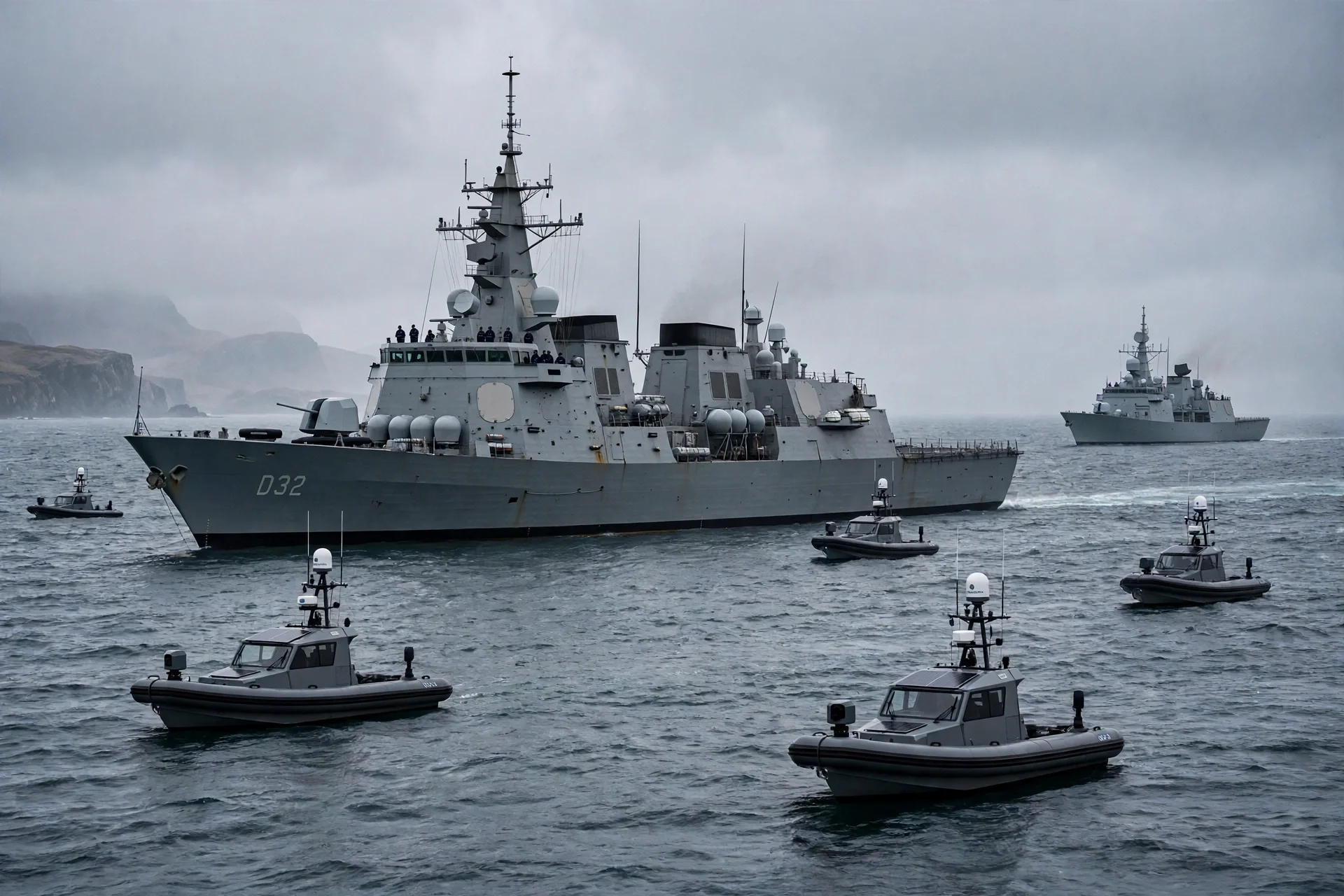
Buques de guerra junto a embarcaciones autónomas, la combinación tripulada y no tripulada de la nueva marina híbrida británica. · EPM
Britain builds hybrid navy with Nordic pact and autonomous fleet
In Oslo, General Sir Gwyn Jenkins signed the northern navies agreement after nine months, detailed thirteen frigates in build, 280,000 tonnes of new steel and…
Royal Navy must be ready to fight in 1,000 days, chief warns
The Royal Navy chief set a 1,000 day fighting readiness task in Oslo, citing thirteen frigates, four Dreadnought submarines, up to a dozen AUKUS attack…
First Sea Lord General Sir Gwyn Jenkins used the International Sea Power Conference in Oslo to sign the Joint Expeditionary Force Northern Navies Initiative agreement after nine months of work and to present a naval rebuild already visible in steel, autonomous squadrons and shared undersea sensing for Britain, its NATO partners and its northern allies in the coming decade ahead.
--- The context ---
Jenkins told fellow chiefs and delegates that the world has changed, that threats are multiplying and that Britain and its European allies must step up to defend what they hold most dear. He placed the agreement inside a return to an era of state-on-state contest, unfamiliar territory even for officers with long uniformed careers, and he did not hide the unsettling character of that shift. At the same time he pointed to agency rather than fatalism, arguing that ministers, military planners and industry leaders can still shape outcomes if they act together and adapt quickly enough to meet the challenge before them in time.
--- The facts ---
The recapitalisation is the most extensive for the Royal Navy since the Second World War. Thirteen new frigates are already in build, including the Type 26 ships to be operated alongside Norway, followed by six Common Combat Vessels designed to command uncrewed systems. Under the sea, four Dreadnought submarines renew the nuclear deterrent, the Astute programme is being completed and AUKUS prepares a next generation of up to a dozen attack submarines. Four new amphibious ships and four Fleet Solid Support ships complete the picture. The current programme totals 280,000 tonnes of new steel, rising to around 450,000 tonnes with planned programmes included, and the Defence Secretary has set the task of being ready to fight within 1,000 days.
--- The positions ---
Jenkins said Russia will continue to test allied resolve and look for weakness, while insisting that war is not inevitable if adversaries believe the preparation is serious, in line with the old maxim of preparing for war to preserve peace. He recalled that for eighteen months his core mission has been to rebuild the Royal Navy around its fundamental purpose to lead, fight and win. Ukraine provided his main lesson in adaptation, as its forces have combined extraordinary courage with technology and innovation, refused a future written by others and kept fighting five years after the invasion he described to the conference audience in Oslo.
--- What remains unknown ---
The Hybrid Navy, still largely a paper vision a year ago, is now operating. RFA Lyme Bay was converted into a mothership for autonomous minehunting systems in response to the situation in the Strait of Hormuz, and a fleet of several dozen Kraken uncrewed surface vessels was secured in just a few months. Last week the 1st Autonomous Squadron was commissioned in Portsmouth and a Capability Accelerator Hub opened there to bring operators, engineers and industry together. In the new year Kraken scouts will gain a counter-drone capability, Atlantic Net, phase one of Atlantic Bastion, will become operational within months with Ocean Infinity, and in two days a statement of intent will be signed with Northrop Grumman to prepare the TALON demonstrator for Royal Navy trials under Project VANQUISH, aiming at a 2027 demonstration in UK waters including a launch from the carrier.
--- Unanswered questions ---
Can industry deliver every announced hull and system at the pace the thousand day readiness task now demands overall? Will uncrewed combat aircraft operate safely and effectively alongside the existing carrier air wing in the planned trials? Can Atlantic Net detect hostile underwater activity early enough to protect critical infrastructure for Britain and its allies? Will the new autonomous squadron turn coastal monitoring into a permanent operational advantage rather than a short experiment?
--- EPM analysis ---
The cooperative reading of the speech starts with its partnerships. The northern navies agreement was signed with fellow Joint Expeditionary Force chiefs, the Type 26 frigates will be operated alongside Norway, and the benefits of Atlantic Bastion were explicitly extended to NATO and Joint Expeditionary Force allies seeking a clearer picture beneath the surface. The economic story is also shared across the country, with supply chains in every region and shipbuilding sustaining thousands of jobs, while the conference gathered more than 80 leading industry partners and more than 700 delegates, the largest gathering of business leaders ever convened on a UK carrier for this purpose. It also treats the accelerator hub as civic infrastructure for innovation, a place where operators, capability teams and engineers test proven or near ready technology together, integrate it safely and move it to the front line at the pace the fleet actually requires. That rhythm, repeated month after month, is presented as the way a paper vision becomes shared operational habit.
📌 EPM Take: In EPM's view, the strength of the Oslo announcements lies in turning alliance language into dated, testable steps that others can verify, from a commissioned autonomous squadron in Portsmouth to a carrier launch demonstration planned for 2027 in British waters under a named project with an industrial partner already identified. If that shared model keeps delivering at pace, protects undersea infrastructure and spreads industrial gains across regions, the rebuild will rest on cooperation and learning as much as on tonnage counted in steel across the whole programme nationwide.
Royal Navy chief General Sir Gwyn Jenkins signed the Joint Expeditionary Force Northern Navies agreement in Oslo and set out a hard readiness deadline for Britain at sea, warning that Russia will keep probing for weakness and that only a fleet rebuilt to fight within 1,000 days can deter war and protect national prosperity in a renewed era of state competition.
--- The context ---
Speaking at the International Sea Power Conference in Oslo after nine months of work on the northern navies initiative, Jenkins said the world has changed and threats are multiplying. He described a return to state-on-state contest as unfamiliar and unsettling territory, even for those with long careers in uniform, and linked the moment to a basic duty, that Britain and its European allies must step up and defend what they hold most dear. Everything the Royal Navy now does, he explained, is focused on the end of the decade so the nation can be protected alongside NATO and its allies if fighting becomes necessary in earnest.
--- The facts ---
The scale is historic, the most extensive recapitalisation of the Royal Navy since the Second World War. Thirteen new frigates are already in build, including the Type 26 vessels to be operated alongside Norway, and six Common Combat Vessels will follow, designed to command uncrewed systems. Four Dreadnought submarines renew the nuclear deterrent, the Astute programme is being completed and AUKUS prepares up to a dozen next generation attack submarines. Four new amphibious ships will extend commando reach and four Fleet Solid Support ships will sustain the fleet worldwide. That equals 280,000 tonnes of new steel in the existing programme, rising to around 450,000 tonnes when planned programmes are included, under the Defence Secretary task to be ready to fight within 1,000 days.
--- The positions ---
Jenkins warned that the risk of conflict is rising and that Russia will continue to test resolve, yet he argued war is not inevitable if enemies believe Britain is serious. His formula was classical deterrence, build strength, adapt faster, stand together and show readiness to fight, summed up in the saying that preparing for war preserves peace. He said his mission for eighteen months has been to rebuild the service around leading, fighting and winning, and he cited Ukraine as proof that courage combined with technology and constant adaptation can deny an aggressor the future it tried to impose by force on a smaller neighbour fighting for survival.
--- What remains unknown ---
Delivery is already under way in the hybrid fleet. RFA Lyme Bay was converted into a mothership for autonomous minehunting systems after the situation in the Strait of Hormuz required a rapid multinational response, and several dozen Kraken uncrewed vessels were secured in a few months. Last week Portsmouth commissioned the 1st Autonomous Squadron, giving autonomy a permanent operational home, and opened an accelerator hub to test and integrate proven technology faster. Kraken scouts will receive a counter-drone capability in the new year to defeat airborne threats at lower cost, Atlantic Net will become operational within months with Ocean Infinity as phase one of Atlantic Bastion, and in two days Jenkins will sign with Northrop Grumman to prepare the TALON demonstrator for trials under Project VANQUISH, with a demonstration in UK waters in 2027 including a carrier launch.
--- Unanswered questions ---
Will the fleet truly be ready to fight when the deadline set by the Defence Secretary expires for the service? Can British yards sustain simultaneous construction of frigates, submarines and support ships without fresh delays or cost drift? Will lower cost counter-drone interceptors on uncrewed vessels preserve advanced missiles for the threats that genuinely require them? Is the institution willing to accept procurement risk now rather than face the greater risk of unreadiness later?
--- EPM analysis ---
The order and deterrence reading is unmistakable. Jenkins did not offer tonnage as vanity, he tied it to availability, to getting more ships to sea and to a pledge that when allies need Britain the Royal Navy will not be found wanting. Industry is treated as part of national strength, with more than 80 partners and more than 700 delegates aboard, the largest business gathering ever held on a UK carrier, and yards from the Clyde and Rosyth to Barrow, Belfast, Birkenhead and the Solent inside one supply chain. Protecting prosperity and projecting sea power are presented as a single sovereign responsibility for a maritime nation. It also insists that smaller companies and new ideas must enter through an open door, provided their solutions are simpler, adaptable and capable of being scaled rapidly once a system is proven to work in realistic operating conditions at sea.
📌 EPM Take: In EPM's view, deterrence will be judged by readiness that an adversary can observe, count and test against a public deadline rather than by speeches alone in Oslo or London during this decade of renewed competition between states across the Euro-Atlantic area and beyond it. Warships in build, a renewed deterrent and an autonomous squadron only persuade if they produce ships at sea, crews prepared and combat power that can be generated on demand. Meeting the thousand day task is therefore the measure by which this entire rebuild should be held to account nationally.
Reino Unido acelera su rearme naval con acuerdo nórdico y flota híbrida
En Oslo, el general Sir Gwyn Jenkins firmó el acuerdo de marinas del norte tras nueve meses, detalló trece fragatas en construcción, 280.000 toneladas de acero…
Londres ordena una marina lista para luchar en mil días frente a Rusia
El jefe naval británico fijó en Oslo la preparación para luchar en mil días, con trece fragatas, cuatro submarinos Dreadnought, hasta una docena de submarinos…
El primer lord del Mar, el general Sir Gwyn Jenkins, anunció en Oslo la firma del acuerdo de la Iniciativa de Marinas del Norte de la Fuerza Expedicionaria Conjunta, tras nueve meses de trabajo, y presentó una reconstrucción naval que ya se mide en acero, escuadrones autónomos y plazos concretos de preparación para el combate antes de que termine la década en curso junto a la OTAN y los aliados.
--- El contexto ---
El discurso se pronunció durante la Conferencia Internacional de Poder Marítimo celebrada en Oslo, descrita como un momento de cambio profundo en el entorno de seguridad. Jenkins sostuvo que el mundo ha cambiado, que las amenazas se multiplican y que el Reino Unido y sus aliados europeos deben dar un paso adelante para defender lo que más valoran. En ese marco situó el regreso a una era de competencia entre estados, un territorio poco familiar incluso para militares con largas carreras uniformadas, y reconoció que esa sensación resulta inquietante y no debe disimularse ante socios ni ante la propia flota.
--- Los hechos ---
El plan de recapitalización es el más extenso de la Marina Real desde la Segunda Guerra Mundial. Ya están en construcción trece fragatas nuevas, incluidas las Type 26 que se operarán junto a Noruega, y les seguirán seis buques de combate comunes diseñados para comandar los sistemas no tripulados. Bajo el mar se renueva la disuasión nuclear con cuatro submarinos Dreadnought, se completa el programa Astute y, a través de AUKUS, se prepara una nueva generación de hasta una docena de submarinos de ataque. Se suman cuatro buques anfibios nuevos y cuatro buques de apoyo sólido a la flota. El programa vigente suma 280.000 toneladas de acero nuevo, que suben a unas 450.000 toneladas cuando se incluyen los programas previstos, y el secretario de Defensa ha fijado la tarea de estar listos para luchar en mil días.
--- Las posiciones ---
Jenkins afirmó que Rusia seguirá poniendo a prueba la determinación aliada y buscando debilidades, pero defendió que la guerra no es inevitable si los adversarios creen que la preparación es seria, recuperando la idea de prepararse para la guerra si se quiere la paz. Su misión central desde que asumió el cargo hace dieciocho meses, explicó, ha sido reconstruir la Marina Real y reenfocarla en liderar, luchar y ganar. También subrayó la lección de Ucrania, cuyos combatientes han combinado coraje, tecnología e innovación con una adaptación constante, y sostuvo que ministros, planificadores militares y líderes industriales conservan capacidad de actuar si deciden hacerlo con rapidez suficiente.
--- Lo que falta saber ---
La Marina Híbrida ya dejó de ser una visión en papel. En respuesta a la situación en el estrecho de Ormuz, el buque RFA Lyme Bay se convirtió en nave nodriza de sistemas autónomos de caza de minas y en pocos meses se aseguró una flota de varias docenas de vehículos de superficie no tripulados Kraken. La semana pasada se comisionó en Portsmouth el primer Escuadrón Autónomo, con defensa costera como primera tarea, y se abrió el centro acelerador de capacidades. En el nuevo año los Kraken recibirán capacidad antidrones, la primera fase del Bastión Atlántico, la Red Atlántica, entrará en funcionamiento en meses junto a Ocean Infinity, y en dos días se firmará una declaración de intención con Northrop Grumman para preparar el demostrador TALON para pruebas bajo el Proyecto VANQUISH, con demostración en aguas británicas en 2027 que incluirá una salida desde el portaaviones.
--- Preguntas sin respuesta ---
¿Podrá la industria entregar al ritmo exigido todos los buques y sistemas anunciados dentro del plazo fijado? ¿Cómo se integrarán de forma segura los aviones de combate colaborativos no tripulados junto al ala aérea actual del portaaviones? ¿Alcanzará la Red Atlántica para detectar antes la actividad submarina hostil y proteger la infraestructura crítica? ¿Logrará la flota autónoma mantener la disponibilidad operativa que hoy todavía se reconoce como un desafío pendiente?
--- Análisis EPM ---
La apuesta progresista que se desprende del discurso es colectiva antes que solitaria. El acuerdo firmado con los jefes de la Fuerza Expedicionaria Conjunta tras nueve meses de trabajo, la cooperación con Noruega en las fragatas Type 26 y el beneficio compartido del Bastión Atlántico para aliados de la OTAN y de esa fuerza conjunta muestran una seguridad entendida como red. A ello se suma una dimensión económica distribuida, con cadenas de suministro en todas las regiones británicas y astilleros citados desde el Clyde hasta Belfast, y una conferencia que reunió a más de 80 socios industriales y más de 700 delegados, la mayor reunión de líderes empresariales celebrada en un portaaviones británico. Esa lectura también valora que la autonomía tenga ya un hogar operativo permanente en la flota y que el centro acelerador una a operadores e industria bajo un mismo techo para probar tecnología probada o casi lista e integrarla con seguridad al frente.
📌 Conclusion EPM: A juicio de EPM, el valor central de lo anunciado en Oslo está en la combinación de alianza, aprendizaje y velocidad verificable en hechos concretos, desde el escuadrón autónomo ya comisionado hasta la demostración aérea prevista para 2027 con salida desde el portaaviones británico en aguas nacionales. Si esa cooperación sostiene los plazos, protege la infraestructura crítica y convierte la innovación ucraniana en capacidad compartida, la reconstrucción ganará legitimidad más allá del tonelaje acumulado en los astilleros del país durante los próximos años de ejecución plena.
El jefe de la Marina Real británica, el general Sir Gwyn Jenkins, firmó en Oslo el acuerdo de la Iniciativa de Marinas del Norte de la Fuerza Expedicionaria Conjunta y advirtió de que la reconstrucción naval tiene una fecha límite clara, porque Rusia seguirá probando la determinación occidental y solo una fuerza creíble, lista para luchar en mil días, puede preservar la paz mediante la disuasión efectiva.
--- El contexto ---
Jenkins habló en la Conferencia Internacional de Poder Marítimo de Oslo tras nueve meses de trabajo con sus homólogos de la fuerza conjunta. Allí afirmó que el mundo ha cambiado y que las amenazas se multiplican, en un regreso a la competencia entre estados que describió como territorio desconocido incluso para oficiales de larga trayectoria. Reconoció el carácter inquietante de ese escenario y vinculó la respuesta a una obligación básica de soberanía, defender lo que el Reino Unido y sus aliados europeos más valoran, con acciones que respalden las palabras y con una disponibilidad real para combatir si fuera necesario al cierre de la década.
--- Los hechos ---
La renovación en acero es la recapitalización más extensa desde la Segunda Guerra Mundial. Se construyen trece fragatas nuevas, incluidas las Type 26 que se operarán junto a Noruega, seguidas por seis buques de combate comunes pensados para comandar sistemas no tripulados. La disuasión nuclear se renueva con cuatro submarinos Dreadnought, se completa el programa Astute y AUKUS prepara hasta una docena de submarinos de ataque de nueva generación. Habrá además cuatro buques anfibios nuevos para dar mayor alcance a los comandos y cuatro buques de apoyo sólido para sostener a la flota en todo el mundo. Todo ello equivale a 280.000 toneladas de acero nuevo en el programa actual y a unas 450.000 toneladas con los programas previstos, bajo la orden del secretario de Defensa de estar listos para luchar en mil días.
--- Las posiciones ---
El primer lord del Mar sostuvo que el riesgo de conflicto aumenta y que Rusia continuará buscando debilidades, pero que la guerra no es inevitable si el adversario percibe seriedad. De ahí su defensa del principio clásico de preparar la guerra para preservar la paz y de reconstruir fortaleza adaptándose más rápido y actuando junto a los aliados. Recordó que su misión desde hace dieciocho meses es reconstruir la armada y devolverle su propósito fundamental de liderar, luchar y ganar, y puso a Ucrania como ejemplo de resistencia, donde el coraje unido a la tecnología y a la innovación ha impedido aceptar un futuro escrito por otros en el frente.
--- Lo que falta saber ---
La parte tecnológica ya opera. El RFA Lyme Bay fue transformado en nave nodriza de sistemas autónomos de caza de minas ante la situación en el estrecho de Ormuz, y en pocos meses se reunió una flota de varias docenas de vehículos Kraken no tripulados. La semana pasada se comisionó en Portsmouth el primer Escuadrón Autónomo y se inauguró el centro acelerador de capacidades, que reúne a operadores, ingenieros e industria. Los Kraken integrarán capacidad antidrones en el nuevo año, la Red Atlántica del Bastión Atlántico estará operativa en meses con Ocean Infinity, y en dos días Jenkins firmará con Northrop Grumman la declaración para preparar el demostrador TALON bajo el Proyecto VANQUISH, con demostración en 2027 en aguas británicas y lanzamiento desde el portaaviones.
--- Preguntas sin respuesta ---
¿Estará realmente lista la flota para luchar al vencer el plazo marcado por el secretario de Defensa británico? ¿Podrán los astilleros sostener sin retrasos la construcción simultánea de fragatas, submarinos y buques de apoyo anunciados? ¿Resultará suficiente la capacidad antidrones de bajo coste para preservar los misiles avanzados ante amenazas aéreas menores? ¿Aceptará la institución naval el riesgo de acelerar sin esperar soluciones perfectas durante varios años más de desarrollo?
--- Análisis EPM ---
Desde una lectura de orden y responsabilidad, el discurso coloca la credibilidad en el centro. No promete una flota futura en abstracto, sino buques en construcción, un escuadrón autónomo ya comisionado y una fecha de preparación que obliga a toda la cadena, desde los astilleros del Clyde, Rosyth, Barrow y Belfast hasta Birkenhead y el Solent. La presencia de más de 80 socios industriales y más de 700 delegados, en la mayor reunión empresarial celebrada en un portaaviones británico, refuerza esa exigencia compartida. Para esta visión, proteger la prosperidad nacional y proyectar poder marítimo son la misma tarea, sostenida por industria, empleo y disuasión nuclear renovada. Esa exigencia incluye mejorar la disponibilidad y sacar más buques al mar aquí y ahora, sin ocultar los desafíos presentes que el propio mando reconoció ante los aliados reunidos en la conferencia de Oslo de esta semana en el portaaviones.
📌 Conclusion EPM: A juicio de EPM, la reconstrucción naval británica se juzgará por un criterio severo y medible en el tiempo fijado por su propio mando político y militar durante esta década decisiva para la seguridad europea y atlántica. O la Marina Real llega preparada para liderar, luchar y ganar junto a sus aliados cuando sea requerida, o el adversario extraerá la conclusión contraria de cada retraso acumulado. El tonelaje anunciado, la disuasión renovada y la flota híbrida solo disuaden si se traducen en disponibilidad real, buques en el mar y capacidad de combate comprobada sin excusas.