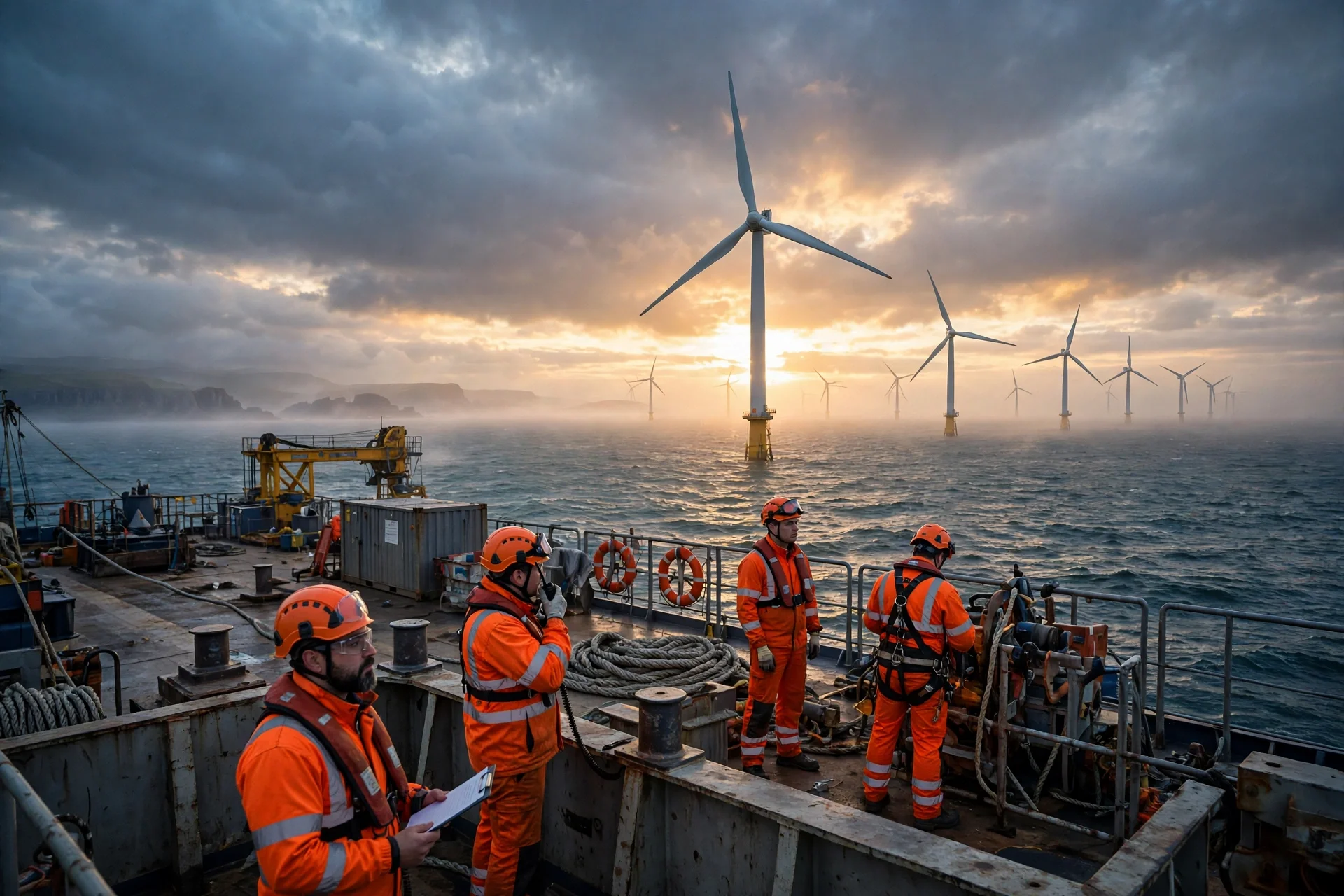
Parques eólicos marinos frente a la costa británica al amanecer, en una imagen alusiva. · Imagen generada para EPM
UK gives green light to record offshore wind investment
RWE and KKR will invest £12 billion in Vanguard West and Vanguard East, operational by 2030 for around three million homes, backed by the National Wealth Fund…
London backs homegrown power with record wind investment
The UK backs £12 billion from RWE and KKR in two offshore farms for 2030, with £1 billion from the National Wealth Fund, a new energy fund and 2,677 jobs…
--- The context ---
The announcement comes ahead of the Prime Minister's travel to the COP31 Leaders' Summit in Türkiye, where the government wants to show that action on climate change and clean energy brings skilled jobs and new opportunities for industrial and coastal communities across the country.
--- The facts ---
Energy company RWE, together with global investment firm KKR, announced a total investment of £12 billion, believed to be the biggest of its kind in UK history to date. The decision gives the green light to the Vanguard West and Vanguard East offshore wind farms, set to be operational by 2030 and to deliver clean, secure, homegrown power to homes and businesses.
Onshore works are already well advanced, with offshore construction set to begin in early 2027. Once operational, the wind farms will have the capacity to supply the equivalent of around three million UK homes, and the investment will support more than 2,400 jobs during construction and operation, while protecting families from global fossil fuel price shocks.
The financing includes a £1 billion investment from the National Wealth Fund, the publicly owned policy bank that aims to drive more than £100 billion of finance into the UK economy, in what is described as its largest investment in offshore wind to date. The government also announced a new Energy Wealth Fund linked to future North Sea revenues, starting with a £2 billion injection for renewable and low carbon projects.
SSE announced that the latest phase of Berwick Bank B will back 2,677 skilled jobs in manufacturing, engineering and project delivery across the north of England and Scotland, with Siemens Energy contracted for turbines and substation platforms, including 130 new project delivery roles in Glasgow and Montrose. At full capacity, Berwick Bank, off the east coast of Scotland, could become the world's largest offshore wind farm, meeting more than 6% of current UK electricity demand.
--- The positions ---
Prime Minister Andy Burnham said, according to the announcement, that the investment is a vote of confidence for building in Britain and good news for billpayers, because every turbine put up is power under British control rather than at the mercy of distant events. Energy Secretary Miatta Fahnbulleh said it is another vote of confidence in homegrown clean energy that creates quality jobs and rebuilds industry.
Markus Krebber of RWE said that together with KKR they are delivering two of the UK's largest offshore wind projects, strengthening domestic generation. Vincent Policard of KKR said their work shows how private capital can turn energy ambitions into reality. Martin Pibworth of SSE described clear political direction matched by businesses prepared to invest as public-private partnership in action.
--- What remains unknown ---
The announcement does not detail the full milestone schedule between the start of offshore construction in 2027 and operation in 2030, nor does it specify exactly how the 2,400 jobs will be split between construction and operation, nor the expected return for the taxpayer from the public contribution.
--- Unanswered questions ---
How will it be guaranteed that Vanguard West and Vanguard East are operational by 2030 without supply chain delays? How much of the £100 support for households this winter and the removal of standing charges will be sustained beyond this season? On what criteria will the new Energy Wealth Fund allocate its first £2 billion among renewable and low carbon projects?
--- EPM analysis ---
The package joins three planes that are often treated separately: energy security against external fossil fuel price shocks, industrial jobs in coastal communities and public control over part of the financing. The Energy Independence Bill introduced last week, with greater public oversight and a larger local stake, appears as the framework intended to give these announcements continuity.
📌 EPM Take:
In EPM's view, the most valuable part of the announcement is that it links the clean transition to tangible and verifiable benefits for households: power under national control, £100 of help this winter, the removal of standing charges and thousands of jobs with concrete names, places and companies. That connection between climate, bills and work in Scotland, East Anglia, Glasgow and Montrose gives the plan a broad social base, provided the 2027 and 2030 deadlines are met and public money truly mobilizes additional private capital without shifting hidden risks onto British families in the coming years ahead.
--- The context ---
The government presented the green light for two major offshore wind farms as a matter of energy security and long-term growth for communities, ahead of the COP31 Leaders' Summit in Türkiye, arguing that the green transition should reduce exposure to fossil fuel price shocks while tackling the climate crisis.
--- The facts ---
RWE and investment firm KKR announced a total investment of £12 billion, believed to be the biggest of its kind in UK history, to deliver Vanguard West and Vanguard East. Both farms are set to be operational by 2030, with capacity equivalent to around three million homes, and will support more than 2,400 jobs during construction and operation.
Onshore works are already well advanced and offshore construction is set to begin in early 2027, following the developers' final investment commitment. The financing includes a £1 billion investment from the National Wealth Fund, described as its largest in offshore wind to date, within a public bank that aims to drive more than £100 billion into the economy.
The government also announced a new Energy Wealth Fund linked to future North Sea revenues, starting with a £2 billion injection for renewable and low carbon energy. In parallel, SSE said Berwick Bank B will back 2,677 skilled jobs with Siemens Energy contracted for turbines and substation platforms, including 130 new roles in Glasgow and Montrose, and that Berwick Bank at full capacity could become the world's largest offshore wind farm and meet more than 6% of current electricity demand.
--- The positions ---
Prime Minister Andy Burnham argued, according to the announcement, that every turbine put up is power under British control and that public investment alongside private capital should also bring a return for the taxpayer. Energy Secretary Miatta Fahnbulleh said offshore wind creates quality jobs, rebuilds industry and helps lower bills while reaching net zero.
From the companies, Markus Krebber of RWE emphasized strengthening domestic electricity generation and long-term energy security. Vincent Policard of KKR highlighted the role of private capital in delivering infrastructure capable of powering around three million UK homes. Martin Pibworth of SSE attributed the progress to clear political direction combined with businesses prepared to invest in British jobs, skills and manufacturing.
--- What remains unknown ---
The text offers no cost breakdown by project, nor the expected final price of energy for households, nor the concrete mechanisms by which the return for the taxpayer from the public funds involved in the operation will be verified over time.
--- Unanswered questions ---
What safeguards ensure that the £1 billion contribution from the public fund generates a return and does not simply transfer risk to the taxpayer? How will it be measured whether removing standing charges and the £100 this winter lower bills in a lasting way? What will happen to the 2030 timetable if turbine and substation manufacturing suffers delays?
--- EPM analysis ---
The bet rests on a classic discipline: large-scale private capital, bounded public backing and a national industrial chain running from Hull, Newcastle and Manchester to Glasgow and Montrose. The Energy Independence Bill introduced last week adds oversight of rogue operators and greater local control, together with stronger protections for households and businesses, a framework that will only have value if it is applied rigorously and without slowing execution or deterring the private investment that the whole programme still depends upon.
📌 EPM Take:
In EPM's view, the strength of the plan is that it treats energy as strategic infrastructure rather than current spending: £12 billion of private and public investment, dated milestones in 2027 and 2030 and a British supply chain give the project a logic of order, industry and security that goes beyond climate rhetoric. Its test will be strictly practical, with works advancing in the North Sea, skilled jobs materializing in the 2,677 posts at Berwick Bank B and bills genuinely falling for households without compromising the country's public accounts over the long term ahead.
Reino Unido da luz verde a una inversión eólica récord
RWE y KKR invertirán £12 billion en Vanguard West y Vanguard East, operativos en 2030 para unos tres millones de hogares, con respaldo del National Wealth Fund…
Londres apuesta por energía propia con inversión récord
El Reino Unido respalda £12 billion de RWE y KKR en dos parques marinos para 2030, con £1 billion del National Wealth Fund, un nuevo fondo energético y 2,677…
--- El contexto ---
El anuncio se presenta en vísperas del viaje del primer ministro a la cumbre de líderes de COP31 en Türkiye, donde el gobierno quiere mostrar que la acción climática y la energía limpia traen empleo calificado y nuevas oportunidades para comunidades industriales y costeras de todo el país.
--- Los hechos ---
La empresa RWE, junto con la firma global de inversión KKR, anunció una inversión total de £12 billion, considerada la mayor de su tipo en la historia del Reino Unido hasta la fecha. La decisión da luz verde a los parques eólicos marinos Vanguard West y Vanguard East, que deben estar operativos en 2030 y entregar energía limpia, segura y de producción nacional a hogares y empresas.
Según lo anunciado, las obras en tierra ya están avanzadas y la construcción marina debe comenzar a principios de 2027. Una vez en operación, los dos parques tendrán capacidad para suministrar el equivalente a alrededor de tres millones de hogares del Reino Unido, y la inversión respaldará más de 2,400 empleos durante la construcción y la operación.
La financiación incluye una aportación de £1 billion del National Wealth Fund, el banco público de políticas que busca movilizar más de £100 billion de financiación hacia la economía británica. El gobierno anunció además un nuevo Energy Wealth Fund vinculado a los ingresos futuros del mar del Norte, con una inyección inicial de £2 billion para proyectos renovables y de baja emisión de carbono.
Por su parte, SSE anunció que la fase más reciente de su parque Berwick Bank B respaldará 2,677 empleos calificados en manufactura, ingeniería y entrega de proyectos en el norte de Inglaterra y en Escocia, con Siemens Energy contratada para fabricar turbinas y plataformas de subestación, incluida la creación de 130 roles nuevos de entrega de proyectos en Glasgow y Montrose. A plena capacidad, Berwick Bank, frente a la costa este de Escocia, podría ser el mayor parque eólico marino del mundo y cubrir más del 6% de la demanda eléctrica actual del país.
--- Las posiciones ---
El primer ministro Andy Burnham sostuvo, según el anuncio, que la inversión es un voto de confianza para construir en Gran Bretaña y una buena noticia para quienes pagan las facturas, porque cada turbina instalada es energía bajo control británico y no a merced de acontecimientos lejanos. La secretaria de Energía Miatta Fahnbulleh afirmó que se trata de otro voto de confianza en la energía limpia de producción nacional, que crea empleo de calidad y reconstruye la industria.
Markus Krebber, de RWE, señaló que junto con KKR están entregando dos de los mayores proyectos eólicos marinos del país, reforzando la generación eléctrica nacional. Vincent Policard, de KKR, indicó que el trabajo con RWE muestra cómo el capital privado puede convertir las ambiciones energéticas en realidad. Martin Pibworth, de SSE, describió el momento como una alianza público-privada en acción, con dirección política clara y empresas dispuestas a invertir.
--- Lo que falta saber ---
El anuncio no detalla el calendario completo de hitos entre el inicio de la construcción marina en 2027 y la entrada en operación en 2030, ni precisa cómo se repartirán exactamente los 2,400 empleos entre construcción y operación, ni el retorno esperado para el contribuyente por la aportación pública.
--- Preguntas sin respuesta ---
¿Cómo se garantizará que Vanguard West y Vanguard East estén operativos en 2030 sin retrasos en la cadena de suministro? ¿Qué parte de los £100 que recibirán los hogares este invierno y de la eliminación de cargos fijos se sostendrá más allá de esta temporada? ¿Con qué criterios repartirá el nuevo Energy Wealth Fund sus primeros £2 billion entre proyectos renovables y de baja emisión?
--- Análisis EPM ---
El paquete une tres planos que suelen tratarse por separado: seguridad energética frente a choques externos de precios de combustibles fósiles, empleo industrial en comunidades costeras y control público sobre parte de la financiación. La Energy Independence Bill presentada la semana pasada, con mayor supervisión pública y más participación local, aparece como el marco que pretende dar continuidad a estos anuncios.
📌 Conclusion EPM:
A juicio de EPM, lo más valioso del anuncio es que vincula la transición limpia con beneficios tangibles y verificables para los hogares: energía bajo control nacional, £100 de ayuda este invierno, eliminación de cargos fijos y miles de empleos con nombres, lugares y empresas concretas. Esa conexión entre clima, facturas y trabajo en Escocia, East Anglia, Glasgow y Montrose le da al plan una base social amplia, siempre que los plazos de 2027 y 2030 se cumplan y el dinero público movilice de verdad capital privado adicional sin trasladar riesgos ocultos a las familias británicas en los próximos años.
--- El contexto ---
El gobierno presentó la luz verde a dos grandes parques eólicos marinos como una cuestión de seguridad energética y de crecimiento a largo plazo para las comunidades, en la antesala de la cumbre de líderes de COP31 en Türkiye, con el argumento de aprovechar la transición verde para reducir la exposición a los choques de precios de los combustibles fósiles.
--- Los hechos ---
RWE y la firma de inversión KKR anunciaron una inversión total de £12 billion, considerada la mayor de su tipo en la historia del Reino Unido, para sacar adelante Vanguard West y Vanguard East. Ambos parques deben estar operativos en 2030, con capacidad equivalente a unos tres millones de hogares, y respaldarán más de 2,400 empleos durante la construcción y la operación.
Las obras en tierra ya están avanzadas y la construcción en el mar debe empezar a principios de 2027, tras el compromiso final de inversión de los promotores. Dentro de la financiación figura una aportación de £1 billion del National Wealth Fund, descrita como su mayor inversión en eólica marina hasta la fecha, dentro de un banco público que busca movilizar más de £100 billion hacia la economía.
El ejecutivo anunció también un nuevo Energy Wealth Fund vinculado a los ingresos futuros del mar del Norte, que empezará con £2 billion para energía renovable y de baja emisión. En paralelo, SSE comunicó que Berwick Bank B respaldará 2,677 empleos calificados con Siemens Energy como contratista de turbinas y plataformas, incluidos 130 roles nuevos en Glasgow y Montrose, y que Berwick Bank a plena capacidad podría ser el mayor parque marino del mundo y superar el 6% de la demanda eléctrica actual.
--- Las posiciones ---
El primer ministro Andy Burnham defendió, según el comunicado, que cada turbina levantada es energía bajo control británico y que la inversión pública junto al capital privado debe rendir también para el contribuyente. La secretaria de Energía Miatta Fahnbulleh sostuvo que la eólica marina crea empleo de calidad, reconstruye industria y ayuda a bajar facturas y alcanzar el cero neto.
Desde las empresas, Markus Krebber, de RWE, puso el acento en reforzar la generación eléctrica nacional y la seguridad a largo plazo. Vincent Policard, de KKR, subrayó el papel del capital privado para hacer realidad la infraestructura capaz de abastecer a unos tres millones de hogares. Martin Pibworth, de SSE, atribuyó el avance a una dirección política clara combinada con empresas dispuestas a invertir en empleo y manufactura británicos.
--- Lo que falta saber ---
El texto no ofrece un desglose de costes por parque, ni el precio final esperado de la energía para los hogares, ni los mecanismos concretos con los que se comprobará el retorno para el contribuyente de los fondos públicos implicados en la operación.
--- Preguntas sin respuesta ---
¿Qué salvaguardas aseguran que la aportación de £1 billion del fondo público genere retorno y no solo traslade riesgo al contribuyente? ¿Cómo se medirá si la eliminación de cargos fijos y los £100 de este invierno bajan las facturas de forma duradera? ¿Qué ocurrirá con el calendario de 2030 si la fabricación de turbinas y subestaciones sufre retrasos?
--- Análisis EPM ---
La apuesta descansa en una disciplina clásica: capital privado a gran escala, respaldo público acotado y una cadena industrial nacional que va de Hull, Newcastle y Manchester a Glasgow y Montrose. La Energy Independence Bill de la semana pasada añade supervisión sobre operadores y más control local, un marco que solo tendrá valor si se aplica con rigor y sin frenar la ejecución.
📌 Conclusion EPM:
A juicio de EPM, el acierto del plan está en tratar la energía como infraestructura estratégica y no como gasto corriente: £12 billion de inversión privada y pública, plazos fechados en 2027 y 2030 y una cadena de suministro británica dan al proyecto una lógica de orden, industria y seguridad que trasciende el discurso climático. Su prueba será estrictamente práctica, con obras que avancen en el mar del Norte, empleos calificados que se concreten en 2,677 puestos en Berwick Bank B y facturas que bajen de verdad para los hogares sin comprometer las cuentas públicas del país.